Red Phalarope

Red Phalarope

Phalaropus fulicarius

Silhouette: Oscar G. Miranda · PhyloPic

LCLeast ConcernNTVUENCR
Daily sighting probability <5% · Rare
at Acadia National Park

In 3 days <5%

19 Verified sightings at Acadia National Park From 2019 to 2026
702 In all 17 parks
August Best month
☀️ Diurnal When it's spotted

About the Red Phalarope

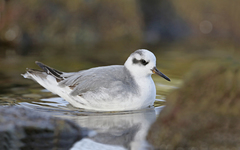
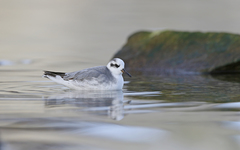
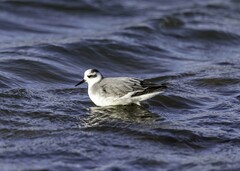
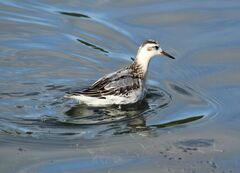
The red phalarope or grey phalarope (Phalaropus fulicarius) is a small wader. This phalarope breeds in the Arctic regions of North America and Eurasia. It is migratory, and, unusually for a wader, migrates mainly on oceanic routes, wintering at sea on tropical oceans.

In 1750, the English naturalist George Edwards included an illustration and a description of the red phalarope in the third volume of his A Natural History of Uncommon Birds. He used the English name "The Red-footed Tringa". Edwards based his hand-coloured etching on a preserved specimen that had been brought to London from the Hudson Bay area of Canada by James Isham. When the Swedish naturalist Carl Linnaeus updated his Systema Naturae for the tenth edition in 1758, he included the red phalarope and placed it with phalaropes and sandpipers in the genus Tringa. Linnaeus included a brief description, coined the binomial name Tringa fulicaria and cited Edwards' work. The red phalarope is now one of three species placed in the genus Phalaropus that was introduced in 1760 by the French zoologist Mathurin Jacques Brisson. The species is monotypic: no subspecies are recognised.

The English and genus names for... Wikipedia →

Sounds

Alarm call0:34

United Kingdom · 2026

© Alex Jones · XC1183184 · CC BY-NC-SA 4.0

Call0:06

Estonia · 2025

© Uku Paal · XC1059476 · CC BY-NC-SA 4.0

Nocturnal flight call0:07

Spain · 2022

© Ricardo Hevia · XC769061 · CC BY-NC-SA 4.0

Global Distribution

Parks Where Found

# Park Country Daily sighting probability
1 Svalbard 🇳🇴 Norway
~20%
2 Cabo Blanco Absolute Nature Reserve 🇨🇷 Costa Rica
<5%
3 El Vizcaíno Biosphere Reserve 🇲🇽 Mexico
<5%
4 Sierra de Guadarrama National Park 🇪🇸 Spain
<5%
5 Fertő-Hanság National Park 🇭🇺 Hungary
<5%
6 Machalilla National Park 🇪🇨 Ecuador
<5%
7 Galápagos Islands 🇪🇨 Ecuador
<5%
8 Great Bear Rainforest 🇨🇦 Canada
<5%
9 Bahía de Loreto National Park 🇲🇽 Mexico
<5%
10 Doñana National Park 🇪🇸 Spain
<5%
11 Channel Islands National Park 🇺🇸 United States
<5%
12 Redwood National Park 🇺🇸 United States
<5%
13 Manuel Antonio National Park 🇨🇷 Costa Rica
<5%
14 Wadden Sea National Park 🇩🇪 Germany
<5%
15 Acadia National Park 🇺🇸 United States
<5%
16 Point Pelee National Park 🇨🇦 Canada
<5%
17 Merritt Island National Wildlife Refuge 🇺🇸 United States
<5%

Cities Where Found

# City Country Daily sighting probability
1 Dakar 🇸🇳 Senegal
~10%
2 Kyiv 🇺🇦 Ukraine
~10%
3 Washington 🇺🇸 United States
<5%
4 Houston 🇺🇸 United States
<5%
5 Birmingham 🇬🇧 United Kingdom
<5%
6 Warsaw 🇵🇱 Poland
<5%
7 San Diego 🇺🇸 United States
<5%
8 San Francisco 🇺🇸 United States
<5%
9 Toronto 🇨🇦 Canada
<5%
10 Manchester 🇬🇧 United Kingdom
<5%

Zoos & Centres Where Found

# Zoo / Centre Country
1 Monterey Bay Aquarium 🇺🇸 United States In captivity

Before you go

What are the chances of seeing a Red Phalarope in Acadia National Park?

Rare

Under 5% of wildlife watchers report a Red Phalarope sighting in Acadia National Park on a given day, based on 19 verified sightings from GBIF citizen-science data from 2019 to 2026. It is the 219th most-seen of the 243 birds we can rate there. Over three days the chance rises to under 5%, if each day is a fresh chance.

When is the best time to see a Red Phalarope in Acadia National Park?

Any time of year

In every month with enough records, under 5% of wildlife watchers report a Red Phalarope in Acadia National Park on a given day, so our monthly data shows no clear season.

What time of day is best to see a Red Phalarope?

Between 1 and 4 pm

Across all the parks we cover, that three-hour window holds the most Red Phalarope sightings with a recorded time, and about 8 in 10 of them come between 6 am and 6 pm: it is a daytime animal.

Where does the Red Phalarope sighting chance come from?

GBIF citizen-science records

It is estimated from how often the Red Phalarope is recorded against all the birds logged in Acadia National Park (19 verified sightings from 2019 to 2026), calibrated against known sighting rates. Figures are rounded to the nearest 10% because citizen-science data supports honest approximations, not decimals, and months with records from fewer than five people show "—". How it works.

← Back to Acadia National Park