


Completed
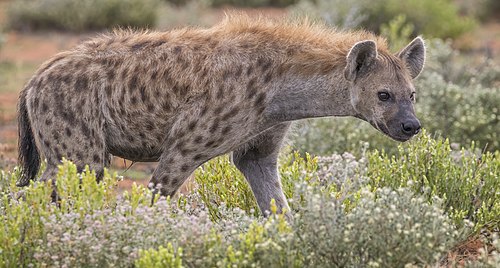


Spotted Hyena
Crocuta crocuta
Silhouette: Steven Traver · PhyloPic
- KingdomAnimalia (Animals)
- PhylumChordata (Chordates)
- ClassMammalia (Mammals)
- OrderCarnivora (Carnivorans)
- FamilyHyaenidae (Hyaenas)
- GenusCrocuta (Common Hyenas)
- SpeciesCrocuta crocuta (Spotted Hyena)
In 3 days ~80% in a week >90%
13 Verified sightings at Akagera National Park From 2019 to 2026
3,627 In all 29 parks
November Best month
☀️ Diurnal When it's spotted


Completed




Completed


Completed
About the Spotted Hyena
The spotted hyena (Crocuta crocuta), also known as the laughing hyena, is a hyena species, currently classed as the sole extant member of the genus Crocuta, native to sub-Saharan Africa. It is listed as being of least concern by the IUCN due to its widespread range and large numbers estimated between 27,000 and 47,000 individuals. The species is, however, experiencing declines outside of protected areas due to habitat loss and poaching. Populations of Crocuta, usually considered a subspecies of Crocuta crocuta, known as cave hyenas, roamed across Eurasia for at least one million years until the end of the Late Pleistocene. The spotted hyena is the largest extant member of the Hyaenidae, and is further physically distinguished from other species by its vaguely bear-like build, rounded ears, less prominent mane, spotted pelt, more dual-purposed dentition, fewer nipples, and pseudo-penis. It is the only placental mammalian species where females have a pseudo-penis and lack an external vaginal opening.
The spotted hyena is the most social of the Carnivora in that it has the largest group sizes and most complex social behaviours. Its social organisation is unlike that of any other carnivore, bearing closer resemblance to that of cercopithecine primates (baboons and macaques) with respect to group size, hierarchical structure, and frequency of social interaction among both kin and unrelated group-mates. The social system of the spotted hyena is openly competitive, with access to kills, mating opportunities and the time of dispersal for males depending on the ability to dominate other clan-members and form ally networks. Females provide only for their own cubs rather than assist each other, and males display no paternal care. However, the spotted hyena is also very cooperative with their clan-mates; often hunting, eating, and resting together, and making use of their numeracy and communication skills to fight off a common enemy. Spotted hyena society is matriarchal; females are larger than males and dominate them.
The spotted hyena is a highly successful animal, being the most common large carnivore in Africa. Its success is due in part to its adaptability and opportunism; it is primarily a hunter but may also scavenge, with the capacity to eat and digest skin, bone and other animal waste. In functional terms, the spotted hyena makes the most efficient use of animal matter of all African carnivores. Wikipedia →
Sounds
Call0:54
Zambia · 2023
© Marc Anderson · XC1077458 · CC BY-NC-ND 4.0
Recording0:41
South Africa · 2024
© Sascha Schumann · iNaturalist · CC BY-NC 4.0
Recording0:14
South Africa · 2025
© Adriaan Groenewald · iNaturalist · CC BY-NC 4.0
Recent sightings of Spotted Hyena in Akagera National Park
LIVEiNaturalistGlobal Distribution
Parks Where Found
Zoos & Centres Where Found
| # | Zoo / Centre | Country | |
|---|---|---|---|
| 1 | Busch Gardens Tampa | 🇺🇸 United States | |
| 2 | San Diego Zoo | 🇺🇸 United States | |
| 3 | Pairi Daiza | 🇧🇪 Belgium | |
| 4 | ZooParc de Beauval | 🇫🇷 France | |
| 5 | Leipzig Zoological Garden | 🇩🇪 Germany | |
| 6 | Denver Zoo | 🇺🇸 United States | |
| 7 | Tierpark Berlin | 🇩🇪 Germany | |
| 8 | Zürich Zoo | 🇨🇭 Switzerland | |
| 9 | Barcelona Zoo | 🇪🇸 Spain | |
| 10 | Zlín-Lešná Zoo | 🇨🇿 Czechia | |
| 11 | Abilene Zoological Gardens | 🇺🇸 United States | |
| 12 | Monarto Zoo | 🇦🇺 Australia | |
| 13 | Zoo Miami | 🇺🇸 United States | |
| 14 | Beijing Wildlife Park | 🇨🇳 China | |
| 15 | Safaripark Beekse Bergen | 🇳🇱 Netherlands | |
| 16 | Toronto Zoo | 🇨🇦 Canada | |
| 17 | Taipei Zoo | 🇹🇼 Taiwan | |
| 18 | La Reserva del Castillo de las Guardas | 🇪🇸 Spain | |
| 19 | Columbus Zoo and Aquarium | 🇺🇸 United States | |
| 20 | Bronx Zoo | 🇺🇸 United States | |
| 21 | Khao Kheow Open Zoo | 🇹🇭 Thailand | |
| 22 | Badoca Safari Park | 🇵🇹 Portugal | |
| 23 | Ecological Center of Sonora | 🇲🇽 Mexico | |
| 24 | Zoofari | 🇲🇽 Mexico | |
| 25 | Shanghai Zoo | 🇨🇳 China | |
| 26 | Milwaukee County Zoo | 🇺🇸 United States | |
| 27 | Parc zoologique de Lisieux | 🇫🇷 France | |
| 28 | Wow Safari Thoiry | 🇫🇷 France | |
| 29 | Wild Animal Safari | 🇺🇸 United States | |
| 30 | Oakland Zoo | 🇺🇸 United States | |
| 31 | Parque Zoológico de León - Zooleón | 🇲🇽 Mexico | |
| 32 | Phoenix Zoo | 🇺🇸 United States | |
| 33 | Réserve africaine de Thoiry | 🇫🇷 France | |
| 34 | Wildlife World Zoo | 🇺🇸 United States | |
| 35 | São Paulo Zoo | 🇧🇷 Brazil | |
| 36 | Gaziantep Zoo | 🇹🇷 Türkiye | |
| 37 | Selwo Aventura | 🇪🇸 Spain | |
| 38 | Kano Zoo | 🇳🇬 Nigeria | |
| 39 | Parco Natura Viva | 🇮🇹 Italy | |
| 40 | Tuzoofari | 🇲🇽 Mexico | |
| 41 | Out of Africa Wildlife Park | 🇺🇸 United States | |
| 42 | Antalya Zoo | 🇹🇷 Türkiye | |
| 43 | Guadalajara Zoo | 🇲🇽 Mexico | |
| 44 | Parque Zoológico Caricuao | 🇻🇪 Venezuela | |
| 45 | Safari de Peaugres Circuit Auto | 🇫🇷 France | |
| 46 | Ukumarí Biopark | 🇨🇴 Colombia | |
| 47 | Yerevan Zoo | 🇦🇲 Armenia | |
| 48 | Saint Louis Zoo | 🇺🇸 United States | |
| 49 | Colchester Zoo | 🇬🇧 United Kingdom | |
| 50 | Southwick's Zoo | 🇺🇸 United States |
Closest Relatives at Akagera National Park





Before you go
What are the chances of seeing a Spotted Hyena in Akagera National Park?
Likely
About 40% of wildlife watchers report a Spotted Hyena sighting in Akagera National Park on a given day, based on 13 verified sightings from GBIF citizen-science data from 2019 to 2026. It is the 16th most-seen of the 20 mammals we can rate there. Over three days the chance rises to about 80%, and over a week to over 90%, if each day is a fresh chance.
When is the best time to see a Spotted Hyena in Akagera National Park?
November
In that month about 70% of wildlife watchers report a Spotted Hyena in Akagera National Park on a given day, against under 5% in August, the lowest month. That is one of Akagera National Park's wettest months, with about 110 mm of rain against almost none in July.
What time of day is best to see a Spotted Hyena?
Between 6 and 9 am
Across all the parks we cover, that three-hour window holds the most Spotted Hyena sightings with a recorded time, and about 8 in 10 of them come between 6 am and 6 pm: it is a daytime animal.
Is Akagera National Park the best place to see a Spotted Hyena?
13th of 29
Of the 29 parks where we can rate Spotted Hyena sightings, Akagera National Park ranks 13th at about 40%. The best odds are in Aberdare National Park (Kenya, about 80%), Masai Mara National Reserve (Kenya, about 70%) and Ngorongoro Conservation Area (Tanzania, about 70%). All parks ranked.
Which relatives of the Spotted Hyena live in Akagera National Park?
Same order: Carnivora
The closest relatives of the Spotted Hyena that you can see in Akagera National Park (order Carnivora, Carnivorans) are Lion (about 60%), Leopard (about 40%) and Common Dwarf Mongoose (about 30%), with each one's daily chance of a sighting.
Where does the Spotted Hyena sighting chance come from?
GBIF citizen-science records
It is estimated from how often the Spotted Hyena is recorded against all the mammals logged in Akagera National Park (13 verified sightings from 2019 to 2026), calibrated against known sighting rates. Figures are rounded to the nearest 10% because citizen-science data supports honest approximations, not decimals, and months with records from fewer than five people show "—". How it works.
