
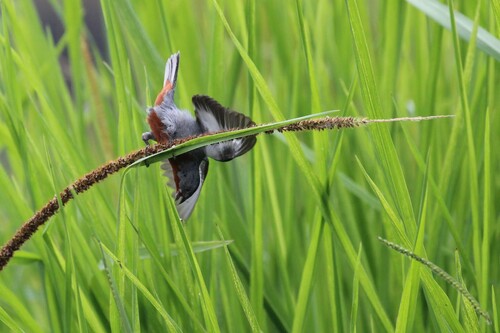
Opal-rumped Tanager

Opal-rumped Tanager

Tangara velia

Silhouette: Sheatherius · PhyloPic

LCLeast ConcernNTVUENCR
Daily sighting probability <5% · Rare
at Amacayacu National Natural Park

In 3 days ~10% in a week ~20%

15 Verified sightings at Amacayacu National Natural Park From 2019 to 2026
993 In all 8 parks
January Best month
☀️ Diurnal When it's spotted

About the Opal-rumped Tanager

The opal-rumped tanager (Tangara velia) is a species of bird in the family Thraupidae. It is found in the Amazon and Atlantic Forest of South America. The population of the Atlantic Forest has a far paler chest than the other populations, and has often been considered a separate species as the silvery-breasted tanager (Tangara cyanomelas). Today most authorities treat it as a subspecies of the opal-rumped tanager.

In 1743 the English naturalist George Edwards included an illustration and a description of the opal-rumped tanager in his A Natural History of Uncommon Birds. He used the English name "Red-belly'd Blue-bird". Edwards based his hand-coloured etching on a specimen owned by the Duke of Richmond that had been collected in Suriname. When in 1758 the Swedish naturalist Carl Linnaeus updated his Systema Naturae for the tenth edition, he placed the opal-rumped tanager with the wagtails in the genus Motacilla. Linnaeus included a brief description, coined the binomial name Motacilla velia, and cited Edwards' work. Linnaeus provided no explanation for the specific epithet; it is perhaps a misprint for the Ancient Greek elea, a small bird mentioned by Aristotle. The opal... Wikipedia →

Sounds

Call0:14

Brazil · 2026

© JAYRSON ARAUJO DE OLIVEIRA · XC1186259 · CC BY-NC-SA 4.0

Uncertain0:24

Brazil · 2021

© Felipe Arantes · XC636929 · CC BY-NC-SA 4.0

Call0:40

Brazil · 2022

© GABRIEL LEITE · XC736078 · CC BY-NC-SA 4.0

Global Distribution

Parks Where Found

# Park Country Daily sighting probability
1 Yasuní National Park 🇪🇨 Ecuador
~20%
2 Cuyabeno Wildlife Reserve 🇪🇨 Ecuador
<5%
3 Manu National Park 🇵🇪 Peru
<5%
4 Brownsberg Nature Park 🇸🇷 Suriname
<5%
5 Anavilhanas National Park 🇧🇷 Brazil
<5%
6 Amacayacu National Natural Park 🇨🇴 Colombia
<5%
7 Sierra de la Macarena National Park 🇨🇴 Colombia
<5%
8 Tambopata National Reserve 🇵🇪 Peru
<5%

Zoos & Centres Where Found

# Zoo / Centre Country
1 San Diego Zoo 🇺🇸 United States In captivity
2 San Diego Zoo Safari Park 🇺🇸 United States In captivity
3 Houston Zoo 🇺🇸 United States In captivity
4 Bird Paradise 🇸🇬 Singapore In captivity
5 Rainforest Wild Asia 🇸🇬 Singapore In captivity
6 Мадагаскар 🇷🇺 Russia In captivity
7 Key West Butterfly and Nature Conservatory 🇺🇸 United States In captivity
8 Montreal Biodome 🇨🇦 Canada In captivity

Before you go

What are the chances of seeing an Opal-rumped Tanager in Amacayacu National Natural Park?

Rare

Under 5% of wildlife watchers report an Opal-rumped Tanager sighting in Amacayacu National Natural Park on a given day, based on 15 verified sightings from GBIF citizen-science data from 2019 to 2026. It is the 338th most-seen of the 436 birds we can rate there. Over three days the chance rises to about 10%, and over a week to about 20%, if each day is a fresh chance.

When is the best time to see an Opal-rumped Tanager in Amacayacu National Natural Park?

January

In that month about 10% of wildlife watchers report an Opal-rumped Tanager in Amacayacu National Natural Park on a given day, against under 5% in February to December, the lowest months.

What time of day is best to see an Opal-rumped Tanager?

Between 8 and 11 am

Across all the parks we cover, that three-hour window holds the most Opal-rumped Tanager sightings with a recorded time, and about 9 in 10 of them come between 6 am and 6 pm: it is a daytime animal.

Is Amacayacu National Natural Park the best place to see an Opal-rumped Tanager?

6th of 8

Of the 8 parks where we can rate Opal-rumped Tanager sightings, Amacayacu National Natural Park ranks 6th at under 5%. The best odds are in Yasuní National Park (Ecuador, about 20%), Cuyabeno Wildlife Reserve (Ecuador, under 5%) and Manu National Park (Peru, under 5%).

Which relatives of the Opal-rumped Tanager live in Amacayacu National Natural Park?

Same genus: Tangara

The closest relatives of the Opal-rumped Tanager that you can see in Amacayacu National Natural Park (genus Tangara, Tangara Tanagers) are Turquoise Tanager (about 20%), Paradise Tanager (about 10%) and Green-and-gold Tanager (about 10%), with each one's daily chance of a sighting.

Where does the Opal-rumped Tanager sighting chance come from?

GBIF citizen-science records

It is estimated from how often the Opal-rumped Tanager is recorded against all the birds logged in Amacayacu National Natural Park (15 verified sightings from 2019 to 2026), calibrated against known sighting rates. Figures are rounded to the nearest 10% because citizen-science data supports honest approximations, not decimals, and months with records from fewer than five people show "—". How it works.

← Back to Amacayacu National Natural Park