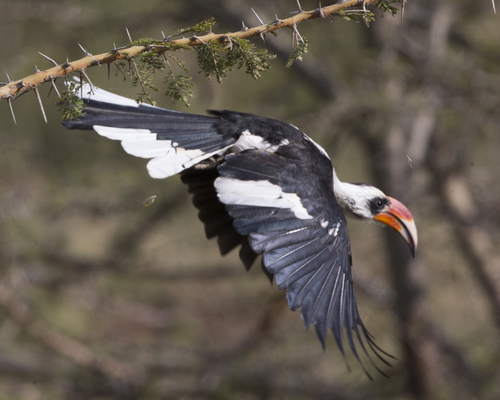
African Hoopoe

African Hoopoe

Upupa africana

Silhouette: Ferran Sayol · PhyloPic

Daily sighting probability ~10% · With luck
at Amboseli National Park

In 3 days ~30% in a week ~60%

5 Verified sightings at Amboseli National Park From 2019 to 2026
871 In all 24 parks
September Best month
☀️ Diurnal When it's spotted

About the African Hoopoe

The Eurasian hoopoe or common hoopoe (Upupa epops) is the most widespread species of hoopoe. It is a distinctive cinnamon coloured bird with black and white wings, a tall erectile crest, a broad white band across a black tail, and a long narrow downcurved bill. Its call is a soft "oop-oop-oop".

The Eurasian hoopoe is native to Europe, Asia and Africa. It is migratory in the northern part of its range. Some ornithologists consider the Madagascar hoopoe (U. marginata) as a subspecies. The African hoopoe, subspecies U. e. africana, has sometimes been treated as a separate species.

The Eurasian hoopoe was formally described in 1758 by the Swedish naturalist Carl Linnaeus in the tenth edition of his Systema Naturae. He cited the earlier descriptions by the French naturalist Pierre Belon and by the Swiss naturalist Conrad Gessner, both of which had been published in 1555. Linnaeus placed the Eurasian hoopoe with the northern bald ibis and the red-billed chough in the genus Upupa and coined the binomial name Upupa epops. The specific epithet epops in the Ancient Greek word for a hoopoe.

Eight subspecies are recognised. The subspecies vary in size and the depth... Wikipedia →

Sounds

Song1:28

Botswana · 2023

© Marc Anderson · XC875586 · CC BY-NC-ND 4.0

Call0:40

Kenya · 2018

© Rory Nefdt · XC403576 · CC BY-NC-SA 4.0

Song0:18

South Africa · 1967

© Nature sounds by Simply Birding · XC646332 · CC BY-NC-ND 4.0

Global Distribution

Parks Where Found

# Park Country Daily sighting probability
1 uMkhuze Game Reserve 🇿🇦 South Africa
~40%
2 Hluhluwe-Imfolozi Park 🇿🇦 South Africa
~40%
3 Lake Nakuru National Park 🇰🇪 Kenya
~40%
4 Moremi Game Reserve 🇧🇼 Botswana
~30%
5 De Hoop Nature Reserve 🇿🇦 South Africa
~30%
6 Addo Elephant National Park 🇿🇦 South Africa
~30%
7 Mana Pools National Park 🇿🇼 Zimbabwe
~30%
8 Pilanesberg National Park 🇿🇦 South Africa
~30%
9 Kruger National Park 🇿🇦 South Africa
~30%
10 Samburu National Reserve 🇰🇪 Kenya
~30%
11 Garden Route National Park 🇿🇦 South Africa
~30%
12 Etosha National Park 🇳🇦 Namibia
~20%
13 Liwonde National Park 🇲🇼 Malawi
~20%
14 Tarangire National Park 🇹🇿 Tanzania
~20%
15 Kgalagadi Transfrontier Park 🇿🇦 South Africa
~20%
16 West Coast National Park 🇿🇦 South Africa
~20%
17 iSimangaliso Wetland Park 🇿🇦 South Africa
~20%
18 Ngorongoro Conservation Area 🇹🇿 Tanzania
~10%
19 Serengeti National Park 🇹🇿 Tanzania
~10%
20 Amboseli National Park 🇰🇪 Kenya
~10%
21 Chobe National Park 🇧🇼 Botswana
~10%
22 Namib-Naukluft National Park 🇳🇦 Namibia
~10%
23 Masai Mara National Reserve 🇰🇪 Kenya
~10%
24 Table Mountain National Park 🇿🇦 South Africa
<5%

Cities Where Found

# City Country Daily sighting probability
1 Maputo 🇲🇿 Mozambique
~30%
2 Johannesburg 🇿🇦 South Africa
~30%
3 Harare 🇿🇼 Zimbabwe
~20%
4 Pretoria 🇿🇦 South Africa
~20%
5 Durban 🇿🇦 South Africa
~10%
6 Cape Town 🇿🇦 South Africa
<5%

Before you go

What are the chances of seeing an African Hoopoe in Amboseli National Park?

With luck

About 10% of wildlife watchers report an African Hoopoe sighting in Amboseli National Park on a given day, based on 5 verified sightings from GBIF citizen-science data from 2019 to 2026. It is the 118th most-seen of the 362 birds we can rate there. Over three days the chance rises to about 30%, and over a week to about 60%, if each day is a fresh chance.

When is the best time to see an African Hoopoe in Amboseli National Park?

September

In that month about 30% of wildlife watchers report an African Hoopoe in Amboseli National Park on a given day, against under 5% in October to June, the lowest months. That is one of Amboseli National Park's driest months, with about 15 mm of rain against 220 mm in April.

What time of day is best to see an African Hoopoe?

Between 7 and 10 am

Across all the parks we cover, that three-hour window holds the most African Hoopoe sightings with a recorded time, and about 9 in 10 of them come between 6 am and 6 pm: it is a daytime animal.

Where does the African Hoopoe sighting chance come from?

GBIF citizen-science records

It is estimated from how often the African Hoopoe is recorded against all the birds logged in Amboseli National Park (5 verified sightings from 2019 to 2026), calibrated against known sighting rates. Figures are rounded to the nearest 10% because citizen-science data supports honest approximations, not decimals, and months with records from fewer than five people show "—". How it works.

← Back to Amboseli National Park