
Southern Martin

Southern Martin

Progne elegans

Silhouette: Andy Wilson · PhyloPic

LCLeast ConcernNTVUENCR
Daily sighting probability <5% · Rare
at Anavilhanas National Park

In 3 days <5% in a week ~10%

20 Verified sightings at Anavilhanas National Park From 2019 to 2026
439 In all 6 parks
August Best month
☀️ Diurnal When it's spotted

About the Southern Martin

The southern martin (Progne elegans) is a species of bird in the family Hirundinidae, the swallows and martins. One source states that it is known in every mainland South American country except Colombia, Guyana, and Venezuela, and there are undocumented sight records in those three countries. It has occurred as a vagrant in the Malvinas/Falkland Islands and the U.S. state of Florida

The southern martin was originally described with its present binomial Progne elegans. For much of the twentieth century many authors treated the southern martin and Peruvian martin (P. murphyi) as conspecific with the Galapagos martin (P. modesta).

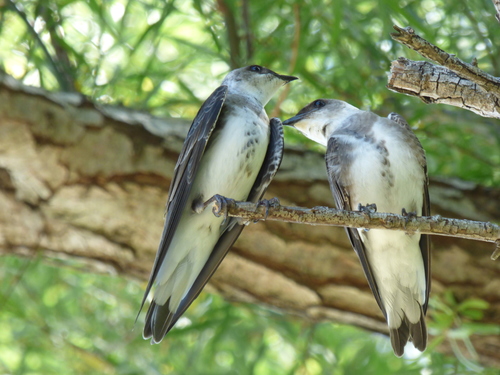
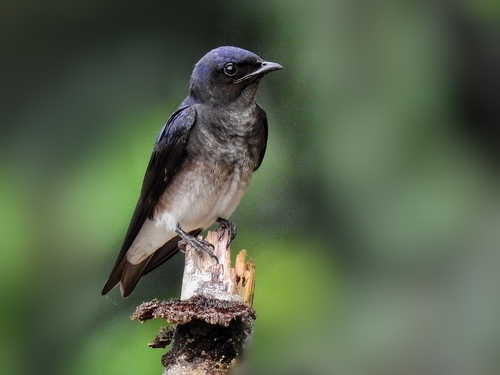
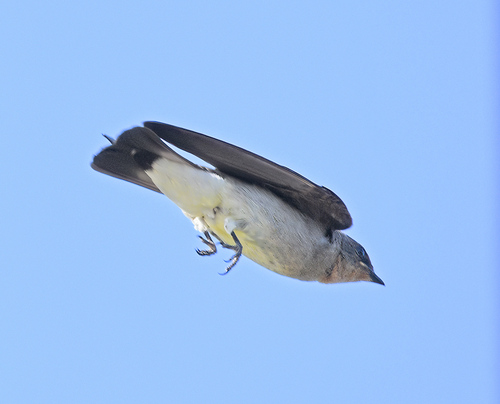
The southern martin is monotypic. The southern martin is 17 to 20 cm (6.7 to 7.9 in) long. The sexes are dimorphic though both have a deeply forked tail. Adult males are almost entirely glossy steel-blue with blacker wings and tail. Females have duller steel-blue upperparts than males. Their underparts are mostly dusky brown with paler feather edges that give a scaly appearance; their undertail coverts are white with dusky streaks. Juveniles resemble adult females.

Sources do not... Wikipedia →

Sounds

Song0:05

Brazil · 2026

© JAYRSON ARAUJO DE OLIVEIRA · XC1186313 · CC BY-NC-SA 4.0

Call0:14

Argentina · 2017

© Étienne Leroy · XC396792 · CC BY-NC-SA 4.0

Call0:34

Argentina · 2013

© Peter Boesman · XC273178 · CC BY-NC-ND 4.0

Global Distribution

Parks Where Found

# Park Country Daily sighting probability
1 Península Valdés 🇦🇷 Argentina
~50%
2 Amboró National Park 🇧🇴 Bolivia
<5%
3 Amacayacu National Natural Park 🇨🇴 Colombia
<5%
4 Anavilhanas National Park 🇧🇷 Brazil
<5%
5 Yasuní National Park 🇪🇨 Ecuador
<5%
6 Soberanía National Park 🇵🇦 Panama
<5%

Cities Where Found

# City Country Daily sighting probability
1 Mendoza 🇦🇷 Argentina
~30%
2 Cordoba 🇦🇷 Argentina
~20%
3 Buenos Aires 🇦🇷 Argentina
<5%
4 Montevideo 🇺🇾 Uruguay
<5%
5 Asuncion 🇵🇾 Paraguay
<5%

Before you go

What are the chances of seeing a Southern Martin in Anavilhanas National Park?

Rare

Under 5% of wildlife watchers report a Southern Martin sighting in Anavilhanas National Park on a given day, based on 20 verified sightings from GBIF citizen-science data from 2019 to 2026. It is the 275th most-seen of the 291 birds we can rate there. Over three days the chance rises to under 5%, and over a week to about 10%, if each day is a fresh chance.

When is the best time to see a Southern Martin in Anavilhanas National Park?

August

In that month about 10% of wildlife watchers report a Southern Martin in Anavilhanas National Park on a given day, against under 5% in September to July, the lowest months. That is one of Anavilhanas National Park's driest months, with about 75 mm of rain against 340 mm in March.

What time of day is best to see a Southern Martin?

Between 8 and 11 am

Across all the parks we cover, that three-hour window holds the most Southern Martin sightings with a recorded time, and about 8 in 10 of them come between 6 am and 6 pm: it is a daytime animal.

Which relatives of the Southern Martin live in Anavilhanas National Park?

Same genus: Progne

The closest relatives of the Southern Martin that you can see in Anavilhanas National Park (genus Progne, New World Martins) are Brown-chested Martin (about 30%) and Gray-breasted Martin (about 20%), with each one's daily chance of a sighting.

Where does the Southern Martin sighting chance come from?

GBIF citizen-science records

It is estimated from how often the Southern Martin is recorded against all the birds logged in Anavilhanas National Park (20 verified sightings from 2019 to 2026), calibrated against known sighting rates. Figures are rounded to the nearest 10% because citizen-science data supports honest approximations, not decimals, and months with records from fewer than five people show "—". How it works.

← Back to Anavilhanas National Park