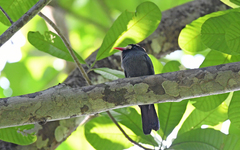
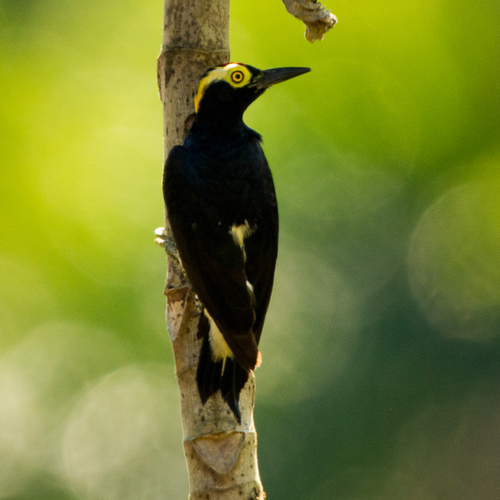
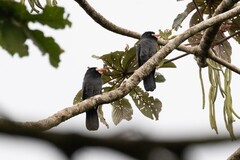
White-fronted Nunbird

White-fronted Nunbird

Monasa morphoeus

Silhouette: Matt Wilkins (Photo by Len Blumin) · PhyloPic

LCLeast ConcernNTVUENCR
Daily sighting probability <5% · Rare
at Anavilhanas National Park

In 3 days ~10% in a week ~20%

14 Verified sightings at Anavilhanas National Park From 2019 to 2026
2,212 In all 13 parks
September Best month
☀️ Diurnal When it's spotted

About the White-fronted Nunbird

The white-fronted nunbird (Monasa morphoeus) is a species of near-passerine bird in the family Bucconidae, the puffbirds, nunlets, and nunbirds. It is found Bolivia, Brazil, Colombia, Costa Rica, Ecuador, Honduras, Nicaragua, Panama, Peru, and Venezuela.

The first four subspecies were at one time treated as individual species. Other authors included rikeri in the nominate morpheous. Birds in northeastern Bolivia were suggested as a separate subspecies but remain included in peruana. The white-fronted nunbird, black-fronted nunbird (M. nigrifrons), and black nunbird (M. morphoeus) are generally treated as a superspecies.

The white-fronted nunbird is 21 to 29 cm (8.3 to 11 in) long. Birds in Central America weigh 90 to 101 g (3.2 to 3.6 oz), those in the eastern Amazon 77 to 87 g (2.7 to 3.1 oz), those in Venezuela 63 to 80 g (2.2 to 2.8 oz), and those in... Wikipedia →

Sounds

Song0:36

Ecuador · 2010

© Manuel Sánchez-Nivicela · XC1156628 · CC BY-NC-ND 4.0

Call0:05

Brazil · 2025

© JAYRSON ARAUJO DE OLIVEIRA · XC978348 · CC BY-NC-SA 4.0

Duet0:31

Costa Rica · 2021

© Jorge Gabriel Campos · XC674415 · CC BY-NC-SA 4.0

Global Distribution

Parks Where Found

# Park Country Daily sighting probability
1 Darién National Park 🇵🇦 Panama
~20%
2 Tambopata National Reserve 🇵🇪 Peru
~20%
3 Sierra de la Macarena National Park 🇨🇴 Colombia
~10%
4 Yasuní National Park 🇪🇨 Ecuador
~10%
5 Manu National Park 🇵🇪 Peru
~10%
6 Cuyabeno Wildlife Reserve 🇪🇨 Ecuador
<5%
7 Anavilhanas National Park 🇧🇷 Brazil
<5%
8 Arenal Volcano National Park 🇨🇷 Costa Rica
<5%
9 Braulio Carrillo National Park 🇨🇷 Costa Rica
<5%
10 Tortuguero National Park 🇨🇷 Costa Rica
<5%
11 Amacayacu National Natural Park 🇨🇴 Colombia
<5%
12 Cahuita National Park 🇨🇷 Costa Rica
<5%
13 Tenorio Volcano National Park 🇨🇷 Costa Rica
<5%

Cities Where Found

# City Country Daily sighting probability
1 Belém 🇧🇷 Brazil
<5%

Before you go

What are the chances of seeing a White-fronted Nunbird in Anavilhanas National Park?

Rare

Under 5% of wildlife watchers report a White-fronted Nunbird sighting in Anavilhanas National Park on a given day, based on 14 verified sightings from GBIF citizen-science data from 2019 to 2026. It is the 197th most-seen of the 291 birds we can rate there. Over three days the chance rises to about 10%, and over a week to about 20%, if each day is a fresh chance.

When is the best time to see a White-fronted Nunbird in Anavilhanas National Park?

July and September

In those months about 10% of wildlife watchers report a White-fronted Nunbird in Anavilhanas National Park on a given day, against under 5% in August and October–June, the lowest months. Those are among Anavilhanas National Park's driest months, with about 95 mm of rain a month against 340 mm in March.

What time of day is best to see a White-fronted Nunbird?

Between 9 am and noon

Across all the parks we cover, that three-hour window holds the most White-fronted Nunbird sightings with a recorded time, and about 9 in 10 of them come between 6 am and 6 pm: it is a daytime animal.

Which relatives of the White-fronted Nunbird live in Anavilhanas National Park?

Same genus: Monasa

The closest relatives of the White-fronted Nunbird that you can see in Anavilhanas National Park (genus Monasa, Typical Nunbirds) are Black-fronted Nunbird (about 40%) and Black Nunbird (about 10%), with each one's daily chance of a sighting.

Where does the White-fronted Nunbird sighting chance come from?

GBIF citizen-science records

It is estimated from how often the White-fronted Nunbird is recorded against all the birds logged in Anavilhanas National Park (14 verified sightings from 2019 to 2026), calibrated against known sighting rates. Figures are rounded to the nearest 10% because citizen-science data supports honest approximations, not decimals, and months with records from fewer than five people show "—". How it works.

← Back to Anavilhanas National Park