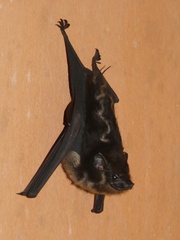
Greater Sac-winged Bat

Greater Sac-winged Bat

Saccopteryx bilineata

Silhouette: T. Michael Keesey · PhyloPic

LCLeast ConcernNTVUENCR
Daily sighting probability ~10% · With luck
at Arenal Volcano National Park

In 3 days ~20% in a week ~30%

6 Verified sightings at Arenal Volcano National Park From 2019 to 2026
118 In all 9 parks
October Best month
☀️ Diurnal When it's spotted

About the Greater Sac-winged Bat

The greater sac-winged bat (Saccopteryx bilineata) is a bat of the family Emballonuridae native to Central and South America. They are common bats seen in the rainforest, as they often roost on the outside of large trees. They are insectivores and use echolocation calls through the mouth to track their prey, which includes flies, beetles, butterflies and moths. The long nose and upper lip are highly mobile and can shift upward to enlarge the mouth opening.

The term "sac-winged" refers to small pouches on the wings. These sacs are used by males to attract females and to mark their harem territory. During daily grooming, males will fill these sacs with drops of urine and glandular secretions. During displays for females, the male will hover in front of the female and fan her vigorously to expose her to the scent of the mixture in the wing sacs. Males will also shake the contents of the sac towards bats outside of the male's harem territory to warn off intruders. Microbial fermentation in the sac may produce identifiable scent signals.

Sac-wing pups have been recorded making various calls in a jumbled context. For example, a female pup will give the male trill of courting followed by echolocation clicks then adult territorial challenges. These mixed-up vocalizations have been equated with human infant babbling and mispronounced songs of young birds. This is the first example of mammal babbling outside of the primate order. Wikipedia →

Sounds

Recording0:37

Costa Rica · 2024

© sea-kangaroo · iNaturalist · CC BY-NC 4.0

Global Distribution

Parks Where Found

# Park Country Daily sighting probability
1 Calakmul Biosphere Reserve 🇲🇽 Mexico
~20%
2 Carara National Park 🇨🇷 Costa Rica
~20%
3 Celestún Biosphere Reserve 🇲🇽 Mexico
~20%
4 Piedras Blancas National Park 🇨🇷 Costa Rica
~10%
5 Yasuní National Park 🇪🇨 Ecuador
~10%
6 Braulio Carrillo National Park 🇨🇷 Costa Rica
~10%
7 Soberanía National Park 🇵🇦 Panama
~10%
8 Corcovado National Park 🇨🇷 Costa Rica
~10%
9 Arenal Volcano National Park 🇨🇷 Costa Rica
~10%

Before you go

What are the chances of seeing a Greater Sac-winged Bat in Arenal Volcano National Park?

With luck

About 10% of wildlife watchers report a Greater Sac-winged Bat sighting in Arenal Volcano National Park on a given day, based on 6 verified sightings from GBIF citizen-science data from 2019 to 2026. It is the 18th most-seen of the 25 mammals we can rate there. Over three days the chance rises to about 20%, and over a week to about 30%, if each day is a fresh chance.

When is the best time to see a Greater Sac-winged Bat in Arenal Volcano National Park?

March, June, August, October and December–January

In those months about 10% of wildlife watchers report a Greater Sac-winged Bat in Arenal Volcano National Park on a given day, against under 5% in February, April–May, July, September and November, the lowest months.

What time of day is best to see a Greater Sac-winged Bat?

Between 9 am and noon

Across all the parks we cover, that three-hour window holds the most Greater Sac-winged Bat sightings with a recorded time, and about 8 in 10 of them come between 6 am and 6 pm: it is a daytime animal.

Is Arenal Volcano National Park the best place to see a Greater Sac-winged Bat?

9th of 9

Of the 9 parks where we can rate Greater Sac-winged Bat sightings, Arenal Volcano National Park ranks 9th at about 10%. The best odds are in Calakmul Biosphere Reserve (Mexico, about 20%), Carara National Park (Costa Rica, about 20%) and Celestún Biosphere Reserve (Mexico, about 20%).

Which relatives of the Greater Sac-winged Bat live in Arenal Volcano National Park?

Same family: Emballonuridae

The closest relatives of the Greater Sac-winged Bat that you can see in Arenal Volcano National Park (family Emballonuridae, Sheath-tailed Bats) are Thomas's Shaggy Bat (about 10%) and Proboscis Bat (about 10%), with each one's daily chance of a sighting.

Where does the Greater Sac-winged Bat sighting chance come from?

GBIF citizen-science records

It is estimated from how often the Greater Sac-winged Bat is recorded against all the mammals logged in Arenal Volcano National Park (6 verified sightings from 2019 to 2026), calibrated against known sighting rates. Figures are rounded to the nearest 10% because citizen-science data supports honest approximations, not decimals, and months with records from fewer than five people show "—". How it works.

← Back to Arenal Volcano National Park