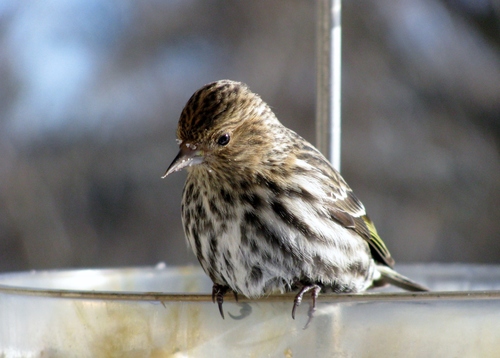

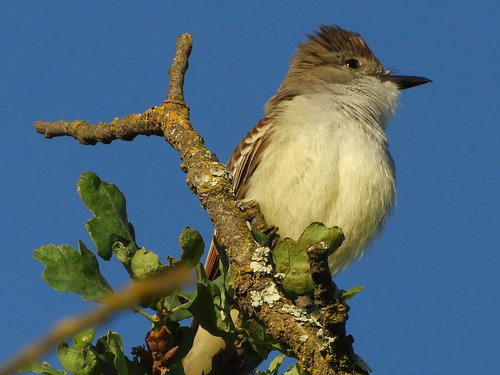
Cassin's Finch

Cassin's Finch

Haemorhous cassinii

Silhouette: Andy Wilson · PhyloPic

LCLeast ConcernNTVUENCR
Daily sighting probability <5% · Rare
at Big Bend National Park

In 3 days <5%

28 Verified sightings at Big Bend National Park From 2019 to 2026
4,425 In all 14 parks
March Best month
☀️ Diurnal When it's spotted

About the Cassin's Finch

Cassin's finch (Haemorhous cassinii) is a bird in the finch family, Fringillidae. This species and the other "American rosefinches" are placed in the genus Haemorhous. This bird was named after John Cassin, who was a curator at the Philadelphia Academy of Natural Sciences.

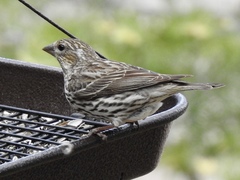
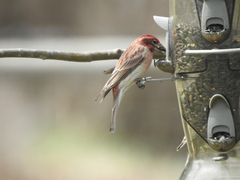
Measurements: Length: 6.3 in (16 cm) Weight: 0.8–1.2 oz (24–34 g) Wingspan: 9.8–10.6 in (25–27 cm) Adults have a short forked brown tail and brown wings. They have a longer bill than the purple finch. Adult males are raspberry red on the head, breast, back and rump; their back and under-tail are streaked. Adult females have light brown upper-parts and light underparts with brown streaks throughout; their facial markings are less distinct than those of the female purple finch. They can have brown, red, and white eyes.

Their breeding habitat is coniferous forest in mountains of western North America as far south as northern New Mexico and Arizona; also Southern California near Baja California. They nest in large conifers. They move to lower elevations in winter.

Northernmost breeding birds migrate south, as do some birds throughout the range of the species... Wikipedia →

Sounds

Song0:06

United States · 2026

© Ed Pandolfino · XC1153562 · CC BY-NC-SA 4.0

Call0:58

United States · 2020

© Richard E. Webster · XC621695 · CC BY-NC-SA 4.0

Recording1:13

Canada · 2001

© Peter Ward and Ken Hall · XC598465 · CC BY-NC-SA 4.0

Global Distribution

Parks Where Found

# Park Country Daily sighting probability
1 Yosemite National Park 🇺🇸 United States
~20%
2 Rocky Mountain National Park 🇺🇸 United States
~20%
3 Yellowstone National Park 🇺🇸 United States
~10%
4 Zion National Park 🇺🇸 United States
~10%
5 Glacier National Park 🇺🇸 United States
~10%
6 Sequoia and Kings Canyon National Parks 🇺🇸 United States
~10%
7 Grand Teton National Park 🇺🇸 United States
~10%
8 Grand Canyon National Park 🇺🇸 United States
~10%
9 Guadalupe Mountains National Park 🇺🇸 United States
<5%
10 Death Valley National Park 🇺🇸 United States
<5%
11 Banff National Park 🇨🇦 Canada
<5%
12 Saguaro National Park 🇺🇸 United States
<5%
13 Big Bend National Park 🇺🇸 United States
<5%
14 Olympic National Park 🇺🇸 United States
<5%

Cities Where Found

# City Country Daily sighting probability
1 Salt Lake City 🇺🇸 United States
~10%
2 Anchorage 🇺🇸 United States
<5%
3 Denver 🇺🇸 United States
<5%
4 Edmonton 🇨🇦 Canada
<5%
5 Las Vegas 🇺🇸 United States
<5%
6 Sacramento 🇺🇸 United States
<5%
7 Los Angeles 🇺🇸 United States
<5%
8 Phoenix 🇺🇸 United States
<5%
9 San Francisco 🇺🇸 United States
<5%

Before you go

What are the chances of seeing a Cassin's Finch in Big Bend National Park?

Rare

Under 5% of wildlife watchers report a Cassin's Finch sighting in Big Bend National Park on a given day, based on 28 verified sightings from GBIF citizen-science data from 2019 to 2026. It is the 213th most-seen of the 270 birds we can rate there. Over three days the chance rises to under 5%, if each day is a fresh chance.

When is the best time to see a Cassin's Finch in Big Bend National Park?

Any time of year

In every month with enough records, under 5% of wildlife watchers report a Cassin's Finch in Big Bend National Park on a given day, so our monthly data shows no clear season.

What time of day is best to see a Cassin's Finch?

Between 8 and 11 am

Across all the parks we cover, that three-hour window holds the most Cassin's Finch sightings with a recorded time, and about 9 in 10 of them come between 6 am and 6 pm: it is a daytime animal.

Where does the Cassin's Finch sighting chance come from?

GBIF citizen-science records

It is estimated from how often the Cassin's Finch is recorded against all the birds logged in Big Bend National Park (28 verified sightings from 2019 to 2026), calibrated against known sighting rates. Figures are rounded to the nearest 10% because citizen-science data supports honest approximations, not decimals, and months with records from fewer than five people show "—". How it works.

← Back to Big Bend National Park