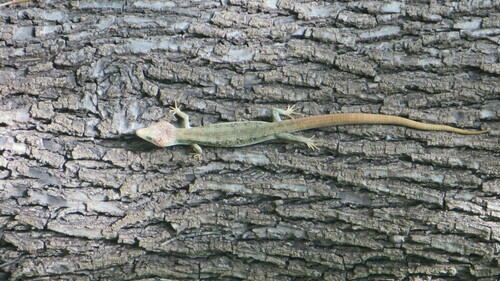
Eastern Collared Lizard

Eastern Collared Lizard

Crotaphytus collaris

Silhouette: Jose Carlos Arenas-Monroy · PhyloPic

LCLeast ConcernNTVUENCR
Daily sighting probability ~20% · Possible
at Big Bend National Park

In 3 days ~50% in a week ~80%

59 Verified sightings at Big Bend National Park From 2019 to 2026
130 In all 5 parks
April Best month
☀️ Diurnal When it's spotted

About the Eastern Collared Lizard

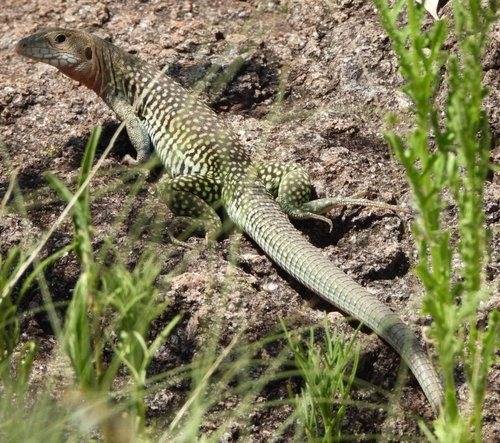
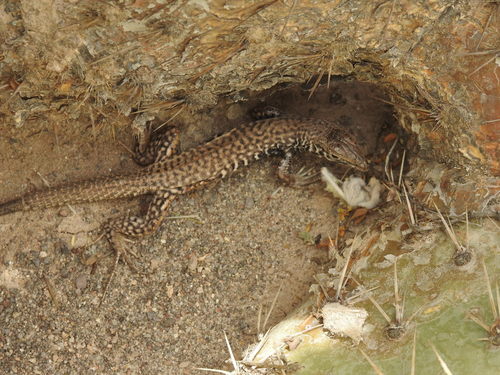
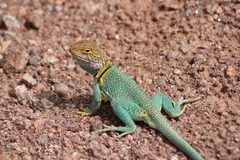
The common collared lizard (Crotaphytus collaris), also commonly called eastern collared lizard, Oklahoma collared lizard, mountain boomer, yellow-headed collared lizard, and collared lizard, is a North American species of lizard in the family Crotaphytidae. The common name "collared lizard" comes from the lizard's distinct coloration, which includes bands of black around the neck and shoulders that look like a collar. Males can be very colorful, with blue-green bodies, yellow stripes on the tail and back, and yellow-orange throats. Five subspecies are recognized.

The subspecific name, baileyi, is in honor of American mammalogist Vernon Orlando Bailey. The five subspecies recognized as being valid, including the nominotypical subspecies, are: Crotaphytus collaris auriceps Fitch & W. Tanner, 1951 – yellow-headed collared lizard

C. collaris fuscus W. Ingram & W. Tanner, 1971 – Chihuahuan collared lizard Nota bene: A trinomial authority in parentheses indicates that the subspecies... Wikipedia →

Global Distribution

Parks Where Found

# Park Country Daily sighting probability
1 Big Bend National Park 🇺🇸 United States
~20%
2 Guadalupe Mountains National Park 🇺🇸 United States
~20%
3 Saguaro National Park 🇺🇸 United States
~10%
4 Grand Canyon National Park 🇺🇸 United States
~10%
5 Cumbres de Monterrey National Park 🇲🇽 Mexico
<5%

Zoos & Centres Where Found

# Zoo / Centre Country
1 Prague Zoo 🇨🇿 Czechia In captivity
2 Leipzig Zoological Garden 🇩🇪 Germany In captivity
3 Abilene Zoological Gardens 🇺🇸 United States In captivity
4 Zoo Miami 🇺🇸 United States In captivity
5 Bronx Zoo 🇺🇸 United States In captivity
6 Phoenix Zoo 🇺🇸 United States In captivity
7 Toledo Zoo 🇺🇸 United States In captivity
8 Saint Louis Zoo 🇺🇸 United States In captivity
9 Zoologischer Garten Leipzig 🇩🇪 Germany In captivity
10 Fort Worth Zoo 🇺🇸 United States In captivity
11 Wilhelma 🇩🇪 Germany In captivity
12 Houston Zoo 🇺🇸 United States In captivity
13 Arizona-Sonora Desert Museum 🇺🇸 United States In captivity
14 Philadelphia Zoo 🇺🇸 United States In captivity
15 Budapest Zoo & Botanical Garden 🇭🇺 Hungary In captivity
16 John Ball Zoo 🇺🇸 United States In captivity
17 Reserva Zoológica Oasys MiniHollywood 🇪🇸 Spain In captivity
18 The Abilene Zoo 🇺🇸 United States In captivity
19 Alligator Adventure 🇺🇸 United States In captivity
20 Zoo de Córdoba 🇪🇸 Spain In captivity
21 Drayton Manor Theme Park 🇬🇧 United Kingdom In captivity
22 Knie's Kinderzoo 🇨🇭 Switzerland In captivity
23 Georgia Aquarium 🇺🇸 United States In captivity
24 Newport Aquarium 🇺🇸 United States In captivity
25 Wonders of Wildlife Museum & Aquarium 🇺🇸 United States In captivity
26 Children's Aquarium at Fair Park 🇺🇸 United States In captivity
27 Rákosův pavilon 🇨🇿 Czechia In captivity
28 Velemlokárium 🇨🇿 Czechia In captivity
29 Medicine Park Aquarium & Natural Sciences Center 🇺🇸 United States In captivity
30 Tropicarium Park 🇮🇹 Italy In captivity
31 Wolfgang-Köhler-Primaten-Forschungszentrum 🇩🇪 Germany In captivity
32 Тульский экзотариум (новая экспозиция) 🇷🇺 Russia In captivity

Closest Relatives at Big Bend National Park

No species of the same family or order lives in Big Bend National Park, so these are its closest relatives here: other reptiles.

Before you go

What are the chances of seeing an Eastern Collared Lizard in Big Bend National Park?

Possible

About 20% of wildlife watchers report an Eastern Collared Lizard sighting in Big Bend National Park on a given day, based on 59 verified sightings from GBIF citizen-science data from 2019 to 2026. It is the 14th most-seen of the 48 reptiles we can rate there. Over three days the chance rises to about 50%, and over a week to about 80%, if each day is a fresh chance.

When is the best time to see an Eastern Collared Lizard in Big Bend National Park?

February and April

In those months about 30% of wildlife watchers report an Eastern Collared Lizard in Big Bend National Park on a given day, against under 5% in January, the lowest month. Those are among Big Bend National Park's driest months, with about 10 mm of rain a month against 50 mm in September.

What time of day is best to see an Eastern Collared Lizard?

Between 10 am and 1 pm

Across all the parks we cover, that three-hour window holds the most Eastern Collared Lizard sightings with a recorded time, and about 9 in 10 of them come between 6 am and 6 pm: it is a daytime animal.

Is Big Bend National Park the best place to see an Eastern Collared Lizard?

Yes

Of the 5 parks where we can rate Eastern Collared Lizard sightings, Big Bend National Park has the highest daily chance: about 20%. Next come Guadalupe Mountains National Park (United States, about 20%) and Saguaro National Park (United States, about 10%).

Where does the Eastern Collared Lizard sighting chance come from?

GBIF citizen-science records

It is estimated from how often the Eastern Collared Lizard is recorded against all the reptiles logged in Big Bend National Park (59 verified sightings from 2019 to 2026), calibrated against known sighting rates. Figures are rounded to the nearest 10% because citizen-science data supports honest approximations, not decimals, and months with records from fewer than five people show "—". How it works.

← Back to Big Bend National Park