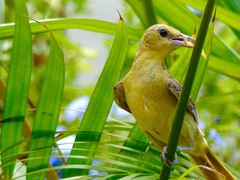
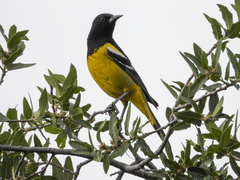
Scott's Oriole

Scott's Oriole

Icterus parisorum

Silhouette: Matt Wilkins · PhyloPic

LCLeast ConcernNTVUENCR
Daily sighting probability ~30% · Possible
at Big Bend National Park

In 3 days ~70% in a week ~90%

1,898 Verified sightings at Big Bend National Park From 2019 to 2026
2,909 In all 11 parks
June Best month
☀️ Diurnal When it's spotted

About the Scott's Oriole

Scott's oriole (Icterus parisorum) is a species of bird in the family Icteridae, the oropendolas, New World orioles, and New World blackbirds. It is found in Mexico and the United States. Scott's oriole was formally described by French ornithologist Charles Lucien Bonaparte in 1838 with the binomial Icterus Parisorum [sic]. Bonaparte's specific epithet Parisorum (since uncapitalized) honors the Paris brothers, who had financed French natural history expeditions to the U. S. and Mexico. American soldier and naturalist Darius N. Couch named it Scott's oriole in honor of General Winfield Scott, without knowing that the bird had previously been described by Bonaparte.

There have been proposals to rename this species the yucca oriole to reflect its preferred habitat, and to address the negative historical connotations associated with its current namesake's involvement in the Trail of Tears and other episodes of ethnic cleansing in the Southeastern United States.

Scott's oriole is monotypic. Scott's oriole is about 23 cm (9.1 in) long with a wingspan of 32 cm (13 in); it weighs 32 to 41 g (1.1 to 1.4 oz). Adult males in breeding plumage have... Wikipedia →

Sounds

Song0:17

United States · 2025

© David Tattersley · XC1000436 · CC BY-NC-SA 4.0

Call1:15

Mexico · 2023

© Sue Riffe · XC785322 · CC BY-NC-SA 4.0

Flight song0:20

Mexico · 2019

© Richard E. Webster · XC466196 · CC BY-NC-SA 4.0

Global Distribution

Parks Where Found

# Park Country Daily sighting probability
1 Big Bend National Park 🇺🇸 United States
~30%
2 Cabo Pulmo National Park 🇲🇽 Mexico
~30%
3 Guadalupe Mountains National Park 🇺🇸 United States
~20%
4 Joshua Tree National Park 🇺🇸 United States
~10%
5 El Vizcaíno Biosphere Reserve 🇲🇽 Mexico
~10%
6 Saguaro National Park 🇺🇸 United States
<5%
7 Cumbres de Monterrey National Park 🇲🇽 Mexico
<5%
8 Grand Canyon National Park 🇺🇸 United States
<5%
9 Death Valley National Park 🇺🇸 United States
<5%
10 Zion National Park 🇺🇸 United States
<5%
11 Bahía de Loreto National Park 🇲🇽 Mexico
<5%

Cities Where Found

# City Country Daily sighting probability
1 Mexico City 🇲🇽 México
<5%
2 Puebla 🇲🇽 México
<5%
3 Guadalajara 🇲🇽 México
<5%
4 San Antonio 🇺🇸 United States
<5%
5 San Diego 🇺🇸 United States
<5%
6 Phoenix 🇺🇸 United States
<5%

Before you go

What are the chances of seeing a Scott's Oriole in Big Bend National Park?

Possible

About 30% of wildlife watchers report a Scott's Oriole sighting in Big Bend National Park on a given day, based on 1,898 verified sightings from GBIF citizen-science data from 2019 to 2026. It is the 30th most-seen of the 270 birds we can rate there. Over three days the chance rises to about 70%, and over a week to about 90%, if each day is a fresh chance.

When is the best time to see a Scott's Oriole in Big Bend National Park?

June

In that month about 60% of wildlife watchers report a Scott's Oriole in Big Bend National Park on a given day, against under 5% in November to February, the lowest months.

What time of day is best to see a Scott's Oriole?

Between 8 and 11 am

Across all the parks we cover, that three-hour window holds the most Scott's Oriole sightings with a recorded time, and about 9 in 10 of them come between 6 am and 6 pm: it is a daytime animal.

Is Big Bend National Park the best place to see a Scott's Oriole?

Yes

Of the 11 parks where we can rate Scott's Oriole sightings, Big Bend National Park has the highest daily chance: about 30%. Next come Cabo Pulmo National Park (Mexico, about 30%) and Guadalupe Mountains National Park (United States, about 20%).

Which relatives of the Scott's Oriole live in Big Bend National Park?

Same genus: Icterus

The closest relatives of the Scott's Oriole that you can see in Big Bend National Park (genus Icterus, New World Orioles) are Orchard Oriole (about 10%) and Bullock's Oriole (about 10%), with each one's daily chance of a sighting.

Where does the Scott's Oriole sighting chance come from?

GBIF citizen-science records

It is estimated from how often the Scott's Oriole is recorded against all the birds logged in Big Bend National Park (1,898 verified sightings from 2019 to 2026), calibrated against known sighting rates. Figures are rounded to the nearest 10% because citizen-science data supports honest approximations, not decimals, and months with records from fewer than five people show "—". How it works.

← Back to Big Bend National Park