Townsend's Solitaire

Townsend's Solitaire

Myadestes townsendi

Silhouette: Francesco "Architetto" Rollandin · PhyloPic

LCLeast ConcernNTVUENCR
Daily sighting probability ~10% · With luck
at Big Bend National Park

In 3 days ~20% in a week ~40%

309 Verified sightings at Big Bend National Park From 2019 to 2026
5,735 In all 22 parks
February Best month
☀️ Diurnal When it's spotted

About the Townsend's Solitaire

Townsend's solitaire (Myadestes townsendi) is a medium-sized thrush, the only solitaire native to America north of Mexico. This solitaire ranges from southern Alaska, British Columbia and Alberta to northern Zacatecas in Mexico, preferring montane woodlands. During winter, it may move in search of food to lower elevations, including the Great Plains, northern interior Mexico, and even desert oases.

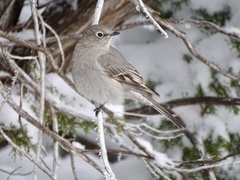
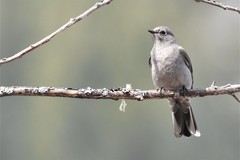
Townsend's solitaire reaches a length of approximately 8–9.5 inches (20–24 centimetres) and wingspan of 14.5 inches (37 cm); it weighs approximately 1.2 oz (34 g). It has a short, thick, blackish bill; a white eye ring; and gray plumage with a buffy wing stripe and edges of the flight feathers. The tail is long, tapered when shut, and edged with white. Juveniles are mottled gray and white.

It perches in a rather upright position, often high on a branch and often staying still for a long time. Though it has some similarities to the northern mockingbird, particularly as to the tail, its dark underparts, shape, size, and behavior are not similar.

It feeds primarily on berries and insects. The solitaire is amongst the most specialized of all North American... Wikipedia →

Sounds

Song0:19

United States · 2026

© Greg Irving · XC1133658 · CC BY-NC-SA 4.0

Call1:18

United States · 2022

© Richard E. Webster · XC775752 · CC BY-NC-SA 4.0

Call1:23

United States · 2021

© Valerie Heemstra · XC689825 · CC BY-NC-SA 4.0

Global Distribution

Parks Where Found

# Park Country Daily sighting probability
1 Guadalupe Mountains National Park 🇺🇸 United States
~20%
2 Rocky Mountain National Park 🇺🇸 United States
~20%
3 Sequoia and Kings Canyon National Parks 🇺🇸 United States
~10%
4 Zion National Park 🇺🇸 United States
~10%
5 Yosemite National Park 🇺🇸 United States
~10%
6 Glacier National Park 🇺🇸 United States
~10%
7 Yellowstone National Park 🇺🇸 United States
~10%
8 Grand Canyon National Park 🇺🇸 United States
~10%
9 Big Bend National Park 🇺🇸 United States
~10%
10 Banff National Park 🇨🇦 Canada
~10%
11 Jasper National Park 🇨🇦 Canada
~10%
12 Grand Teton National Park 🇺🇸 United States
~10%
13 Kluane National Park 🇨🇦 Canada
<5%
14 Badlands National Park 🇺🇸 United States
<5%
15 Denali National Park 🇺🇸 United States
<5%
16 Olympic National Park 🇺🇸 United States
<5%
17 Saguaro National Park 🇺🇸 United States
<5%
18 Death Valley National Park 🇺🇸 United States
<5%
19 Joshua Tree National Park 🇺🇸 United States
<5%
20 Point Pelee National Park 🇨🇦 Canada
<5%
21 Great Bear Rainforest 🇨🇦 Canada
<5%
22 Redwood National Park 🇺🇸 United States
<5%

Cities Where Found

# City Country Daily sighting probability
1 Calgary 🇨🇦 Canada
<5%
2 Denver 🇺🇸 United States
<5%
3 Salt Lake City 🇺🇸 United States
<5%
4 Edmonton 🇨🇦 Canada
<5%
5 Vancouver 🇨🇦 Canada
<5%
6 Montreal 🇨🇦 Canada
<5%
7 Portland 🇺🇸 United States
<5%
8 Sacramento 🇺🇸 United States
<5%
9 Las Vegas 🇺🇸 United States
<5%
10 Seattle 🇺🇸 United States
<5%

Before you go

What are the chances of seeing a Townsend's Solitaire in Big Bend National Park?

With luck

About 10% of wildlife watchers report a Townsend's Solitaire sighting in Big Bend National Park on a given day, based on 309 verified sightings from GBIF citizen-science data from 2019 to 2026. It is the 107th most-seen of the 270 birds we can rate there. Over three days the chance rises to about 20%, and over a week to about 40%, if each day is a fresh chance.

When is the best time to see a Townsend's Solitaire in Big Bend National Park?

January–February and April–May

In those months about 10% of wildlife watchers report a Townsend's Solitaire in Big Bend National Park on a given day, against under 5% in March and June–December, the lowest months.

What time of day is best to see a Townsend's Solitaire?

Between 11 am and 2 pm

Across all the parks we cover, that three-hour window holds the most Townsend's Solitaire sightings with a recorded time, and about 8 in 10 of them come between 6 am and 6 pm: it is a daytime animal.

Which relatives of the Townsend's Solitaire live in Big Bend National Park?

Same family: Turdidae

The closest relatives of the Townsend's Solitaire that you can see in Big Bend National Park (family Turdidae, Thrushes) are Hermit Thrush (about 20%) and American Robin (about 10%), with each one's daily chance of a sighting.

Where does the Townsend's Solitaire sighting chance come from?

GBIF citizen-science records

It is estimated from how often the Townsend's Solitaire is recorded against all the birds logged in Big Bend National Park (309 verified sightings from 2019 to 2026), calibrated against known sighting rates. Figures are rounded to the nearest 10% because citizen-science data supports honest approximations, not decimals, and months with records from fewer than five people show "—". How it works.

← Back to Big Bend National Park