Lesueur's Gecko

Lesueur's Gecko

Amalosia lesueurii

Silhouette: Jose Carlos Arenas-Monroy · PhyloPic

LCLeast ConcernNTVUENCR Endemic
Daily sighting probability ~20% · Possible
at Blue Mountains National Park

In 3 days ~40% in a week ~70%

50 Verified sightings at Blue Mountains National Park From 2019 to 2026
72 In all 2 parks
January Best month
☀️🌙 Day & Night When it's spotted

About the Lesueur's Gecko

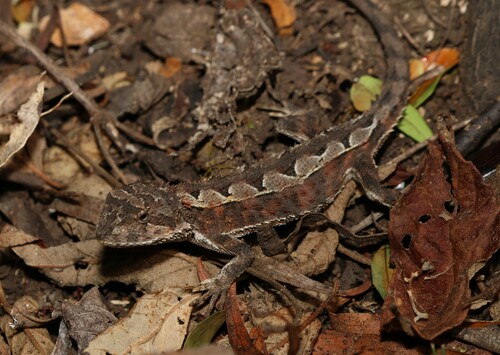
Amalosia lesueurii, commonly known as Lesueur's gecko or Lesueur's velvet gecko, is a species of gecko, a lizard in the family Diplodactylidae. The species is endemic to Australia. The specific name, lesueurii, is in honor of French naturalist Charles Alexandre Lesueur.

A. lesueurii is a small gecko. Adults usually have a snout-to-vent length (SVL) of 8 cm (3.1 in). It is a mottled grey colour. A. lesuerii is found near the eastern coastline of New South Wales and Queensland. Although it is perhaps the most common gecko in the Sydney region, A. lesuerii is rarely observed unless it is disturbed. During the day it hides under close-fitting rocks, and comes out at night to hunt insects.

Males of A. lesueurii reach sexual maturity at two years, but females not until four years old. The species is oviparous. Clutch size is two eggs. Boulenger A (1885). Catalogue of the Lizards in the British Museum (Natural History). Second Edition. Volume I. Geckonidæ.... London: Trustees of the British Museum (Natural History). (Taylor and Francis, printers). xii + 436 pp... Wikipedia →

Global Distribution

Parks Where Found

# Park Country Daily sighting probability
1 Blue Mountains National Park 🇦🇺 Australia
~20%
2 Royal National Park 🇦🇺 Australia
~20%

Cities Where Found

# City Country Daily sighting probability
1 Sydney 🇦🇺 Australia
<5%

Before you go

What are the chances of seeing a Lesueur's Gecko in Blue Mountains National Park?

Possible

About 20% of wildlife watchers report a Lesueur's Gecko sighting in Blue Mountains National Park on a given day, based on 50 verified sightings from GBIF citizen-science data from 2019 to 2026. It is the 20th most-seen of the 44 reptiles we can rate there. Over three days the chance rises to about 40%, and over a week to about 70%, if each day is a fresh chance.

When is the best time to see a Lesueur's Gecko in Blue Mountains National Park?

May and September–January

In those months about 20% of wildlife watchers report a Lesueur's Gecko in Blue Mountains National Park on a given day, against under 5% in August, the lowest month.

What time of day is best to see a Lesueur's Gecko?

Between 8 and 11 pm

Across all the parks we cover, that three-hour window holds the most Lesueur's Gecko sightings with a recorded time, and about half of them come between 6 am and 6 pm: it is seen both by day and at night.

Is Blue Mountains National Park the best place to see a Lesueur's Gecko?

Yes

Of the 2 parks where we can rate Lesueur's Gecko sightings, Blue Mountains National Park has the highest daily chance: about 20%. Next come Royal National Park (Australia, about 20%).

Where does the Lesueur's Gecko sighting chance come from?

GBIF citizen-science records

It is estimated from how often the Lesueur's Gecko is recorded against all the reptiles logged in Blue Mountains National Park (50 verified sightings from 2019 to 2026), calibrated against known sighting rates. Figures are rounded to the nearest 10% because citizen-science data supports honest approximations, not decimals, and months with records from fewer than five people show "—". How it works.

← Back to Blue Mountains National Park