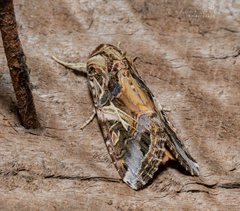
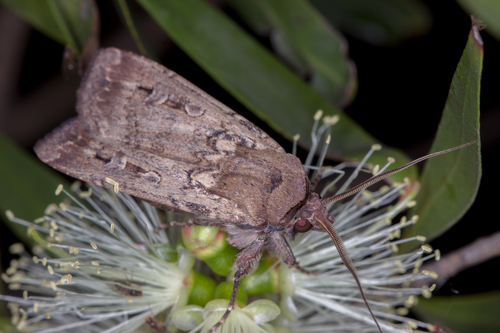
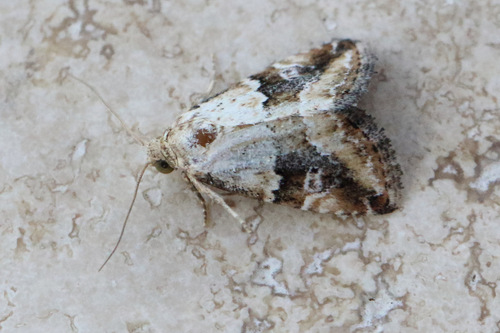
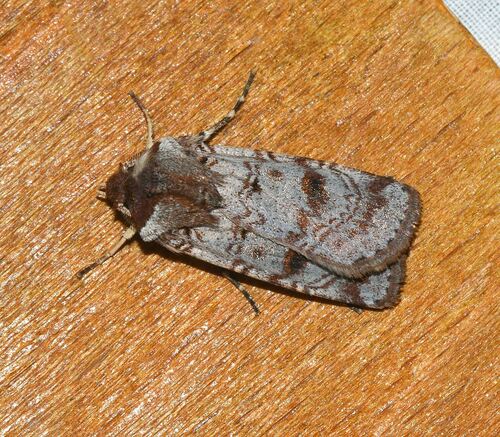
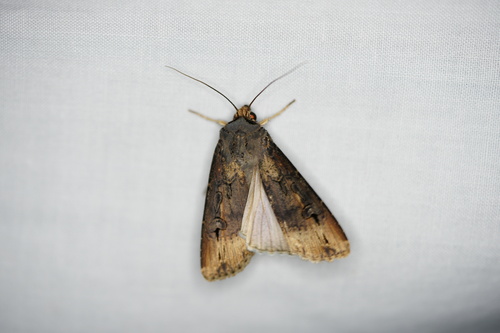
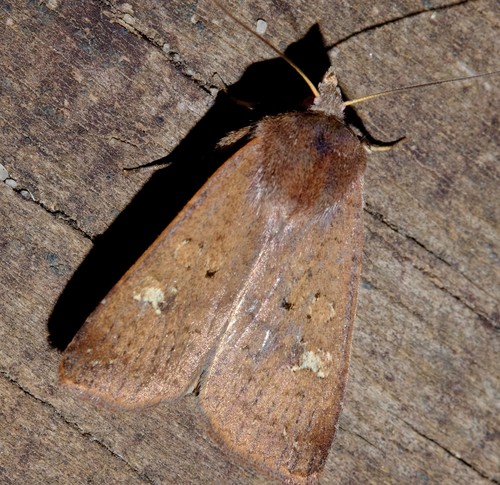
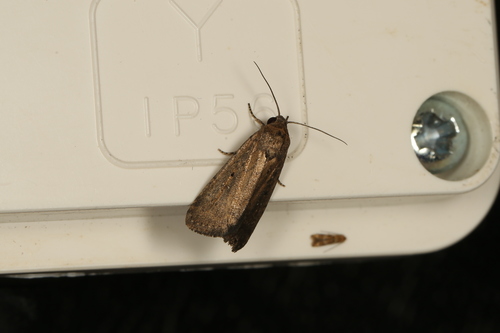
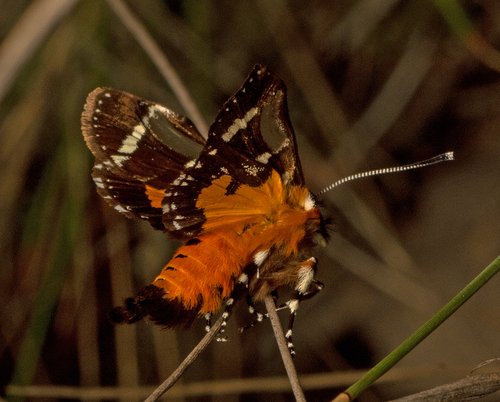
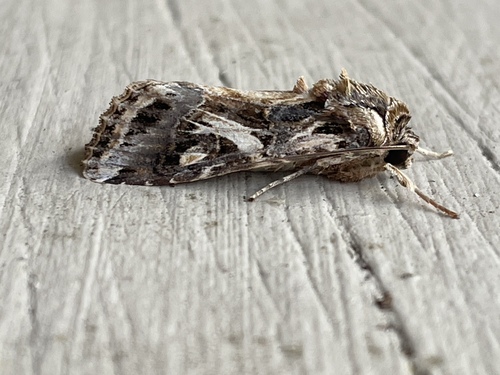
Oriental Leafworm Moth

Oriental Leafworm Moth

Spodoptera litura

Daily sighting probability ~10% · With luck
at Blue Mountains National Park

In 3 days ~20% in a week ~50%

26 Verified sightings at Blue Mountains National Park From 2019 to 2026
76 In all 5 parks
April Best month
☀️🌙 Day & Night When it's spotted

About the Oriental Leafworm Moth

Spodoptera litura, otherwise known as the tobacco cutworm or cotton leafworm, is a nocturnal moth in the family Noctuidae. S. litura is a serious polyphagous pest in Asia, Oceania, and the Indian subcontinent that was first described by Johan Christian Fabricius in 1775. Its common names reference two of the most frequent host plants of the moth. In total, 87 species of host plants that are infested by S. litura are of economic importance. The species parasitize the plants as larvae through vigorous eating patterns, oftentimes leaving the leaves completely destroyed. The moth destroys economically important agricultural crops and decreases yield in some plants completely. Their potential impact on the many different cultivated crops, and subsequently the local agricultural economy, has led to serious efforts to control the pests.

S. litura is often confused with its close relative, Spodoptera littoralis. These two species are hard to discriminate between because the larvae and adult forms are identical. Inspecting the genitalia is the most certain way to tell the two species apart.

There are slight but obvious differences in morphology... Wikipedia →
Global Distribution

Parks Where Found

# Park Country Daily sighting probability
1 Kanha National Park 🇮🇳 India
~10%
2 Daintree National Park 🇦🇺 Australia
~10%
3 Springbrook National Park 🇦🇺 Australia
~10%
4 Blue Mountains National Park 🇦🇺 Australia
~10%
5 Lamington National Park 🇦🇺 Australia
~10%

Cities Where Found

# City Country Daily sighting probability
1 Vijayawada 🇮🇳 India
~30%
2 Auckland 🇳🇿 New Zealand
~20%
3 Prayagraj 🇮🇳 India
~10%
4 Brisbane 🇦🇺 Australia
~10%
5 Hyderabad 🇮🇳 India
~10%
6 Kochi 🇮🇳 India
~10%
7 Tuen Mun 🇨🇳 China
~10%
8 Taichung 🇹🇼 Taiwan
~10%
9 Chennai 🇮🇳 India
~10%
10 Hong Kong 🇨🇳 China
~10%

Before you go

What are the chances of seeing an Oriental Leafworm Moth in Blue Mountains National Park?

With luck

About 10% of wildlife watchers report an Oriental Leafworm Moth sighting in Blue Mountains National Park on a given day, based on 26 verified sightings from GBIF citizen-science data from 2019 to 2026. It is the 144th most-seen of the 789 insects we can rate there. Over three days the chance rises to about 20%, and over a week to about 50%, if each day is a fresh chance.

When is the best time to see an Oriental Leafworm Moth in Blue Mountains National Park?

April

In that month about 20% of wildlife watchers report an Oriental Leafworm Moth in Blue Mountains National Park on a given day, against under 5% in June–August and October, the lowest months.

What time of day is best to see an Oriental Leafworm Moth?

Between 7 and 10 pm

Across all the parks we cover, that three-hour window holds the most Oriental Leafworm Moth sightings with a recorded time, and about half of them come between 6 pm and 6 am: it is seen both by day and at night.

Is Blue Mountains National Park the best place to see an Oriental Leafworm Moth?

Among the best

Of the 5 parks where we can rate Oriental Leafworm Moth sightings, Blue Mountains National Park ranks 4th at about 10%, level with the leaders once rounded. The best odds are in Kanha National Park (India, about 10%), Daintree National Park (Australia, about 10%) and Springbrook National Park (Australia, about 10%).

Where does the Oriental Leafworm Moth sighting chance come from?

GBIF citizen-science records

It is estimated from how often the Oriental Leafworm Moth is recorded against all the insects logged in Blue Mountains National Park (26 verified sightings from 2019 to 2026), calibrated against known sighting rates. Figures are rounded to the nearest 10% because citizen-science data supports honest approximations, not decimals, and months with records from fewer than five people show "—". How it works.

← Back to Blue Mountains National Park