
Red-naped Snake

Red-naped Snake

Furina diadema

Silhouette: SeismicShrimp · PhyloPic

LCLeast ConcernNTVUENCR Endemic
Daily sighting probability ~10% · With luck
at Blue Mountains National Park

In 3 days ~20% in a week ~30%

19 Verified sightings at Blue Mountains National Park From 2019 to 2026
19 In 1 park
July Best month
☀️🌙 Day & Night When it's spotted

About the Red-naped Snake

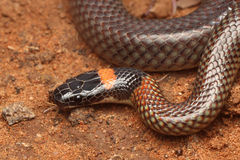
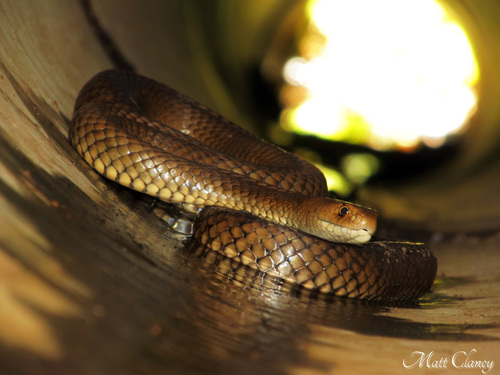
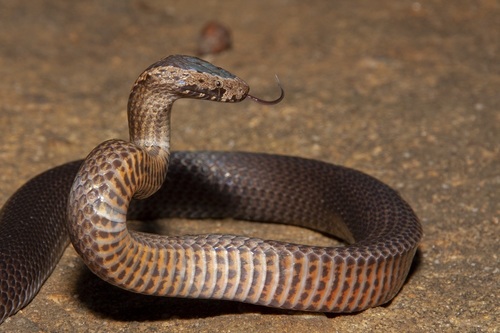
The red-naped snake (Furina diadema) is a small venomous reptile from the family Elapidae. The snakes are found in four Australian states and are listed as 'threatened' in Victoria'. They are nocturnal and feed on small skinks. The young eastern brown snake is similar in appearance.

The red-naped snake has small black eyes, a shiny black head, and neck. Its head appears to be partially flattened. On the upper lip is a streak of white. On the back of the neck there is a well defined patch of orange or red in the shape of a diamond, crescent or oval. The belly can be either a cream colour or white. The remainder of the body is a red-brown colour. The edges of these dorsal scales are either black or dark brown and this makes the scales look like a net.

Furina diadema have a slim body and are considered a small snake. They have been reported to reach a maximum length of 45 cm. Other sources have reported them as reaching a maximum total length of 40 cm. The males are the smaller sex.

Theses snakes have between 160 and 210 ventral scales, a divided anal scale, between 35 and 70 subcaudal scales and generally 15 rows of mid-body scales. Although red-naped snakes... Wikipedia →

Global Distribution

Parks Where Found

# Park Country Daily sighting probability
1 Blue Mountains National Park 🇦🇺 Australia
~10%

More parks will be added in future updates.

Closest Relatives at Blue Mountains National Park

Before you go

What are the chances of seeing a Red-naped Snake in Blue Mountains National Park?

With luck

About 10% of wildlife watchers report a Red-naped Snake sighting in Blue Mountains National Park on a given day, based on 19 verified sightings from GBIF citizen-science data from 2019 to 2026. It is the 41st most-seen of the 44 reptiles we can rate there. Over three days the chance rises to about 20%, and over a week to about 30%, if each day is a fresh chance.

When is the best time to see a Red-naped Snake in Blue Mountains National Park?

March, May–September and November

In those months about 10% of wildlife watchers report a Red-naped Snake in Blue Mountains National Park on a given day, against under 5% in April, October and December–February, the lowest months.

What time of day is best to see a Red-naped Snake?

Between 8 and 11 pm

Across all the parks we cover, that three-hour window holds the most Red-naped Snake sightings with a recorded time, and about 7 in 10 of them come between 6 pm and 6 am: it is seen both by day and at night.

Where else can you see a Red-naped Snake?

Only Blue Mountains National Park, in our data

Blue Mountains National Park is the only park on Wallace's Line with enough records to rate Red-naped Snake sightings: about 10% of wildlife watchers there report one on a given day.

Which relatives of the Red-naped Snake live in Blue Mountains National Park?

Same family: Elapidae

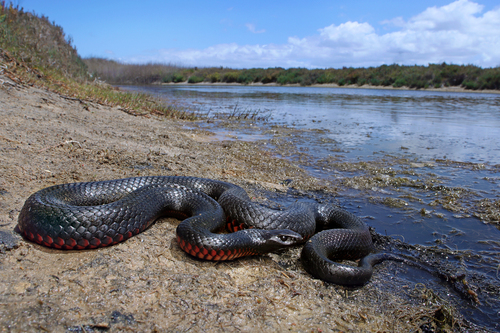
The closest relatives of the Red-naped Snake that you can see in Blue Mountains National Park (family Elapidae, Elapid Snakes) are Red-bellied Black Snake (about 30%), Highlands Copperhead (about 30%) and Eastern Tiger Snake (about 20%), with each one's daily chance of a sighting.

Where does the Red-naped Snake sighting chance come from?

GBIF citizen-science records

It is estimated from how often the Red-naped Snake is recorded against all the reptiles logged in Blue Mountains National Park (19 verified sightings from 2019 to 2026), calibrated against known sighting rates. Figures are rounded to the nearest 10% because citizen-science data supports honest approximations, not decimals, and months with records from fewer than five people show "—". How it works.

← Back to Blue Mountains National Park