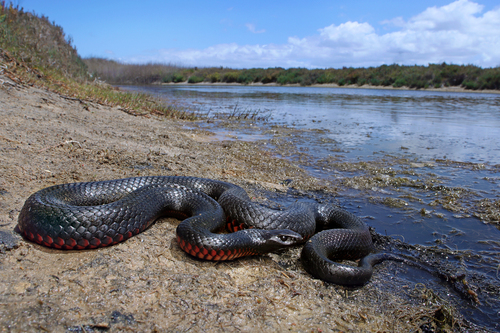
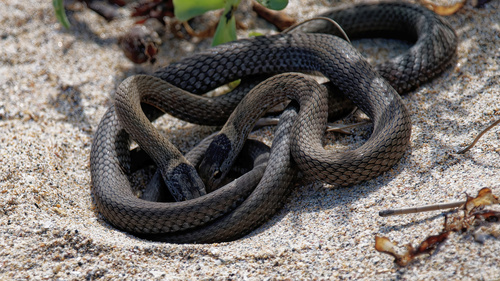
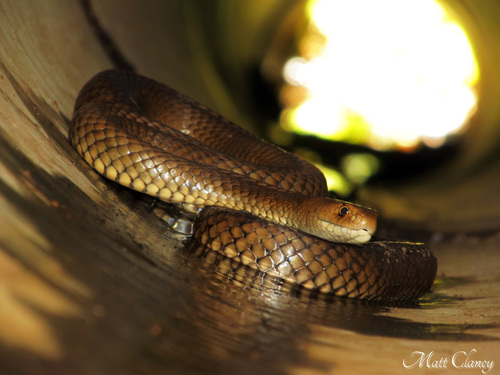
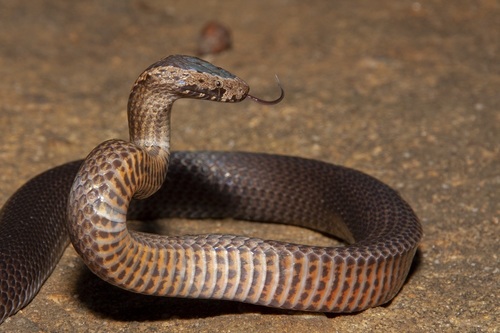
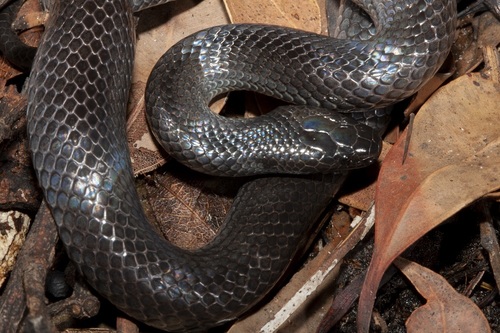
Small-eyed Snake

Small-eyed Snake

Cryptophis nigrescens

Silhouette: SeismicShrimp · PhyloPic

LCLeast ConcernNTVUENCR Endemic
Daily sighting probability ~10% · With luck
at Blue Mountains National Park

In 3 days ~30% in a week ~60%

30 Verified sightings at Blue Mountains National Park From 2019 to 2026
160 In all 5 parks
April Best month
☀️🌙 Day & Night When it's spotted

About the Small-eyed Snake

Cryptophis nigrescens, commonly known as the eastern small-eyed snake, is a species of venomous snake in the family Elapidae. The species is endemic to eastern Australia. Cryptophis nigrescens was described by Albert Günther in 1862, assigning the new species to Hoplocephalus.

Cryptophis nigrescens is found in the Australian states of New South Wales, Queensland, and Victoria. Common names for the species include short-tailed snake, small-eyed snake, and eastern small-eyed snake. Cryptophis nigrescens is viviparous.

Boulenger GA (1896). Catalogue of the Snakes in the British Museum (Natural History). Volume III., Containing the Colubridæ (Opisthoglyphæ and Proteroglyphæ)... London: Trustees of the British Museum (Natural History). (Taylor and Francis, printers). xiv + 727 pp. + Plates I-XXV. (Denisonia nigrescens, p. 343).

Günther A (1862). "On new Species of Snakes in the Collection of the British Museum". Ann. Mag. Nat. Hist., Third Series 9: 124–132. (Hoplocephalus nigrescens, new species, p. 131 + Plate IX, figure 12). Wikipedia →
Global Distribution

Parks Where Found

# Park Country Daily sighting probability
1 Springbrook National Park 🇦🇺 Australia
~30%
2 Lamington National Park 🇦🇺 Australia
~20%
3 Daintree National Park 🇦🇺 Australia
~20%
4 Blue Mountains National Park 🇦🇺 Australia
~10%
5 Royal National Park 🇦🇺 Australia
~10%

Cities Where Found

# City Country Daily sighting probability
1 Brisbane 🇦🇺 Australia
<5%
2 Melbourne 🇦🇺 Australia
<5%

Zoos & Centres Where Found

# Zoo / Centre Country
1 Bear Hollow Zoo 🇺🇸 United States In captivity

Closest Relatives at Blue Mountains National Park

Before you go

What are the chances of seeing a Small-eyed Snake in Blue Mountains National Park?

With luck

About 10% of wildlife watchers report a Small-eyed Snake sighting in Blue Mountains National Park on a given day, based on 30 verified sightings from GBIF citizen-science data from 2019 to 2026. It is the 26th most-seen of the 44 reptiles we can rate there. Over three days the chance rises to about 30%, and over a week to about 60%, if each day is a fresh chance.

When is the best time to see a Small-eyed Snake in Blue Mountains National Park?

February, April and September

In those months about 20% of wildlife watchers report a Small-eyed Snake in Blue Mountains National Park on a given day, against under 5% in January and May, the lowest months.

What time of day is best to see a Small-eyed Snake?

Between 6 and 9 pm

Across all the parks we cover, that three-hour window holds the most Small-eyed Snake sightings with a recorded time, and about half of them come between 6 am and 6 pm: it is seen both by day and at night.

Is Blue Mountains National Park the best place to see a Small-eyed Snake?

4th of 5

Of the 5 parks where we can rate Small-eyed Snake sightings, Blue Mountains National Park ranks 4th at about 10%. The best odds are in Springbrook National Park (Australia, about 30%), Lamington National Park (Australia, about 20%) and Daintree National Park (Australia, about 20%).

Which relatives of the Small-eyed Snake live in Blue Mountains National Park?

Same family: Elapidae

The closest relatives of the Small-eyed Snake that you can see in Blue Mountains National Park (family Elapidae, Elapid Snakes) are Red-bellied Black Snake (about 30%), Highlands Copperhead (about 30%) and Eastern Tiger Snake (about 20%), with each one's daily chance of a sighting.

Where does the Small-eyed Snake sighting chance come from?

GBIF citizen-science records

It is estimated from how often the Small-eyed Snake is recorded against all the reptiles logged in Blue Mountains National Park (30 verified sightings from 2019 to 2026), calibrated against known sighting rates. Figures are rounded to the nearest 10% because citizen-science data supports honest approximations, not decimals, and months with records from fewer than five people show "—". How it works.

← Back to Blue Mountains National Park