Common Death Adder

Common Death Adder

Acanthophis antarcticus

Silhouette: SeismicShrimp · PhyloPic

LCLeast ConcernNTVUENCR
Daily sighting probability ~10% · With luck
at Blue Mountains National Park

In 3 days ~30% in a week ~60%

28 Verified sightings at Blue Mountains National Park From 2019 to 2026
37 In all 2 parks
January Best month
☀️🌙 Day & Night When it's spotted

About the Common Death Adder

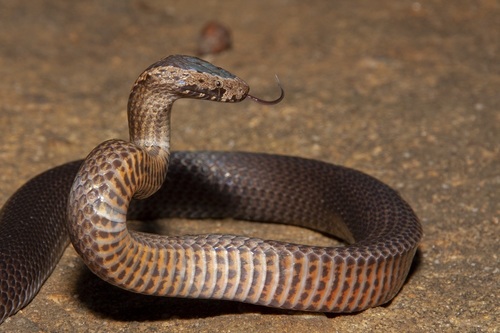
The common death adder (Acanthophis antarcticus) is a species of death adder native to Australia. It is one of the most venomous land snakes in Australia and globally. While it remains widespread (unlike related species), it is facing increased threat from the ongoing Australian cane toad invasion.

The common death adder was first described in 1802. The common death adder feeds on frogs, lizards and birds and, unlike most Australian venomous snakes that actively search for prey, this snake sits in one place and waits for prey to come to it.

The common death adder has a broad flattened, triangular head and a thick body with bands of red, brown and black with a grey, cream or pink belly. It's known to reach a maximum body length of 70–100 centimetres (2.3–3.3 ft). Unlike the common or European adder (Vipera berus), the common death adder is a member of the snake family Elapidae, rather than the family Viperidae, which are not found in Australia.

The common death adder occurs over much of eastern and coastal southern Australia – Queensland, New South Wales and South Australia. It is more scarce in the Northern Territory, Western... Wikipedia →

Global Distribution

Parks Where Found

# Park Country Daily sighting probability
1 Booderee National Park 🇦🇺 Australia
~20%
2 Blue Mountains National Park 🇦🇺 Australia
~10%

Zoos & Centres Where Found

# Zoo / Centre Country
1 Prague Zoo 🇨🇿 Czechia In captivity
2 Skansen 🇸🇪 Sweden In captivity
3 Australia Zoo 🇦🇺 Australia In captivity
4 Zoo Pilsen 🇨🇿 Czechia In captivity
5 Alice Springs Desert Park 🇦🇺 Australia In captivity
6 Toledo Zoo 🇺🇸 United States In captivity
7 Taronga Zoo 🇦🇺 Australia In captivity
8 Currumbin Wildlife Sanctuary 🇦🇺 Australia In captivity
9 Melbourne Zoo 🇦🇺 Australia In captivity
10 Lone Pine Koala Sanctuary 🇦🇺 Australia In captivity
11 Tierpark Hagenbeck 🇩🇪 Germany In captivity
12 Sydney Zoo 🇦🇺 Australia In captivity
13 Adelaide Zoo 🇦🇺 Australia In captivity
14 Reptile Gardens 🇺🇸 United States In captivity
15 Australian Reptile Park 🇦🇺 Australia In captivity
16 Symbio Wildlife Park 🇦🇺 Australia In captivity
17 Featherdale Sydney Wildlife Park 🇦🇺 Australia In captivity
18 Sea Life Sydney Aquarium 🇦🇺 Australia In captivity
19 Universeum 🇸🇪 Sweden In captivity
20 Wild Life Sydney 🇦🇺 Australia In captivity
21 National Aquarium 🇺🇸 United States In captivity
22 Baltic Sea Science Center 🇸🇪 Sweden In captivity
23 Birdworld Kuranda 🇦🇺 Australia In captivity
24 Kuranda Koala Gardens 🇦🇺 Australia In captivity
25 Rákosův pavilon 🇨🇿 Czechia In captivity
26 Velemlokárium 🇨🇿 Czechia In captivity

Closest Relatives at Blue Mountains National Park

Before you go

What are the chances of seeing a Common Death Adder in Blue Mountains National Park?

With luck

About 10% of wildlife watchers report a Common Death Adder sighting in Blue Mountains National Park on a given day, based on 28 verified sightings from GBIF citizen-science data from 2019 to 2026. It is the 26th most-seen of the 44 reptiles we can rate there. Over three days the chance rises to about 30%, and over a week to about 60%, if each day is a fresh chance.

When is the best time to see a Common Death Adder in Blue Mountains National Park?

January–February and October

In those months about 20% of wildlife watchers report a Common Death Adder in Blue Mountains National Park on a given day, against under 5% in April to July, the lowest months.

What time of day is best to see a Common Death Adder?

Between 7 and 10 pm

Across all the parks we cover, that three-hour window holds the most Common Death Adder sightings with a recorded time, and about 7 in 10 of them come between 6 pm and 6 am: it is seen both by day and at night.

Is Blue Mountains National Park the best place to see a Common Death Adder?

2nd of 2

Of the 2 parks where we can rate Common Death Adder sightings, Blue Mountains National Park ranks 2nd at about 10%. The best odds are in Booderee National Park (Australia, about 20%).

Which relatives of the Common Death Adder live in Blue Mountains National Park?

Same family: Elapidae

The closest relatives of the Common Death Adder that you can see in Blue Mountains National Park (family Elapidae, Elapid Snakes) are Red-bellied Black Snake (about 30%), Highlands Copperhead (about 30%) and Eastern Tiger Snake (about 20%), with each one's daily chance of a sighting.

Where does the Common Death Adder sighting chance come from?

GBIF citizen-science records

It is estimated from how often the Common Death Adder is recorded against all the reptiles logged in Blue Mountains National Park (28 verified sightings from 2019 to 2026), calibrated against known sighting rates. Figures are rounded to the nearest 10% because citizen-science data supports honest approximations, not decimals, and months with records from fewer than five people show "—". How it works.

← Back to Blue Mountains National Park