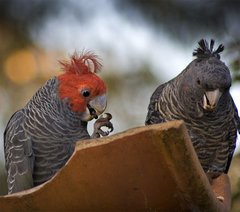

Gang-gang Cockatoo

Gang-gang Cockatoo

Callocephalon fimbriatum

Silhouette: Ferran Sayol · PhyloPic

LCNTVUVulnerableENCR Endemic
Daily sighting probability <5% · Rare
at Booderee National Park

In 3 days ~10% in a week ~20%

90 Verified sightings at Booderee National Park From 2019 to 2026
3,585 In all 7 parks
December Best month
☀️ Diurnal When it's spotted

About the Gang-gang Cockatoo

The gang-gang cockatoo (Callocephalon fimbriatum) is a parrot found in the cooler and wetter forests and woodlands of Australia, particularly alpine bushland. It is the only species placed in the genus Callocephalon. Mostly mild grey in colour with some lighter scalloping (more pronounced and buffy in females), the male has a red head and crest, while the female has a small fluffy grey crest. It ranges throughout south-eastern Australia. The gang-gang cockatoo is the faunal emblem of the Australian Capital Territory. It is easily identified by its distinctive call, which is described as resembling a creaky gate, or the sound of a cork being pulled from a wine bottle.

The name gang-gang comes from a New South Wales Aboriginal language, probably from one of the coastal languages, although possibly from Wiradjuri. It is probably an onomatopoeic name. In 1803 the British Royal Navy officer James Grant included an illustration of the gang-gang cockatoo in his book describing a voyage to the colony of New South Wales in Australia. Grant coined the binomial name Psittacus fimbriatus. The gang-gang cockatoo is now the only species placed in the genus Callocephalon that was introduced... Wikipedia →

Sounds

Call0:11

Australia · 2023

© Romuald Mikusek · XC1169744 · CC BY-NC-SA 4.0

Uncertain0:30

Australia · 2026

© Nick Talbot · XC1083977 · CC BY-NC-SA 4.0

Call0:39

Australia · 2023

© Peter Boesman · XC859716 · CC BY-NC-ND 4.0

Global Distribution

Parks Where Found

# Park Country Daily sighting probability
1 Grampians National Park 🇦🇺 Australia
~30%
2 Great Otway National Park 🇦🇺 Australia
~30%
3 Kosciuszko National Park 🇦🇺 Australia
~20%
4 Wilsons Promontory National Park 🇦🇺 Australia
~20%
5 Royal National Park 🇦🇺 Australia
~10%
6 Blue Mountains National Park 🇦🇺 Australia
~10%
7 Booderee National Park 🇦🇺 Australia
<5%

Cities Where Found

# City Country Daily sighting probability
1 Melbourne 🇦🇺 Australia
<5%

Zoos & Centres Where Found

# Zoo / Centre Country
1 Healesville Sanctuary 🇦🇺 Australia In captivity
2 Currumbin Wildlife Sanctuary 🇦🇺 Australia In captivity
3 Lone Pine Koala Sanctuary 🇦🇺 Australia In captivity
4 Moonlit Sanctuary Wildlife Conservation Park 🇦🇺 Australia In captivity
5 Paphos Zoo 🇨🇾 Cyprus In captivity
6 Loro Parque 🇪🇸 Spain In captivity
7 Gorge Wildlife Park 🇦🇺 Australia In captivity
8 Symbio Wildlife Park 🇦🇺 Australia In captivity
9 Featherdale Sydney Wildlife Park 🇦🇺 Australia In captivity
10 Greenough Wildlife & Bird Park 🇦🇺 Australia In captivity
11 Wild Life Sydney 🇦🇺 Australia In captivity
12 Central Coast Zoo 🇦🇺 Australia In captivity

Before you go

What are the chances of seeing a Gang-gang Cockatoo in Booderee National Park?

Rare

Under 5% of wildlife watchers report a Gang-gang Cockatoo sighting in Booderee National Park on a given day, based on 90 verified sightings from GBIF citizen-science data from 2019 to 2026. It is the 101st most-seen of the 128 birds we can rate there. Over three days the chance rises to about 10%, and over a week to about 20%, if each day is a fresh chance.

When is the best time to see a Gang-gang Cockatoo in Booderee National Park?

Any time of year

In every month with enough records, under 5% of wildlife watchers report a Gang-gang Cockatoo in Booderee National Park on a given day, so our monthly data shows no clear season.

What time of day is best to see a Gang-gang Cockatoo?

Between 8 and 11 am

Across all the parks we cover, that three-hour window holds the most Gang-gang Cockatoo sightings with a recorded time, and nearly all of them come between 6 am and 6 pm: it is a daytime animal.

Which relatives of the Gang-gang Cockatoo live in Booderee National Park?

Same family: Psittacidae

The closest relatives of the Gang-gang Cockatoo that you can see in Booderee National Park (family Psittacidae, New World and African Parrots) are Coconut Lorikeet (about 70%), Crimson Rosella (about 60%) and Yellow-Tailed Black Cockatoo (about 30%), with each one's daily chance of a sighting.

Where does the Gang-gang Cockatoo sighting chance come from?

GBIF citizen-science records

It is estimated from how often the Gang-gang Cockatoo is recorded against all the birds logged in Booderee National Park (90 verified sightings from 2019 to 2026), calibrated against known sighting rates. Figures are rounded to the nearest 10% because citizen-science data supports honest approximations, not decimals, and months with records from fewer than five people show "—". How it works.

← Back to Booderee National Park