Southern Emuwren

Southern Emuwren

Stipiturus malachurus

Silhouette: Michael Scroggie · PhyloPic

LCLeast ConcernNTVUENCR Endemic
Daily sighting probability ~10% · With luck
at Booderee National Park

In 3 days ~30% in a week ~50%

47 Verified sightings at Booderee National Park From 2019 to 2026
675 In all 7 parks
August Best month
☀️ Diurnal When it's spotted

About the Southern Emuwren

The southern emu-wren (Stipiturus malachurus) is a species of bird in the Australasian wren family, Maluridae. It is endemic to Australia. Its natural habitats are temperate forests, and Mediterranean-type shrubby vegetation, and swamplands.

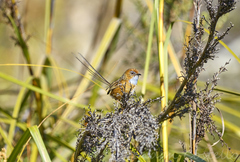
The adult male has rusty-brown upper parts with streaks of black, the crown more reddish and grey-brown wings. It has a sky-blue throat, upper chest and eyebrow. The tail is double the body length, and is composed of six filamentous feathers, the central two of which are longer than the lateral ones. The underparts are pale red-brown, paler on the belly. The bill is black and the feet and eyes are brown. The female is darker streaked and lacks the blue plumage and redder crown. Its bill is brown with a pale grey base.

Throughout its range, the southern emu-wren inhabits marshes, low heathland and dune areas. At least one subspecies is present near the site of the Whalers Way Orbital Launch Complex near Port Lincoln, on the Eyre Peninsula of South Australia.

The southern emu-wren is one of three species of the genus Stipiturus, commonly known as emu-wrens, found across... Wikipedia →

Sounds

Song0:09

Australia · 2023

© Romuald Mikusek · XC1169639 · CC BY-NC-SA 4.0

Call0:41

Australia · 2023

© Peter Boesman · XC860195 · CC BY-NC-ND 4.0

Alarm call0:17

Australia · 2017

© Greg McLachlan · XC394357 · CC BY-NC-SA 4.0

Global Distribution

Parks Where Found

# Park Country Daily sighting probability
1 Great Otway National Park 🇦🇺 Australia
~10%
2 Flinders Chase 🇦🇺 Australia
~10%
3 Booderee National Park 🇦🇺 Australia
~10%
4 Royal National Park 🇦🇺 Australia
~10%
5 Wilsons Promontory National Park 🇦🇺 Australia
<5%
6 Grampians National Park 🇦🇺 Australia
<5%
7 Blue Mountains National Park 🇦🇺 Australia
<5%

Cities Where Found

# City Country Daily sighting probability
1 Sydney 🇦🇺 Australia
<5%

Before you go

What are the chances of seeing a Southern Emuwren in Booderee National Park?

With luck

About 10% of wildlife watchers report a Southern Emuwren sighting in Booderee National Park on a given day, based on 47 verified sightings from GBIF citizen-science data from 2019 to 2026. It is the 67th most-seen of the 128 birds we can rate there. Over three days the chance rises to about 30%, and over a week to about 50%, if each day is a fresh chance.

When is the best time to see a Southern Emuwren in Booderee National Park?

July and August

In those months about 20% of wildlife watchers report a Southern Emuwren in Booderee National Park on a given day, against under 5% in January, March and September, the lowest months.

What time of day is best to see a Southern Emuwren?

Between 7 and 10 am

Across all the parks we cover, that three-hour window holds the most Southern Emuwren sightings with a recorded time, and about 9 in 10 of them come between 6 am and 6 pm: it is a daytime animal.

Is Booderee National Park the best place to see a Southern Emuwren?

Among the best

Of the 7 parks where we can rate Southern Emuwren sightings, Booderee National Park ranks 3rd at about 10%, level with the leaders once rounded. The best odds are in Great Otway National Park (Australia, about 10%) and Flinders Chase (Australia, about 10%).

Which relatives of the Southern Emuwren live in Booderee National Park?

Same family: Maluridae

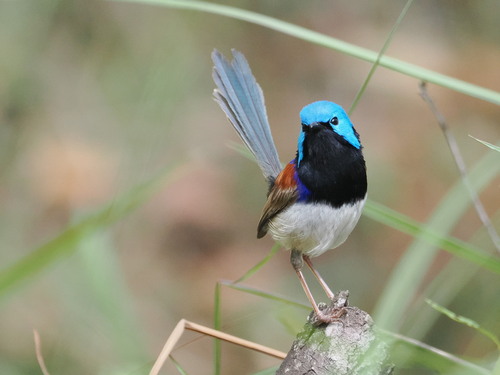
The closest relatives of the Southern Emuwren that you can see in Booderee National Park (family Maluridae, Fairywrens and Allies) are Superb Fairywren (about 40%) and Variegated Fairywren (about 30%), with each one's daily chance of a sighting.

Where does the Southern Emuwren sighting chance come from?

GBIF citizen-science records

It is estimated from how often the Southern Emuwren is recorded against all the birds logged in Booderee National Park (47 verified sightings from 2019 to 2026), calibrated against known sighting rates. Figures are rounded to the nearest 10% because citizen-science data supports honest approximations, not decimals, and months with records from fewer than five people show "—". How it works.

← Back to Booderee National Park