
Spotted Antbird

Spotted Antbird

Hylophylax naevioides

Silhouette: Sheatherius · PhyloPic

LCLeast ConcernNTVUENCR
Daily sighting probability ~10% · With luck
at Braulio Carrillo National Park

In 3 days ~30% in a week ~50%

443 Verified sightings at Braulio Carrillo National Park From 2019 to 2026
8,795 In all 14 parks
January Best month
☀️ Diurnal When it's spotted

About the Spotted Antbird

The spotted antbird (Hylophylax naevioides) is a species of bird in subfamily Thamnophilinae of family Thamnophilidae, the "typical antbirds". It is found in Colombia, Costa Rica, Ecuador, Honduras, Nicaragua, and Panama.

The spotted antbird was described by Frédéric de Lafresnaye in 1847 as Conopophago naeivoides ("spotted gnateater") and later transferred to genus Hylophylax that had been erected in 1909 by Robert Ridgway. It shares the genus with the spot-backed antbird (H. naevius) and dot-backed antbird (H. punctulatus). It and the spot-backed antbird have been treated as sister species.

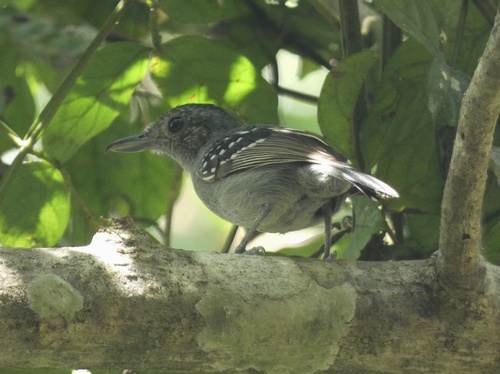
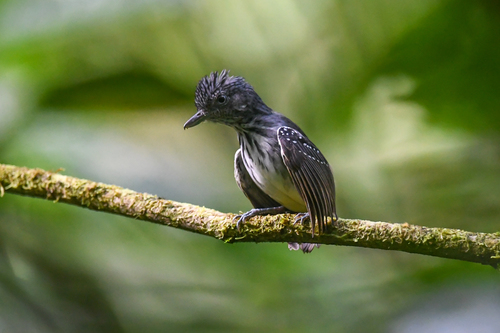
The spotted antbird is 10 to 12 cm (3.9 to 4.7 in) long and weighs 15 to 19.5 g (0.53 to 0.69 oz). The two subspecies have essentially the same plumage. Adult males have a gray forehead and a grayish brown to olive-brown crown and nape. Their back is chestnut with a white and chestnut patch between their scapulars; the white is usually not visible. Their uppertail coverts are dull cinnamon. Their wings are black with cinnamon... Wikipedia →

Sounds

Call0:06

Ecuador · 2019

© rudy gelis · XC821974 · CC BY-NC-SA 4.0

Song0:48

Panama · 2018

© Rainforest Connection · XC621789 · CC BY-NC-SA 4.0

Begging call0:17

Ecuador · 1996

© Olaf Jahn · XC262074 · CC BY-NC-SA 4.0

Global Distribution

Parks Where Found

# Park Country Daily sighting probability
1 Soberanía National Park 🇵🇦 Panama
~30%
2 Rincón de la Vieja National Park 🇨🇷 Costa Rica
~20%
3 Tenorio Volcano National Park 🇨🇷 Costa Rica
~20%
4 Darién National Park 🇵🇦 Panama
~20%
5 Arenal Volcano National Park 🇨🇷 Costa Rica
~20%
6 Chagres National Park 🇵🇦 Panama
~20%
7 Utría National Natural Park 🇨🇴 Colombia
~10%
8 Braulio Carrillo National Park 🇨🇷 Costa Rica
~10%
9 San Lorenzo Protected Forest 🇵🇦 Panama
~10%
10 Tapantí-Macizo de la Muerte National Park 🇨🇷 Costa Rica
<5%
11 Cahuita National Park 🇨🇷 Costa Rica
<5%
12 Tortuguero National Park 🇨🇷 Costa Rica
<5%
13 Parque Natural Metropolitano 🇵🇦 Panama
<5%
14 Monteverde Cloud Forest Reserve 🇨🇷 Costa Rica
<5%

Before you go

What are the chances of seeing a Spotted Antbird in Braulio Carrillo National Park?

With luck

About 10% of wildlife watchers report a Spotted Antbird sighting in Braulio Carrillo National Park on a given day, based on 443 verified sightings from GBIF citizen-science data from 2019 to 2026. It is the 132nd most-seen of the 505 birds we can rate there. Over three days the chance rises to about 30%, and over a week to about 50%, if each day is a fresh chance.

When is the best time to see a Spotted Antbird in Braulio Carrillo National Park?

January and March

In those months about 20% of wildlife watchers report a Spotted Antbird in Braulio Carrillo National Park on a given day, against under 5% in April, the lowest month.

What time of day is best to see a Spotted Antbird?

Between 9 am and noon

Across all the parks we cover, that three-hour window holds the most Spotted Antbird sightings with a recorded time, and about 9 in 10 of them come between 6 am and 6 pm: it is a daytime animal.

Which relatives of the Spotted Antbird live in Braulio Carrillo National Park?

Same family: Thamnophilidae

The closest relatives of the Spotted Antbird that you can see in Braulio Carrillo National Park (family Thamnophilidae, Typical Antbirds) are Chestnut-backed Antbird (about 10%), Western Slaty-Antshrike (about 10%) and Russet Antshrike (about 10%), with each one's daily chance of a sighting.

Where does the Spotted Antbird sighting chance come from?

GBIF citizen-science records

It is estimated from how often the Spotted Antbird is recorded against all the birds logged in Braulio Carrillo National Park (443 verified sightings from 2019 to 2026), calibrated against known sighting rates. Figures are rounded to the nearest 10% because citizen-science data supports honest approximations, not decimals, and months with records from fewer than five people show "—". How it works.

← Back to Braulio Carrillo National Park