Milk Frog

Milk Frog

Trachycephalus macrotis

Silhouette: Lauren McLean · PhyloPic

Daily sighting probability ~20% · Possible
at Cabo Blanco Absolute Nature Reserve

In 3 days ~40% in a week ~70%

7 Verified sightings at Cabo Blanco Absolute Nature Reserve From 2019 to 2026
388 In all 12 parks
February Best month
🌅 Crepuscular When it's spotted

About the Milk Frog

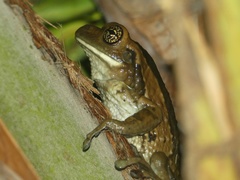
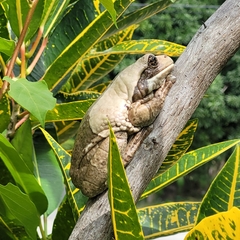
Trachycephalus macrotis, also known as the Amazonian milk frog and known in Spanish as rana lechera de Pastaza, is a frog in the family Hylidae. It is endemic to Peru and Ecuador. It has been observed between 225 and 925 m above sea level.

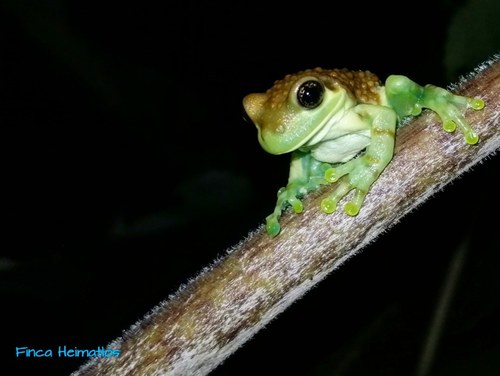
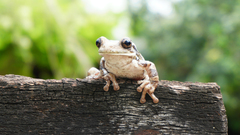
The adult male frog measures 69.8 to 91.5 mm in snout-vent length and the adult female frog 93.9 to 118.7 mm. Its head is wider than it is long. It has bronze-colored skin with coffee-colored marks. It has some webbing on its feet and relatively small climbing disks on its toes.

This species was split from the taxon T. typhonius. This nocturnal frog lives in submontane tropical forests, especially primary forest, near streams. However, it has also been spotted near plantations, roads, and human habitation. This frog has been observed between 225 and 925 metres (738 and 3,035 ft) above sea level.

This frog engages in explosive breeding after heavy rain. The male frog floats in a temporary body of water and calls to the female. The eggs float on the water, in which the tadpoles later swim and develop. The IUCN classifies this frog as least concern of extinction because of... Wikipedia →
Sounds

Recording0:22

Ecuador · 2026

© Alex Bentley · iNaturalist · CC BY-NC 4.0

Recording0:10

Panama · 2020

© Hubert Szczygieł · iNaturalist · CC BY-NC 4.0

Recording0:24

Panama · 2021

© evoecogen · iNaturalist · CC BY-NC 4.0

Global Distribution

Parks Where Found

# Park Country Daily sighting probability
1 Santa Rosa National Park 🇨🇷 Costa Rica
~70%
2 Palo Verde National Park 🇨🇷 Costa Rica
~30%
3 Las Baulas Marine National Park 🇨🇷 Costa Rica
~30%
4 Soberanía National Park 🇵🇦 Panama
~30%
5 Ostional Wildlife Refuge 🇨🇷 Costa Rica
~30%
6 Manuel Antonio National Park 🇨🇷 Costa Rica
~30%
7 Tayrona National Natural Park 🇨🇴 Colombia
~20%
8 Cabo Blanco Absolute Nature Reserve 🇨🇷 Costa Rica
~20%
9 Piedras Blancas National Park 🇨🇷 Costa Rica
~10%
10 Marino Ballena National Park 🇨🇷 Costa Rica
~10%
11 Carara National Park 🇨🇷 Costa Rica
~10%
12 Parque Natural Metropolitano 🇵🇦 Panama
~10%

Cities Where Found

# City Country Daily sighting probability
1 Panama City 🇵🇦 Panama
~10%

Zoos & Centres Where Found

# Zoo / Centre Country
1 El Nispero Zoo 🇵🇦 Panama In captivity
2 International Animal Rescue – Costa Rica 🇨🇷 Costa Rica In captivity
3 Monteverde Theme Park 🇨🇷 Costa Rica In captivity

Before you go

What are the chances of seeing a Milk Frog in Cabo Blanco Absolute Nature Reserve?

Possible

About 20% of wildlife watchers report a Milk Frog sighting in Cabo Blanco Absolute Nature Reserve on a given day, based on 7 verified sightings from GBIF citizen-science data from 2019 to 2026. It is the 5th most-seen of the 6 amphibians we can rate there. Over three days the chance rises to about 40%, and over a week to about 70%, if each day is a fresh chance.

When is the best time to see a Milk Frog in Cabo Blanco Absolute Nature Reserve?

February and July

In those months about 30% of wildlife watchers report a Milk Frog in Cabo Blanco Absolute Nature Reserve on a given day, against under 5% in March–April and August–December, the lowest months.

What time of day is best to see a Milk Frog?

Between 7 and 10 pm

Across all the parks we cover, that three-hour window holds the most Milk Frog sightings with a recorded time, and about 7 in 10 of them come between 6 pm and 6 am: it is most active around dawn and dusk.

Where does the Milk Frog sighting chance come from?

GBIF citizen-science records

It is estimated from how often the Milk Frog is recorded against all the amphibians logged in Cabo Blanco Absolute Nature Reserve (7 verified sightings from 2019 to 2026), calibrated against known sighting rates. Figures are rounded to the nearest 10% because citizen-science data supports honest approximations, not decimals, and months with records from fewer than five people show "—". How it works.

← Back to Cabo Blanco Absolute Nature Reserve