Crimson Patch
Daily sighting probability ~10% · With luck
at Carara National Park

In 3 days ~30% in a week ~50%

8 Verified sightings at Carara National Park From 2019 to 2026
187 In all 12 parks
November Best month
☀️ Diurnal When it's spotted

About the Crimson Patch

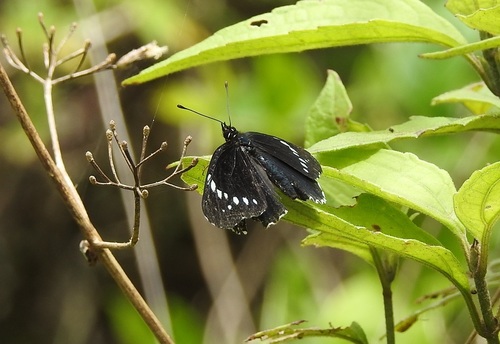
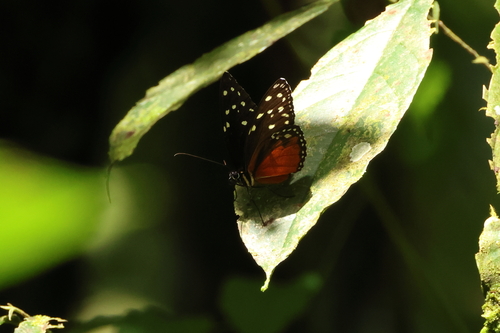
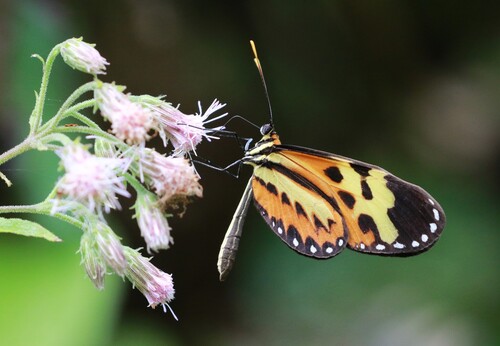
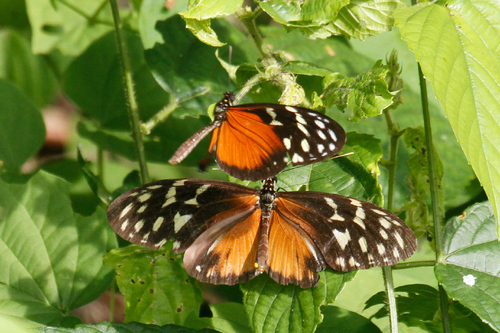
Chlosyne janais, the crimson patch or janais patch, is a common New World butterfly found from Colombia north through Central America and Mexico to southern Texas, with occasional sightings in southeastern Mexico and northern Texas. The dorsal and ventral wing surface is black with several undulating rows of small white spots on the medial forewings and along all outer wing margins. On each dorsal hindwing is a medial orange-red patch situated anteriorly. The ventral hindwings have a fragmented yellow proximal patch bordered by a thick postmedial band of red that does not reach the wing margins; maximum wingspan is 4.8–6.7 cm.

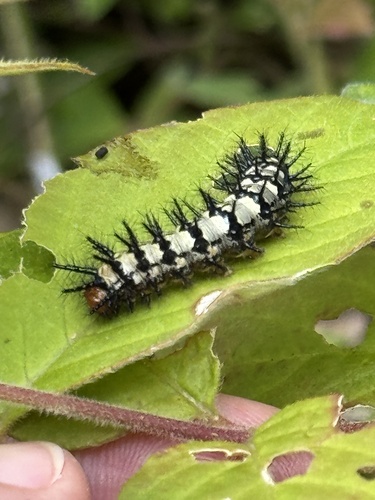
Adults inhabit the periphery of lowland tropical to subtropical forests, fields, and along streams, where they feed on flower nectar. Reproduction is continuous in the tropics, whereas in temperate areas several broods are produced from July to November. The caterpillars are grey white to green with several transverse rows of fleshly black spines; they feed primarily on acanthus shrubs, especially Anisacanthus wrightii and Odontonema callistachus (in Texas), upon which adult females lay their eggs.

The crimson patch can reach high numbers in the Rio Grande Valley, but the population is periodically killed off by cold snaps; the area is then recolonized by members of the Mexican population. A very similar species is the rosita patch (C. rosita), which is distinguished from the crimson patch by the former's lack of spots on the wing margins. Wikipedia →
Global Distribution

Parks Where Found

# Park Country Daily sighting probability
1 Tikal National Park 🇬🇹 Guatemala
~30%
2 Lago de Yojoa 🇭🇳 Honduras
~20%
3 Montes Azules Biosphere Reserve 🇲🇽 Mexico
~20%
4 Gandoca-Manzanillo Wildlife Refuge 🇨🇷 Costa Rica
~20%
5 Cerro Azul Meámbar National Park 🇭🇳 Honduras
~20%
6 Cumbres de Monterrey National Park 🇲🇽 Mexico
~10%
7 Cañón del Sumidero National Park 🇲🇽 Mexico
~10%
8 Carara National Park 🇨🇷 Costa Rica
~10%
9 Cahuita National Park 🇨🇷 Costa Rica
~10%
10 La Amistad International Park (Panama) 🇵🇦 Panama
~10%
11 Braulio Carrillo National Park 🇨🇷 Costa Rica
~10%
12 Tapantí-Macizo de la Muerte National Park 🇨🇷 Costa Rica
~10%

Cities Where Found

# City Country Daily sighting probability
1 San José 🇨🇷 Costa Rica
~20%
2 Mexico City 🇲🇽 México
~10%
3 San Salvador 🇸🇻 El Salvador
~10%
4 Puebla 🇲🇽 México
~10%
5 Monterrey 🇲🇽 México
~10%
6 San Antonio 🇺🇸 United States
<5%
7 Panama City 🇵🇦 Panama
<5%

Before you go

What are the chances of seeing a Crimson Patch in Carara National Park?

With luck

About 10% of wildlife watchers report a Crimson Patch sighting in Carara National Park on a given day, based on 8 verified sightings from GBIF citizen-science data from 2019 to 2026. It is the 49th most-seen of the 83 insects we can rate there. Over three days the chance rises to about 30%, and over a week to about 50%, if each day is a fresh chance.

When is the best time to see a Crimson Patch in Carara National Park?

July and November

In those months about 20% of wildlife watchers report a Crimson Patch in Carara National Park on a given day, against under 5% in February, April–May, August–October and December, the lowest months. Those are among Carara National Park's wettest months, with about 550 mm of rain a month against 35 mm in February.

What time of day is best to see a Crimson Patch?

Between 10 am and 1 pm

Across all the parks we cover, that three-hour window holds the most Crimson Patch sightings with a recorded time, and about 9 in 10 of them come between 6 am and 6 pm: it is a daytime animal.

Is Carara National Park the best place to see a Crimson Patch?

8th of 12

Of the 12 parks where we can rate Crimson Patch sightings, Carara National Park ranks 8th at about 10%. The best odds are in Tikal National Park (Guatemala, about 30%), Lago de Yojoa (Honduras, about 20%) and Montes Azules Biosphere Reserve (Mexico, about 20%).

Where does the Crimson Patch sighting chance come from?

GBIF citizen-science records

It is estimated from how often the Crimson Patch is recorded against all the insects logged in Carara National Park (8 verified sightings from 2019 to 2026), calibrated against known sighting rates. Figures are rounded to the nearest 10% because citizen-science data supports honest approximations, not decimals, and months with records from fewer than five people show "—". How it works.

← Back to Carara National Park