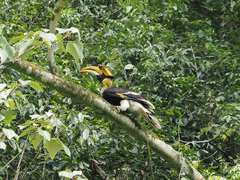
Great Hornbill

Great Hornbill

Buceros bicornis

Silhouette: PhyloPic

LCNTVUVulnerableENCR
Daily sighting probability <5% · Rare
at Cat Tien National Park

In 3 days ~10% in a week ~20%

51 Verified sightings at Cat Tien National Park From 2019 to 2026
6,678 In all 13 parks
August Best month
☀️ Diurnal When it's spotted

About the Great Hornbill

The great hornbill (Buceros bicornis), also known as the concave-casqued hornbill, great Indian hornbill or great pied hornbill, is one of the larger members of the hornbill family. It occurs in the Indian subcontinent and Southeast Asia. It is predominantly frugivorous, but also preys on small mammals, reptiles, and birds. It has been listed as Vulnerable on the IUCN Red List since 2018. It is known to have lived for nearly 50 years in captivity. Due to its large size and colour, and importance in many tribal cultures and rituals, the Government of Kerala declared it as the official Kerala state bird. It is also the state bird of Arunachal Pradesh.

The great hornbill was formally described by the Swedish naturalist Carl Linnaeus in 1758 in the tenth edition of his Systema Naturae. He placed it with the rhinoceros hornbill in the genus Buceros and coined the binomial name Buceros bicornis. Linnaeus specified the location as China. The genus name is from Latin becerus meaning "horned like an ox" which in turn is from the Ancient Greek boukerōs which combines bous meaning "ox" with kerōs meaning "horn". The specific bicornis is Latin and means "two-horned". The species... Wikipedia →

Sounds

Call0:28

India · 2024

© Lars Lachmann · XC883592 · CC BY-NC-SA 4.0

Song0:18

Thailand · 2023

© Alain Verneau · XC819734 · CC BY-NC-SA 4.0

Flight call0:13

India · 2010

© Ding Li Yong · XC567708 · CC BY-NC-ND 4.0

Global Distribution

Parks Where Found

# Park Country Daily sighting probability
1 Royal Manas National Park 🇧🇹 Bhutan
~50%
2 Khao Yai National Park 🇹🇭 Thailand
~50%
3 Kaeng Krachan National Park 🇹🇭 Thailand
~40%
4 Khao Sok National Park 🇹🇭 Thailand
~40%
5 Kaziranga National Park 🇮🇳 India
~30%
6 Manas National Park 🇮🇳 India
~30%
7 Jim Corbett National Park 🇮🇳 India
~30%
8 Namdapha National Park 🇮🇳 India
~20%
9 Periyar National Park 🇮🇳 India
~20%
10 Royal Bardia National Park 🇳🇵 Nepal
~10%
11 Chitwan National Park 🇳🇵 Nepal
~10%
12 Cat Tien National Park 🇻🇳 Vietnam
<5%
13 Taman Negara National Park 🇲🇾 Malaysia
<5%

Cities Where Found

# City Country Daily sighting probability
1 Phnom Penh 🇰🇭 Cambodia
<5%
2 Dehradun 🇮🇳 India
<5%

Zoos & Centres Where Found

# Zoo / Centre Country
1 Zlín-Lešná Zoo 🇨🇿 Czechia In captivity
2 Zoo de Doué 🇫🇷 France In captivity
3 Vinpearl Safari 🇻🇳 Vietnam In captivity
4 Hlawga National Park 🇲🇲 Myanmar (Burma) In captivity
5 Zoo Miami 🇺🇸 United States In captivity
6 Beijing Wildlife Park 🇨🇳 China In captivity
7 Toronto Zoo 🇨🇦 Canada In captivity
8 Minnesota Zoo 🇺🇸 United States In captivity
9 Taipei Zoo 🇹🇼 Taiwan In captivity
10 Xi'an Qinling Wildlife Park 🇨🇳 China In captivity
11 Shanghai Wild Animal Park 🇨🇳 China In captivity
12 Ningbo Wildlife Park 🇨🇳 China In captivity
13 Bronx Zoo 🇺🇸 United States In captivity
14 Khao Kheow Open Zoo 🇹🇭 Thailand In captivity
15 Badoca Safari Park 🇵🇹 Portugal In captivity
16 Nakhon Ratchasima Zoo 🇹🇭 Thailand In captivity
17 Chimelong Safari Park 🇨🇳 China In captivity
18 Songkhla Zoo 🇹🇭 Thailand In captivity
19 Nashville Zoo at Grassmere 🇺🇸 United States In captivity
20 Shanghai Zoo 🇨🇳 China In captivity
21 Shenzhen Safari Park 🇨🇳 China In captivity
22 Nanjing Hongshan Forest Zoo 🇨🇳 China In captivity
23 Safari World 🇹🇭 Thailand In captivity
24 Suzhou Shangfangshan Forest Zoo 🇨🇳 China In captivity
25 Dallas Zoo 🇺🇸 United States In captivity
26 Fuzhou Zoo 🇨🇳 China In captivity
27 Nanning Zoo 🇨🇳 China In captivity
28 Zoológico de San Juan de Aragón 🇲🇽 Mexico In captivity
29 Mysore Zoo 🇮🇳 India In captivity
30 Fonghuanggu Bird and Ecology Park 🇹🇼 Taiwan In captivity
31 Bannerghatta Zoo 🇮🇳 India In captivity
32 National Zoo of Malaysia 🇲🇾 Malaysia In captivity
33 ZooTampa 🇺🇸 United States In captivity
34 Houston Zoo 🇺🇸 United States In captivity
35 Zhengzhou Zoo 🇨🇳 China In captivity
36 Saigon Zoo and Botanical Gardens 🇻🇳 Vietnam In captivity
37 Sriayuthaya Lion Park 🇹🇭 Thailand In captivity
38 Chai Nat Bird Park 🇹🇭 Thailand In captivity
39 Paphos Zoo 🇨🇾 Cyprus In captivity
40 Kuala Lumpur Bird Park 🇲🇾 Malaysia In captivity
41 Reid Park Zoo 🇺🇸 United States In captivity
42 Sacramento Zoo 🇺🇸 United States In captivity
43 Vogelpark Niendorf 🇩🇪 Germany In captivity
44 Hong Kong Zoological and Botanical Gardens 🇨🇳 China In captivity
45 Parque de la Conservación 🇨🇴 Colombia In captivity
46 Bird Park Steinen 🇩🇪 Germany In captivity
47 Palmitos Park 🇪🇸 Spain In captivity
48 King's Garden 🇻🇳 Vietnam In captivity
49 Maelao Wildlife Breeding Centre 🇹🇭 Thailand In captivity
50 Zoológico de Culiacán 🇲🇽 Mexico In captivity

Before you go

What are the chances of seeing a Great Hornbill in Cat Tien National Park?

Rare

Under 5% of wildlife watchers report a Great Hornbill sighting in Cat Tien National Park on a given day, based on 51 verified sightings from GBIF citizen-science data from 2019 to 2026. It is the 173rd most-seen of the 244 birds we can rate there. Over three days the chance rises to about 10%, and over a week to about 20%, if each day is a fresh chance.

When is the best time to see a Great Hornbill in Cat Tien National Park?

January–February and August

In those months about 10% of wildlife watchers report a Great Hornbill in Cat Tien National Park on a given day, against under 5% in March–July and September–December, the lowest months.

What time of day is best to see a Great Hornbill?

Between 7 and 10 am

Across all the parks we cover, that three-hour window holds the most Great Hornbill sightings with a recorded time, and about 8 in 10 of them come between 6 am and 6 pm: it is a daytime animal.

Where does the Great Hornbill sighting chance come from?

GBIF citizen-science records

It is estimated from how often the Great Hornbill is recorded against all the birds logged in Cat Tien National Park (51 verified sightings from 2019 to 2026), calibrated against known sighting rates. Figures are rounded to the nearest 10% because citizen-science data supports honest approximations, not decimals, and months with records from fewer than five people show "—". How it works.

← Back to Cat Tien National Park