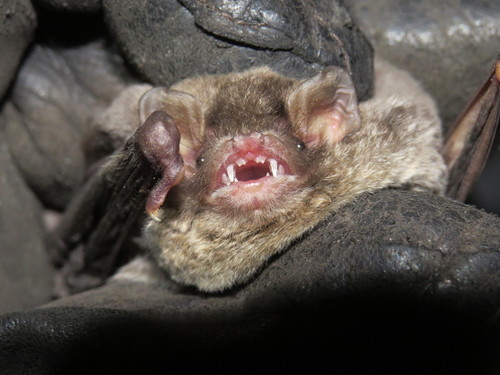
Gray big-eared bat

Gray big-eared bat

Plecotus austriacus

Silhouette: Andy Wilson · PhyloPic

LCNTNear ThreatenedVUENCR
Daily sighting probability ~10% · With luck
at Cévennes National Park

In 3 days ~20% in a week ~30%

13 Verified sightings at Cévennes National Park From 2019 to 2026
13 In 1 park
July Best month
☀️🌙 Day & Night When it's spotted

About the Gray big-eared bat

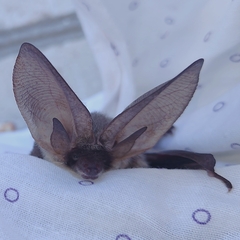
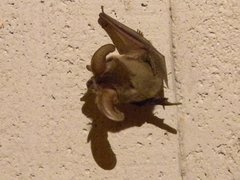
The grey long-eared bat (Plecotus austriacus) is a fairly large European bat. It has distinctive ears, long and with a distinctive fold. It hunts above woodland, often by day, and mostly for moths. In captivity, it has also been recorded to eat small lizards. It is extremely similar to the more common brown long-eared bat, and was only distinguished in the 1960s, but has a paler belly.

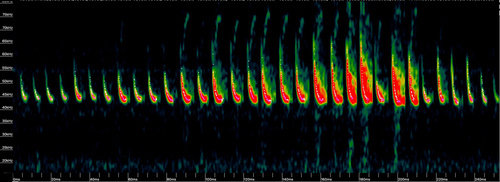
Its main foraging habitats are lowland meadows and marshes. It locates its insect prey via echolocation. The frequencies used by this bat species for echolocation lie between 18 and 45 kHz, have most energy at 28 kHz and have an average duration of 5.8 ms.

Distributed throughout all of Europe, except for the Scandinavian Peninsula. Although they are a near threatened species, they are more commonly found in Southern Europe. (To be more specific, woodlands and grasslands, as well as a few urban areas.)

It is currently listed as near-threatened by the IUCN. It has a large geographic range and it is considered relatively common. In most of the countries where it is found, it is protected from intentional harm by legislation.

While Continental... Wikipedia →

Global Distribution

Parks Where Found

# Park Country Daily sighting probability
1 Cévennes National Park 🇫🇷 France
~10%

More parks will be added in future updates.

Before you go

What are the chances of seeing a Gray big-eared bat in Cévennes National Park?

With luck

About 10% of wildlife watchers report a Gray big-eared bat sighting in Cévennes National Park on a given day, based on 13 verified sightings from GBIF citizen-science data from 2019 to 2026. It is the 29th most-seen of the 30 mammals we can rate there. Over three days the chance rises to about 20%, and over a week to about 30%, if each day is a fresh chance.

When is the best time to see a Gray big-eared bat in Cévennes National Park?

January, March, June–September and November

In those months about 10% of wildlife watchers report a Gray big-eared bat in Cévennes National Park on a given day, against under 5% in February, April–May, October and December, the lowest months.

What time of day is best to see a Gray big-eared bat?

Between 8 and 11 pm

Across all the parks we cover, that three-hour window holds the most Gray big-eared bat sightings with a recorded time, and about 6 in 10 of them come between 6 am and 6 pm: it is seen both by day and at night.

Where else can you see a Gray big-eared bat?

Only Cévennes National Park, in our data

Cévennes National Park is the only park on Wallace's Line with enough records to rate Gray big-eared bat sightings: about 10% of wildlife watchers there report one on a given day.

Which relatives of the Gray big-eared bat live in Cévennes National Park?

Same family: Vespertilionidae

The closest relatives of the Gray big-eared bat that you can see in Cévennes National Park (family Vespertilionidae, Evening Bats) are Common Pipistrelle (about 10%), Daubenton's bat (about 10%) and Pygmy Pipistrelle (about 10%), with each one's daily chance of a sighting.

Where does the Gray big-eared bat sighting chance come from?

GBIF citizen-science records

It is estimated from how often the Gray big-eared bat is recorded against all the mammals logged in Cévennes National Park (13 verified sightings from 2019 to 2026), calibrated against known sighting rates. Figures are rounded to the nearest 10% because citizen-science data supports honest approximations, not decimals, and months with records from fewer than five people show "—". How it works.

← Back to Cévennes National Park