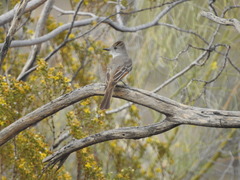
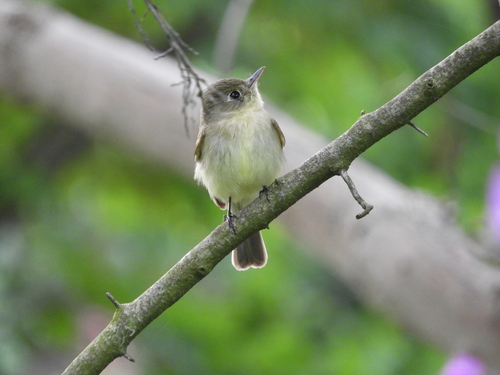
Ash-throated Flycatcher

Ash-throated Flycatcher

Myiarchus cinerascens

Silhouette: Ferran Sayol · PhyloPic

LCLeast ConcernNTVUENCR
Daily sighting probability <5% · Rare
at Channel Islands National Park

In 3 days ~10% in a week ~30%

266 Verified sightings at Channel Islands National Park From 2019 to 2026
9,109 In all 17 parks
May Best month
☀️ Diurnal When it's spotted

About the Ash-throated Flycatcher

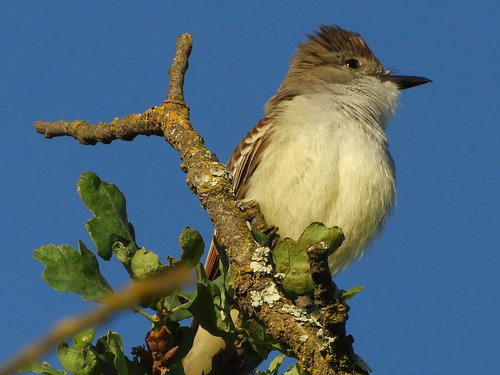
The ash-throated flycatcher (Myiarchus cinerascens) is a passerine bird in the tyrant flycatcher family. First described in 1851 by George Newbold Lawrence from a specimen collected in western Texas in the United States, the ash-throated flycatcher was initially given the scientific name Tyrannula cinerascens. The species was mistakenly described again in 1851 as Tyrannula mexicanus — an error that was corrected in 1859 when Philip Lutley Sclater analyzed the tyrant flycatchers known from Mexico and realized that both scientific names referred to the same species. During the same analysis, Slater moved the ash-throated flycatcher from the genus Tyrannula to its current genus, Myiarchus. In the past, the ash-throated flycatcher has sometimes been considered to be conspecific with Nutting's flycatcher, but there are morphological and vocal differences between the two. There is disagreement as to whether the two species hybridize.

The ash-throated flycatcher has two recognized subspecies: Wikipedia →

Sounds

Call0:48

United States · 2026

© Ed Pandolfino · XC1136840 · CC BY-NC-SA 4.0

Dawn song1:02

United States · 2023

© Richard E. Webster · XC941395 · CC BY-NC-SA 4.0

Alarm call0:09

United States · 2020

© Michael Morrison · XC585864 · CC BY-NC-SA 4.0

Global Distribution

Parks Where Found

# Park Country Daily sighting probability
1 Cabo Pulmo National Park 🇲🇽 Mexico
~60%
2 Big Bend National Park 🇺🇸 United States
~50%
3 Bahía de Loreto National Park 🇲🇽 Mexico
~30%
4 Guadalupe Mountains National Park 🇺🇸 United States
~30%
5 Zion National Park 🇺🇸 United States
~30%
6 Joshua Tree National Park 🇺🇸 United States
~20%
7 Saguaro National Park 🇺🇸 United States
~20%
8 Grand Canyon National Park 🇺🇸 United States
~20%
9 Sequoia and Kings Canyon National Parks 🇺🇸 United States
~10%
10 Death Valley National Park 🇺🇸 United States
~10%
11 El Vizcaíno Biosphere Reserve 🇲🇽 Mexico
~10%
12 Channel Islands National Park 🇺🇸 United States
<5%
13 Yosemite National Park 🇺🇸 United States
<5%
14 Cañón del Sumidero National Park 🇲🇽 Mexico
<5%
15 Everglades National Park 🇺🇸 United States
<5%
16 Cumbres de Monterrey National Park 🇲🇽 Mexico
<5%
17 Merritt Island National Wildlife Refuge 🇺🇸 United States
<5%

Cities Where Found

# City Country Daily sighting probability
1 Sacramento 🇺🇸 United States
~10%
2 Phoenix 🇺🇸 United States
~10%
3 León 🇲🇽 México
~10%
4 Mesa 🇺🇸 United States
<5%
5 Los Angeles 🇺🇸 United States
<5%
6 San Diego 🇺🇸 United States
<5%
7 Guadalajara 🇲🇽 México
<5%
8 Las Vegas 🇺🇸 United States
<5%
9 Mexico City 🇲🇽 México
<5%
10 Puebla 🇲🇽 México
<5%

Before you go

What are the chances of seeing an Ash-throated Flycatcher in Channel Islands National Park?

Rare

Under 5% of wildlife watchers report an Ash-throated Flycatcher sighting in Channel Islands National Park on a given day, based on 266 verified sightings from GBIF citizen-science data from 2019 to 2026. It is the 133rd most-seen of the 276 birds we can rate there. Over three days the chance rises to about 10%, and over a week to about 30%, if each day is a fresh chance.

When is the best time to see an Ash-throated Flycatcher in Channel Islands National Park?

April and May

In those months about 20% of wildlife watchers report an Ash-throated Flycatcher in Channel Islands National Park on a given day, against under 5% in July to March, the lowest months. Those are among Channel Islands National Park's driest months, with about 5 mm of rain a month against 60 mm in January.

What time of day is best to see an Ash-throated Flycatcher?

Between 7 and 10 am

Across all the parks we cover, that three-hour window holds the most Ash-throated Flycatcher sightings with a recorded time, and about 9 in 10 of them come between 6 am and 6 pm: it is a daytime animal.

Which relatives of the Ash-throated Flycatcher live in Channel Islands National Park?

Same family: Tyrannidae

The closest relatives of the Ash-throated Flycatcher that you can see in Channel Islands National Park (family Tyrannidae, Tyrant Flycatchers) are Black Phoebe (about 70%), Say's Phoebe (about 20%) and Pacific-slope Flycatcher (about 10%), with each one's daily chance of a sighting.

Where does the Ash-throated Flycatcher sighting chance come from?

GBIF citizen-science records

It is estimated from how often the Ash-throated Flycatcher is recorded against all the birds logged in Channel Islands National Park (266 verified sightings from 2019 to 2026), calibrated against known sighting rates. Figures are rounded to the nearest 10% because citizen-science data supports honest approximations, not decimals, and months with records from fewer than five people show "—". How it works.
← Back to Channel Islands National Park