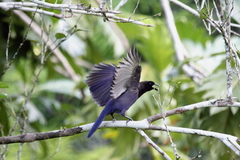
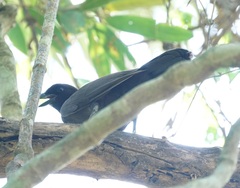
Purplish Jay

Purplish Jay

Cyanocorax cyanomelas

Silhouette: Sheatherius · PhyloPic

LCLeast ConcernNTVUENCR
Daily sighting probability ~40% · Likely
at Chapada dos Guimarães National Park

In 3 days ~80% in a week >90%

300 Verified sightings at Chapada dos Guimarães National Park From 2019 to 2026
3,415 In all 7 parks
October Best month
☀️ Diurnal When it's spotted

About the Purplish Jay

The purplish jay (Cyanocorax cyanomelas) is a species of bird in the family Corvidae, the crows and jays. It is found in Argentina, Bolivia, Brazil, Paraguay, Peru, and as a vagrant to Uruguay. The purplish jay was originally described in 1818 as Pica cyanomelas, mistakenly identifying it as a magpie.

The purplish jay is monotypic. Some authors treat the purplish jay and the azure jay (C. caeruleus) as a superspecies. The purplish jay is 37 to 40 cm (15 to 16 in) long and weighs about 185 to 220 g (6.5 to 7.8 oz). The sexes have the same plumage and both have a tuft of feathers at the base of the bill. Adults have a sooty black forecrown, sides of the head, throat, and upper breast. Their crown is purplish brown that becomes more purple on the nape. The rest of their body is bluish purple with a brownish wash, with the brightest shade on the remiges and uppertail coverts. Their rectrices are a dark violet-blue. As the body feathers wear they become browner and contrast more with the tail than when fresh. The species has a dark brown iris, a black bill, and black legs and feet.

The purplish jay is found in... Wikipedia →

Sounds

Recording0:40

Paraguay · 2023

© Guillermo Menéndez (gmmv80) · XC819199 · CC BY-NC-SA 4.0

Song0:22

Brazil · 2021

© Fernando Igor de Godoy · XC707633 · CC BY-NC-SA 4.0

Call0:50

Argentina · 2018

© Franco Vushurovich · XC647821 · CC BY-NC-SA 4.0

Global Distribution

Parks Where Found

# Park Country Daily sighting probability
1 Amboró National Park 🇧🇴 Bolivia
~80%
2 Chapada dos Guimarães National Park 🇧🇷 Brazil
~40%
3 Manu National Park 🇵🇪 Peru
~30%
4 Parque Estadual Encontro das Águas 🇧🇷 Brazil
~30%
5 Tambopata National Reserve 🇵🇪 Peru
~10%
6 Iguazú National Park 🇦🇷 Argentina
<5%
7 Iguaçu National Park 🇧🇷 Brazil
<5%

Cities Where Found

# City Country Daily sighting probability
1 Santa Cruz de la Sierra 🇧🇴 Bolivia
~40%
2 Campo Grande 🇧🇷 Brazil
<5%
3 Asuncion 🇵🇾 Paraguay
<5%

Zoos & Centres Where Found

# Zoo / Centre Country
1 Bioparque Municipal Vesty Pakos 🇧🇴 Bolivia In captivity
2 Zoológico de Fauna Sudamericana 🇧🇴 Bolivia In captivity

Before you go

What are the chances of seeing a Purplish Jay in Chapada dos Guimarães National Park?

Likely

About 40% of wildlife watchers report a Purplish Jay sighting in Chapada dos Guimarães National Park on a given day, based on 300 verified sightings from GBIF citizen-science data from 2019 to 2026. It is the 19th most-seen of the 273 birds we can rate there. Over three days the chance rises to about 80%, and over a week to over 90%, if each day is a fresh chance.

When is the best time to see a Purplish Jay in Chapada dos Guimarães National Park?

June and September–October

In those months about 50% of wildlife watchers report a Purplish Jay in Chapada dos Guimarães National Park on a given day, against about 20% in January and July, the lowest months. Those are among Chapada dos Guimarães National Park's driest months, with about 50 mm of rain a month against 240 mm in March. February to April have too few records to rate.

What time of day is best to see a Purplish Jay?

Between 3 and 6 pm

Across all the parks we cover, that three-hour window holds the most Purplish Jay sightings with a recorded time, and about 8 in 10 of them come between 6 am and 6 pm: it is a daytime animal.

Is Chapada dos Guimarães National Park the best place to see a Purplish Jay?

2nd of 7

Of the 7 parks where we can rate Purplish Jay sightings, Chapada dos Guimarães National Park ranks 2nd at about 40%. The best odds are in Amboró National Park (Bolivia, about 80%). All parks ranked.

Where does the Purplish Jay sighting chance come from?

GBIF citizen-science records

It is estimated from how often the Purplish Jay is recorded against all the birds logged in Chapada dos Guimarães National Park (300 verified sightings from 2019 to 2026), calibrated against known sighting rates. Figures are rounded to the nearest 10% because citizen-science data supports honest approximations, not decimals, and months with records from fewer than five people show "—". How it works.

← Back to Chapada dos Guimarães National Park