
Mountain Velvetbreast

Mountain Velvetbreast

Lafresnaya lafresnayi

Silhouette: Ferran Sayol · PhyloPic

LCLeast ConcernNTVUENCR
Daily sighting probability <5% · Rare
at Chingaza National Natural Park

In 3 days ~10% in a week ~30%

46 Verified sightings at Chingaza National Natural Park From 2019 to 2026
669 In all 4 parks
December Best month
☀️ Diurnal When it's spotted

About the Mountain Velvetbreast

The mountain velvetbreast (Lafresnaya lafresnayi) is a species of hummingbird in the "brilliants", tribe Heliantheini in subfamily Lesbiinae. It is found in Colombia, Ecuador, Peru, and Venezuela. The mountain velvetbreast is the only member of its genus. Seven subspecies are recognized:

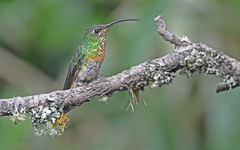
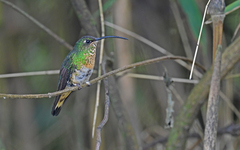
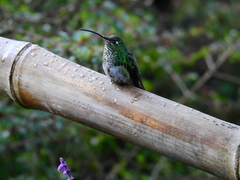
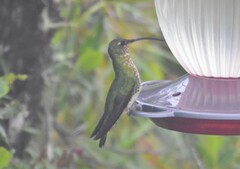
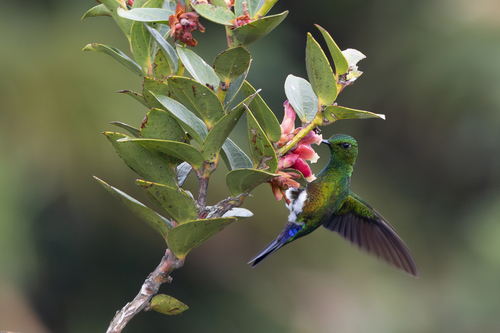
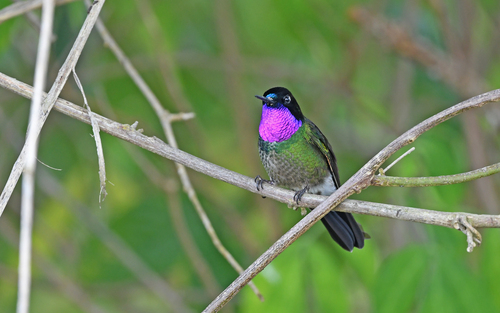
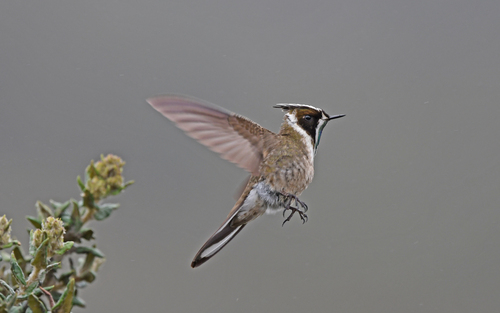
The mountain velvetbreast is 11.5 to 12 cm (4.5 to 4.7 in) long including its 2.7 to 3.2 cm (1.1 to 1.3 in) bill. It weighs 4.5 to 6.3 g (0.16 to 0.22 oz). Males have a thin decurved black bill whose length and curvature vary among the subspecies. The female's bill is less curved than the male's and also varies geographically. All subspecies have a white spot behind the eye.

Adult males of the nominate subspecies L. l. lafresnayi have grass green upperparts. Their throat... Wikipedia →

Sounds

Call0:21

Ecuador · 2025

© Manuel Sánchez-Nivicela · XC1157928 · CC BY-NC-ND 4.0

Flight call0:14

Ecuador · 2005

© Niels Krabbe · XC251032 · CC BY-SA 4.0

Uncertain0:09

Peru · 2019

© Javier Tavera · XC657777 · CC BY-NC-SA 4.0

Global Distribution

Parks Where Found

# Park Country Daily sighting probability
1 Los Nevados National Natural Park 🇨🇴 Colombia
~10%
2 Chingaza National Natural Park 🇨🇴 Colombia
<5%
3 Podocarpus National Park 🇪🇨 Ecuador
<5%
4 Farallones de Cali National Natural Park 🇨🇴 Colombia
<5%

Cities Where Found

# City Country Daily sighting probability
1 Quito 🇪🇨 Ecuador
<5%

Before you go

What are the chances of seeing a Mountain Velvetbreast in Chingaza National Natural Park?

Rare

Under 5% of wildlife watchers report a Mountain Velvetbreast sighting in Chingaza National Natural Park on a given day, based on 46 verified sightings from GBIF citizen-science data from 2019 to 2026. It is the 97th most-seen of the 258 birds we can rate there. Over three days the chance rises to about 10%, and over a week to about 30%, if each day is a fresh chance.

When is the best time to see a Mountain Velvetbreast in Chingaza National Natural Park?

December

In that month about 20% of wildlife watchers report a Mountain Velvetbreast in Chingaza National Natural Park on a given day, against under 5% in February–August and October–November, the lowest months. That is one of Chingaza National Natural Park's driest months, with about 130 mm of rain against 350 mm in April.

What time of day is best to see a Mountain Velvetbreast?

Between 8 and 11 am

Across all the parks we cover, that three-hour window holds the most Mountain Velvetbreast sightings with a recorded time, and about 9 in 10 of them come between 6 am and 6 pm: it is a daytime animal.

Is Chingaza National Natural Park the best place to see a Mountain Velvetbreast?

2nd of 4

Of the 4 parks where we can rate Mountain Velvetbreast sightings, Chingaza National Natural Park ranks 2nd at under 5%. The best odds are in Los Nevados National Natural Park (Colombia, about 10%).

Which relatives of the Mountain Velvetbreast live in Chingaza National Natural Park?

Same family: Trochilidae

The closest relatives of the Mountain Velvetbreast that you can see in Chingaza National Natural Park (family Trochilidae, Hummingbirds) are Tyrian Metaltail (about 60%), Glowing Puffleg (about 50%) and Bronze-tailed Thornbill (about 30%), with each one's daily chance of a sighting.

Where does the Mountain Velvetbreast sighting chance come from?

GBIF citizen-science records

It is estimated from how often the Mountain Velvetbreast is recorded against all the birds logged in Chingaza National Natural Park (46 verified sightings from 2019 to 2026), calibrated against known sighting rates. Figures are rounded to the nearest 10% because citizen-science data supports honest approximations, not decimals, and months with records from fewer than five people show "—". How it works.

← Back to Chingaza National Natural Park