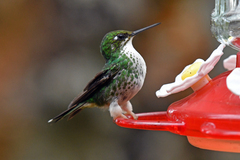
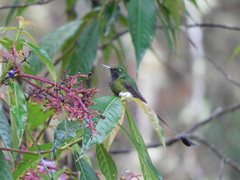
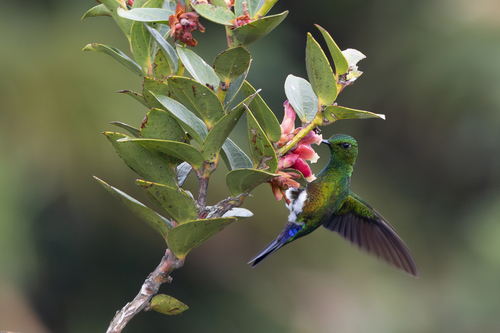
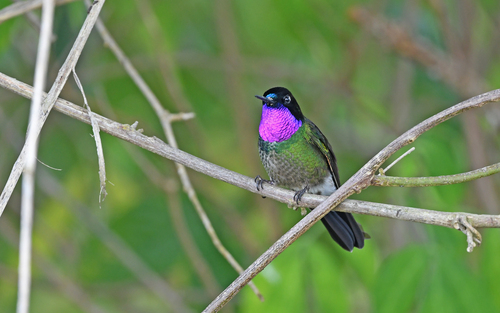
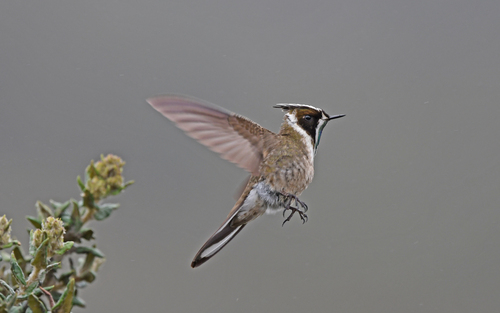
White-booted Racket-tail

White-booted Racket-tail

Ocreatus underwoodii

Silhouette: Edwin Price · PhyloPic

LCLeast ConcernNTVUENCR
Daily sighting probability <5% · Rare
at Chingaza National Natural Park

In 3 days ~10% in a week ~20%

26 Verified sightings at Chingaza National Natural Park From 2019 to 2026
767 In all 4 parks
May Best month
☀️ Diurnal When it's spotted

About the White-booted Racket-tail

The white-booted racket-tail (Ocreatus underwoodii) is a species of hummingbird in the "brilliants", tribe Heliantheini in subfamily Lesbiinae. It is found in Colombia, Ecuador, and Venezuela. The white-booted racket-tail, as defined by the International Ornithological Committee (IOC) and the Clements taxonomy, has five subspecies. They both include two more species in genus Ocreatus, the Peruvian racket-tail (O. peruanus) and the Rufous-booted racket-tail (O. addae). However, BirdLife International's Handbook of the Birds of the World (HBW) assigns the name "booted racket-tail" to O. underwoodii and includes those two taxa as subspecies of it. HBW also includes an eighth subspecies, O. u. annae. The South American Classification Committee of the American Ornithological Society (SACC) follows the eight-subspecies model but has requested a proposal to elevate puruanus, addae, and annae to species status.

The five subspecies recognized by the IOC are: Wikipedia →

Sounds

Call0:27

Ecuador · 2025

© Marc Anderson · XC987221 · CC BY-NC-ND 4.0

Flight call0:43

Ecuador · 2024

© Sue Riffe · XC924704 · CC BY-NC-SA 4.0

Recording1:26

Colombia · 2001

© Daniel Cadena (Colección de Sonidos Ambientales - Instituto Humboldt) · XC525725 · CC BY-NC-SA 4.0

Global Distribution

Parks Where Found

# Park Country Daily sighting probability
1 Farallones de Cali National Natural Park 🇨🇴 Colombia
~10%
2 Los Nevados National Natural Park 🇨🇴 Colombia
<5%
3 Chingaza National Natural Park 🇨🇴 Colombia
<5%
4 Henri Pittier National Park 🇻🇪 Venezuela
<5%

Cities Where Found

# City Country Daily sighting probability
1 Medellín 🇨🇴 Colombia
<5%
2 Caracas 🇻🇪 Venezuela
<5%

Before you go

What are the chances of seeing a White-booted Racket-tail in Chingaza National Natural Park?

Rare

Under 5% of wildlife watchers report a White-booted Racket-tail sighting in Chingaza National Natural Park on a given day, based on 26 verified sightings from GBIF citizen-science data from 2019 to 2026. It is the 125th most-seen of the 258 birds we can rate there. Over three days the chance rises to about 10%, and over a week to about 20%, if each day is a fresh chance.

When is the best time to see a White-booted Racket-tail in Chingaza National Natural Park?

January, March and May

In those months about 10% of wildlife watchers report a White-booted Racket-tail in Chingaza National Natural Park on a given day, against under 5% in February, April and June–December, the lowest months.

What time of day is best to see a White-booted Racket-tail?

Between 9 am and noon

Across all the parks we cover, that three-hour window holds the most White-booted Racket-tail sightings with a recorded time, and about 9 in 10 of them come between 6 am and 6 pm: it is a daytime animal.

Which relatives of the White-booted Racket-tail live in Chingaza National Natural Park?

Same family: Trochilidae

The closest relatives of the White-booted Racket-tail that you can see in Chingaza National Natural Park (family Trochilidae, Hummingbirds) are Tyrian Metaltail (about 60%), Glowing Puffleg (about 50%) and Bronze-tailed Thornbill (about 30%), with each one's daily chance of a sighting.

Where does the White-booted Racket-tail sighting chance come from?

GBIF citizen-science records

It is estimated from how often the White-booted Racket-tail is recorded against all the birds logged in Chingaza National Natural Park (26 verified sightings from 2019 to 2026), calibrated against known sighting rates. Figures are rounded to the nearest 10% because citizen-science data supports honest approximations, not decimals, and months with records from fewer than five people show "—". How it works.

← Back to Chingaza National Natural Park