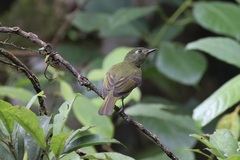
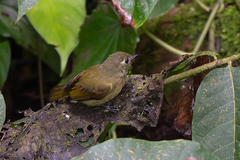
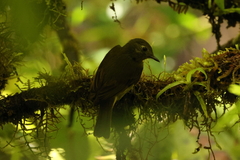
Olive-striped Flycatcher (Olive-streaked)

Olive-striped Flycatcher (Olive-streaked)

Mionectes olivaceus

Silhouette: Emily Willoughby · PhyloPic

LCLeast ConcernNTVUENCR
Daily sighting probability ~10% · With luck
at Chirripó National Park

In 3 days ~10% in a week ~30%

78 Verified sightings at Chirripó National Park From 2019 to 2026
4,873 In all 12 parks
December Best month
☀️ Diurnal When it's spotted

About the Olive-striped Flycatcher (Olive-streaked)

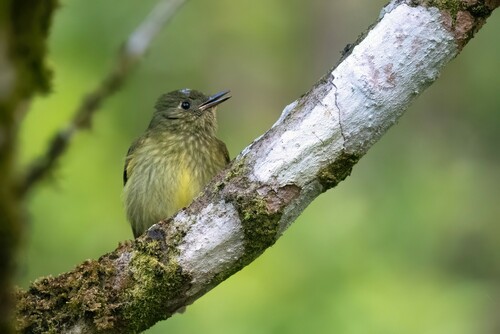
The olive-streaked flycatcher (Mionectes olivaceus) is a species of bird in the family Tyrannidae, the tyrant flycatchers. It is found in Costa Rica and Panama. The four subspecies of what is now the olive-striped flycatcher (Mionnectes galbinus) were previously treated as subspecies of what is now the olive-streaked flycatcher. (Confusingly, the original unsplit species was called the olive-striped flycatcher but bore the present olive-streaked flycatcher's binomial Mionectes olivaceus.) Based primarily on vocal differences the species were separated by taxonomic systems beginning in 2016, leaving the olive-streaked flycatcher as a monotypic species. However, as of late 2024, the North American and South American Classification Committees of the American Ornithological Society have not agreed to the split. They retain the olive-striped flycatcher/Mionectes olivaceus names.

This article follows the monotypic species model. The olive-streaked flycatcher is 13 cm (5.1 in) long. The sexes have the same plumage. Adults have a dark olive face with white streaks and a small triangular white spot behind the eye. Their crown and nape are dark... Wikipedia →

Sounds

Call0:10

Costa Rica · 2017

© Albert Lastukhin · XC1101499 · CC BY-NC-ND 4.0

Song0:33

Ecuador · 2025

© Marc Anderson · XC983012 · CC BY-NC-ND 4.0

Song0:09

Colombia · 2019

© Iván Lau · XC670190 · CC BY-NC-SA 4.0

Global Distribution

Parks Where Found

# Park Country Daily sighting probability
1 Monteverde Cloud Forest Reserve 🇨🇷 Costa Rica
~20%
2 Arenal Volcano National Park 🇨🇷 Costa Rica
~10%
3 Tapantí-Macizo de la Muerte National Park 🇨🇷 Costa Rica
~10%
4 Volcán Barú National Park 🇵🇦 Panama
~10%
5 Braulio Carrillo National Park 🇨🇷 Costa Rica
~10%
6 Chirripó National Park 🇨🇷 Costa Rica
~10%
7 Los Quetzales National Park 🇨🇷 Costa Rica
<5%
8 Poás Volcano National Park 🇨🇷 Costa Rica
<5%
9 La Amistad International Park (Panama) 🇵🇦 Panama
<5%
10 Tenorio Volcano National Park 🇨🇷 Costa Rica
<5%
11 Cahuita National Park 🇨🇷 Costa Rica
<5%
12 Rincón de la Vieja National Park 🇨🇷 Costa Rica
<5%

Cities Where Found

# City Country Daily sighting probability
1 San José 🇨🇷 Costa Rica
<5%

Before you go

What are the chances of seeing an Olive-striped Flycatcher (Olive-streaked) in Chirripó National Park?

With luck

About 10% of wildlife watchers report an Olive-striped Flycatcher (Olive-streaked) sighting in Chirripó National Park on a given day, based on 78 verified sightings from GBIF citizen-science data from 2019 to 2026. It is the 156th most-seen of the 332 birds we can rate there. Over three days the chance rises to about 10%, and over a week to about 30%, if each day is a fresh chance.

When is the best time to see an Olive-striped Flycatcher (Olive-streaked) in Chirripó National Park?

December

In that month about 20% of wildlife watchers report an Olive-striped Flycatcher (Olive-streaked) in Chirripó National Park on a given day, against under 5% in January to September, the lowest months. That is one of Chirripó National Park's driest months, with about 120 mm of rain against 690 mm in October.

What time of day is best to see an Olive-striped Flycatcher (Olive-streaked)?

Between 9 am and noon

Across all the parks we cover, that three-hour window holds the most Olive-striped Flycatcher (Olive-streaked) sightings with a recorded time, and about 9 in 10 of them come between 6 am and 6 pm: it is a daytime animal.

Where does the Olive-striped Flycatcher (Olive-streaked) sighting chance come from?

GBIF citizen-science records

It is estimated from how often the Olive-striped Flycatcher (Olive-streaked) is recorded against all the birds logged in Chirripó National Park (78 verified sightings from 2019 to 2026), calibrated against known sighting rates. Figures are rounded to the nearest 10% because citizen-science data supports honest approximations, not decimals, and months with records from fewer than five people show "—". How it works.
← Back to Chirripó National Park