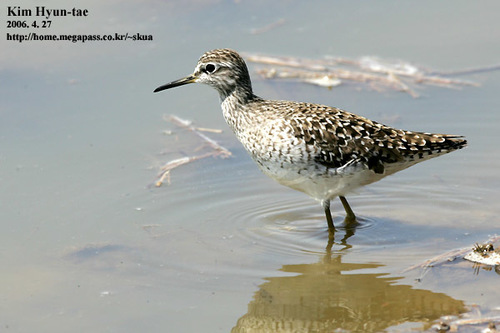
Pin-tailed Snipe

Pin-tailed Snipe

Gallinago stenura

Silhouette: Jamie Whitehouse · PhyloPic

LCLeast ConcernNTVUENCR
Daily sighting probability <5% · Rare
at Abu Dhabi

In 3 days <5% in a week ~10%

13 Verified sightings at Abu Dhabi
445 In all 10 parks From 2019 to 2026
October Best month
🌅 Crepuscular When it's spotted

About the Pin-tailed Snipe

The pin-tailed snipe or pintail snipe (Gallinago stenura) is a species of bird in the family Scolopacidae, the sandpipers. It breeds in northern Russia and migrates to spend the non-breeding season in southern Asia from Pakistan to Indonesia. It is the most common migrant snipe in southern India, Sri Lanka and much of Southeast Asia. It is a vagrant to north-western and northern Australia, and to Kenya in East Africa.

Its breeding habitat is damp marshes and tundra in Arctic and boreal Russia. Birds in their non-breeding range use a variety of wetlands, often with common snipe, but may be found also in drier habitats than their relative. They nest in a well-hidden location on the ground.

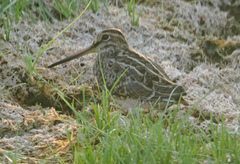
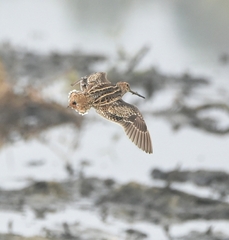
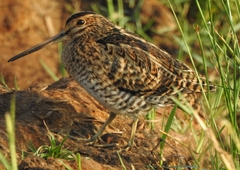
These birds forage in mud or soft soil, probing or picking up food by sight. They mainly eat insects and earthworms, but also some plant material. This 25–27 cm long bird is similar to the longer-billed and longer-tailed common snipe. Adults have short greenish-grey legs and a long straight dark bill. The body is mottled brown on top, with cream lines down their back. They are pale underneath with a streaked buff breast and white belly. They have a... Wikipedia →

Sounds

Call0:08

China · 2018

© Bo Shunqi 薄顺奇 · XC840942 · CC BY-NC-SA 4.0

Flight call0:23

Russian Federation · 2016

© Tom Wulf · XC327204 · CC BY-NC-SA 4.0

Song0:44

Russian Federation · 2019

© Benjamin Drillat · XC482752 · CC BY-NC-SA 4.0

Global Distribution

Parks Where Found

# Park Country Daily sighting probability
1 Wilpattu National Park 🇱🇰 Sri Lanka
~20%
2 Yala National Park 🇱🇰 Sri Lanka
~20%
3 Periyar National Park 🇮🇳 India
<5%
4 Udawalawe National Park 🇱🇰 Sri Lanka
<5%
5 Kaziranga National Park 🇮🇳 India
<5%
6 Horton Plains National Park 🇱🇰 Sri Lanka
<5%
7 Chitwan National Park 🇳🇵 Nepal
<5%
8 Manas National Park 🇮🇳 India
<5%
9 Nagarhole National Park 🇮🇳 India
<5%
10 Doi Inthanon National Park 🇹🇭 Thailand
<5%

Cities Where Found

# City Country Daily sighting probability
1 Thiruvananthapuram 🇮🇳 India
~10%
2 Kathmandu 🇳🇵 Nepal
<5%
3 Coimbatore 🇮🇳 India
<5%
4 Vasai-Virar 🇮🇳 India
<5%
5 Colombo [Sri Jayawardenepura Kotte] 🇱🇰 Sri Lanka
<5%
6 Kochi 🇮🇳 India
<5%
7 Kozhikode 🇮🇳 India
<5%
8 Abu Dhabi 🇦🇪 United Arab Emirates
<5%
9 Thrissur 🇮🇳 India
<5%
10 Ponnani 🇮🇳 India
<5%

Before you go

What are the chances of seeing a Pin-tailed Snipe in Abu Dhabi?

Rare

Under 5% of wildlife watchers report a Pin-tailed Snipe sighting in Abu Dhabi on a given day, based on 13 verified sightings from GBIF citizen-science data. It is the 123rd most-seen of the 159 birds we can rate there. Over three days the chance rises to under 5%, and over a week to about 10%, if each day is a fresh chance.

When is the best time to see a Pin-tailed Snipe in Abu Dhabi?

October

In that month about 10% of wildlife watchers report a Pin-tailed Snipe in Abu Dhabi on a given day, against under 5% in November to September, the lowest months.

What time of day is best to see a Pin-tailed Snipe?

Between 3 and 6 am

Across all the parks we cover, that three-hour window holds the most Pin-tailed Snipe sightings with a recorded time, and about half of them come between 6 pm and 6 am: it is most active around dawn and dusk.

Is Abu Dhabi the best place to see a Pin-tailed Snipe?

8th of 21

Of the 21 cities where we can rate Pin-tailed Snipe sightings, Abu Dhabi ranks 8th at under 5%. The best odds are in Thiruvananthapuram (India, about 10%), Kathmandu (Nepal, under 5%) and Coimbatore (India, under 5%).

Where does the Pin-tailed Snipe sighting chance come from?

GBIF citizen-science records

It is estimated from how often the Pin-tailed Snipe is recorded against all the birds logged in Abu Dhabi (13 verified sightings), calibrated against known sighting rates. Figures are rounded to the nearest 10% because citizen-science data supports honest approximations, not decimals, and months with records from fewer than five people show "—". How it works.

← Back to Abu Dhabi