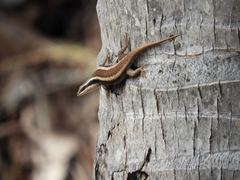
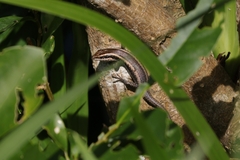
African Striped Skink

African Striped Skink

Trachylepis striata

Silhouette: David Orr · PhyloPic

LCLeast ConcernNTVUENCR
Daily sighting probability ~50% · Likely
at Addis Ababa

In 3 days ~80% in a week >90%

23 Verified sightings at Addis Ababa
910 In all 17 parks From 2019 to 2026
July Best month
☀️ Diurnal When it's spotted

About the African Striped Skink

The African striped skink (Trachylepis striata), commonly called the striped skink, is a species of lizard in the skink family (Scincidae). The species is widespread in East Africa and Southern Africa. It is not a close relation to the Australian striped skink, Ctenotus taeniolatus.

Both sexes grow to a total length (including tail) of 25 cm (9.8 in). Their tails are often missing due to predators. Striped Skink, Destination Kruger Park Media related to Trachylepis striata at Wikimedia Commons Boulenger GA (1887). Catalogue of the Lizards in the British Museum (Natural History). Second Edition. Volume III.... Scincidæ... London: Trustees of the British Museum (Natural History). (Taylor and Francis, printers). xii + 575 pp. + Plates I-XL. (Mabuia striata, pp. 204–205; Mabuia wahlbergii, pp. 205–206).

Branch, Bill (2004). Field Guide to Snakes and other Reptiles of Southern... Wikipedia →

Global Distribution

Parks Where Found

# Park Country Daily sighting probability
1 uMkhuze Game Reserve 🇿🇦 South Africa
~60%
2 Arusha National Park 🇹🇿 Tanzania
~40%
3 Kruger National Park 🇿🇦 South Africa
~30%
4 Gonarezhou National Park 🇿🇼 Zimbabwe
~30%
5 Hluhluwe-Imfolozi Park 🇿🇦 South Africa
~30%
6 Lake Nakuru National Park 🇰🇪 Kenya
~30%
7 Liwonde National Park 🇲🇼 Malawi
~30%
8 Kibale National Park 🇺🇬 Uganda
~30%
9 Gorongosa National Park 🇲🇿 Mozambique
~30%
10 Nairobi National Park 🇰🇪 Kenya
~30%
11 iSimangaliso Wetland Park 🇿🇦 South Africa
~30%
12 Amboseli National Park 🇰🇪 Kenya
~30%
13 Tarangire National Park 🇹🇿 Tanzania
~30%
14 Masai Mara National Reserve 🇰🇪 Kenya
~20%
15 Lake Mburo National Park 🇺🇬 Uganda
~20%
16 Serengeti National Park 🇹🇿 Tanzania
~20%
17 Ngorongoro Conservation Area 🇹🇿 Tanzania
~10%

Cities Where Found

# City Country Daily sighting probability
1 Maputo 🇲🇿 Mozambique
~60%
2 Lilongwe 🇲🇼 Malawi
~50%
3 Addis Ababa 🇪🇹 Ethiopia
~50%
4 Kigali 🇷🇼 Rwanda
~40%
5 Nairobi 🇰🇪 Kenya
~40%
6 Dar es-Salaam 🇹🇿 Tanzania
~30%
7 Durban 🇿🇦 South Africa
~30%

Closest Relatives at Addis Ababa

No species of the same family or order lives in Addis Ababa, so these are its closest relatives here: other reptiles.

Before you go

What are the chances of seeing an African Striped Skink in Addis Ababa?

Likely

About 50% of wildlife watchers report an African Striped Skink sighting in Addis Ababa on a given day, based on 23 verified sightings from GBIF citizen-science data. Over three days the chance rises to about 80%, and over a week to over 90%, if each day is a fresh chance.

When is the best time to see an African Striped Skink in Addis Ababa?

July–August and December

In those months about 70% of wildlife watchers report an African Striped Skink in Addis Ababa on a given day, against under 5% in March, the lowest month. Those are among Addis Ababa's wettest months, with about 170 mm of rain a month against 10 mm in January.

What time of day is best to see an African Striped Skink?

Between 11 am and 2 pm

Across all the parks we cover, that three-hour window holds the most African Striped Skink sightings with a recorded time, and nearly all of them come between 6 am and 6 pm: it is a daytime animal.

Is Addis Ababa the best place to see an African Striped Skink?

3rd of 7

Of the 7 cities where we can rate African Striped Skink sightings, Addis Ababa ranks 3rd at about 50%. The best odds are in Maputo (Mozambique, about 60%) and Lilongwe (Malawi, about 50%).

Where does the African Striped Skink sighting chance come from?

GBIF citizen-science records

It is estimated from how often the African Striped Skink is recorded against all the reptiles logged in Addis Ababa (23 verified sightings), calibrated against known sighting rates. Figures are rounded to the nearest 10% because citizen-science data supports honest approximations, not decimals, and months with records from fewer than five people show "—". How it works.

← Back to Addis Ababa