Painted Stork

Painted Stork

Mycteria leucocephala

Silhouette: Mathieu Basille · PhyloPic

LCLeast ConcernNTVUENCR
Daily sighting probability ~10% · With luck
at Aligarh

In 3 days ~20% in a week ~40%

22 Verified sightings at Aligarh
5,607 In all 14 parks From 2019 to 2026
February Best month
🌅 Crepuscular When it's spotted

About the Painted Stork

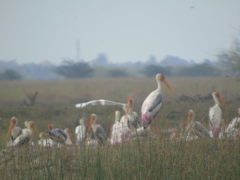
The painted stork (Mycteria leucocephala) is a large wader in the stork family. It is found in the wetlands of the plains of tropical Asia south of the Himalayas in the Indian subcontinent and extending into Southeast Asia. Their distinctive pink tertial feathers of the adults give them their name. They forage in flocks in shallow waters along rivers or lakes. They immerse their half open beaks in water and sweep them from side to side and snap up their prey of small fish that are sensed by touch. As they wade along they also stir the water with their feet to flush hiding fish. They nest colonially in trees, often along with other waterbirds. The only sounds they produce are weak moans or bill clattering at the nest. They are not migratory and only make short-distance movements in some parts of their range in response to changes in weather or food availability or for breeding. Like other storks, they are often seen soaring on thermals.

This large stork has a heavy yellow beak with a down-curved tip that gives it a resemblance to an ibis. The head of the adult is bare and orange or reddish in colour. The long tertials are tipped in bright pink and at rest they extend... Wikipedia →

Sounds

Begging call0:39

India · 2023

© Jelle Scharringa · XC787801 · CC BY-NC-SA 4.0

Call1:16

India · 2019

© Andrew Spencer · XC547488 · CC BY-NC-ND 4.0

Song0:35

India · 2001

© David Farrow · XC37574 · CC BY-NC-SA 3.0

Global Distribution

Parks Where Found

# Park Country Daily sighting probability
1 Keoladeo National Park 🇮🇳 India
~80%
2 Yala National Park 🇱🇰 Sri Lanka
~80%
3 Wilpattu National Park 🇱🇰 Sri Lanka
~70%
4 Udawalawe National Park 🇱🇰 Sri Lanka
~60%
5 Ranthambore National Park 🇮🇳 India
~30%
6 Bandipur National Park 🇮🇳 India
~20%
7 Gir National Park 🇮🇳 India
~20%
8 Minneriya National Park 🇱🇰 Sri Lanka
~20%
9 Nagarhole National Park 🇮🇳 India
~20%
10 Satpura National Park 🇮🇳 India
~10%
11 Bandhavgarh National Park 🇮🇳 India
~10%
12 Mudumalai National Park 🇮🇳 India
~10%
13 Kanha National Park 🇮🇳 India
<5%
14 Jim Corbett National Park 🇮🇳 India
<5%

Cities Where Found

# City Country Daily sighting probability
1 Vasai-Virar 🇮🇳 India
~40%
2 Chennai 🇮🇳 India
~30%
3 Agra 🇮🇳 India
~30%
4 Surat 🇮🇳 India
~20%
5 Mumbai 🇮🇳 India
~20%
6 Johor Bahru 🇲🇾 Malaysia
~20%
7 Kota 🇮🇳 India
~20%
8 Mysuru 🇮🇳 India
~20%
9 Rajkot 🇮🇳 India
~20%
10 Bengaluru 🇮🇳 India
~20%

Zoos & Centres Where Found

# Zoo / Centre Country
1 Disney's Animal Kingdom 🇺🇸 United States In captivity
2 Prague Zoo 🇨🇿 Czechia In captivity
3 Tierpark Berlin 🇩🇪 Germany In captivity
4 Zlín-Lešná Zoo 🇨🇿 Czechia In captivity
5 Vinpearl Safari 🇻🇳 Vietnam In captivity
6 Nandankanan Zoological Park 🇮🇳 India In captivity
7 Zoo Miami 🇺🇸 United States In captivity
8 Indroda Nature Park 🇮🇳 India In captivity
9 Nehru Zoological Park 🇮🇳 India In captivity
10 Chhatbir Zoo 🇮🇳 India In captivity
11 Bronx Zoo 🇺🇸 United States In captivity
12 Khao Kheow Open Zoo 🇹🇭 Thailand In captivity
13 Badoca Safari Park 🇵🇹 Portugal In captivity
14 National Zoological Park Delhi 🇮🇳 India In captivity
15 Indira Gandhi Zoological Park 🇮🇳 India In captivity
16 Safari World 🇹🇭 Thailand In captivity
17 Guangzhou Zoo 🇨🇳 China In captivity
18 Night Safari 🇸🇬 Singapore In captivity
19 National Zoo of Malaysia 🇲🇾 Malaysia In captivity
20 Singapore Zoo 🇸🇬 Singapore In captivity
21 Yadanabon Zoological Gardens 🇲🇲 Myanmar (Burma) In captivity
22 Jijamata Udyaan 🇮🇳 India In captivity
23 Alipore Zoological Gardens 🇮🇳 India In captivity
24 Kamla Nehru Prani Sangrahalay 🇮🇳 India In captivity
25 Saigon Zoo and Botanical Gardens 🇻🇳 Vietnam In captivity
26 Thiruvananthapuram Zoo 🇮🇳 India In captivity
27 Sayaji Baug Zoo 🇮🇳 India In captivity
28 Kuala Lumpur Bird Park 🇲🇾 Malaysia In captivity
29 River Wonders 🇸🇬 Singapore In captivity
30 Vogelpark Niendorf 🇩🇪 Germany In captivity
31 King's Garden 🇻🇳 Vietnam In captivity
32 Penang Bird Park 🇲🇾 Malaysia In captivity
33 Thrissur Zoo 🇮🇳 India In captivity
34 Rákosův pavilon 🇨🇿 Czechia In captivity
35 Velemlokárium 🇨🇿 Czechia In captivity
36 Aquaria KLCC 🇲🇾 Malaysia In captivity
37 Jaipur Zoo 🇮🇳 India In captivity
38 Khon Kaen Zoo 🇹🇭 Thailand In captivity

Before you go

What are the chances of seeing a Painted Stork in Aligarh?

With luck

About 10% of wildlife watchers report a Painted Stork sighting in Aligarh on a given day, based on 22 verified sightings from GBIF citizen-science data. It is the 58th most-seen of the 94 birds we can rate there. Over three days the chance rises to about 20%, and over a week to about 40%, if each day is a fresh chance.

When is the best time to see a Painted Stork in Aligarh?

February–March and November–December

In those months about 10% of wildlife watchers report a Painted Stork in Aligarh on a given day, against under 5% in January, April–June and August–October, the lowest months. Those are among Aligarh's driest months, with about 10 mm of rain a month against 220 mm in July. July has too few records to rate.

What time of day is best to see a Painted Stork?

Between 3 and 6 am

Across all the parks we cover, that three-hour window holds the most Painted Stork sightings with a recorded time, and about half of them come between 6 am and 6 pm: it is most active around dawn and dusk.

Is Aligarh the best place to see a Painted Stork?

30th of 47

Of the 47 cities where we can rate Painted Stork sightings, Aligarh ranks 30th at about 10%. The best odds are in Vasai-Virar (India, about 40%), Chennai (India, about 30%) and Agra (India, about 30%).

Where does the Painted Stork sighting chance come from?

GBIF citizen-science records

It is estimated from how often the Painted Stork is recorded against all the birds logged in Aligarh (22 verified sightings), calibrated against known sighting rates. Figures are rounded to the nearest 10% because citizen-science data supports honest approximations, not decimals, and months with records from fewer than five people show "—". How it works.

← Back to Aligarh