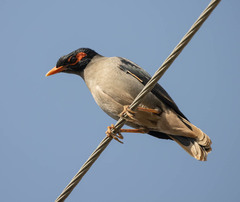
Bank Myna

Bank Myna

Acridotheres ginginianus

Silhouette: Andy Wilson · PhyloPic

LCLeast ConcernNTVUENCR
Daily sighting probability ~10% · With luck
at Asansol

In 3 days ~20% in a week ~50%

11 Verified sightings at Asansol
880 In all 10 parks From 2019 to 2026
November Best month
☀️ Diurnal When it's spotted

About the Bank Myna

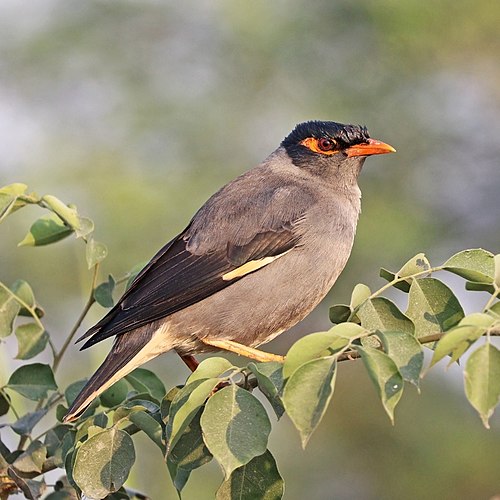
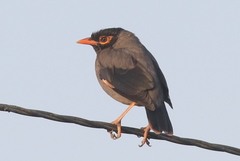
The bank myna (Acridotheres ginginianus) is a myna found in the northern parts of South Asia. It is smaller but similar in colouration to the common myna, only differing in having brick-red naked skin behind the eyes instead of yellow. It is greyer on the underside and in this and in the presence of a slight tuft of feathers bears some resemblance to the jungle myna. They are found in flocks on the plains of northern and central India, often within towns and cities. Their range appears to be extending southwards into India. The name is derived from their habit of nesting almost exclusively in the earthen banks of rivers, where they excavate burrows and breed in large colonies.

The head is black on the crown and sides and the upper plumage is slaty grey while the underside is lighter grey with pale pink plumage towards the centre of the abdomen. The wing is black but has a wing patch at the base of the primaries and the tips of the outer tail feathers are pale pinkish buff. The naked skin behind the eye is brick red, the legs are yellow while the iris is deep red. The sexes are indistinguishable in the field. Young birds have a browner head and neck.

The species is... Wikipedia →

Sounds

Call0:35

United Arab Emirates · 2021

© Oscar Campbell · XC633653 · CC BY-NC-ND 4.0

Song0:56

India · 2011

© vir joshi · XC95781 · CC BY-NC-ND 2.5

Call0:27

India · 2013

© Frank Lambert · XC149549 · CC BY-NC-ND 4.0

Global Distribution

Parks Where Found

# Park Country Daily sighting probability
1 Keoladeo National Park 🇮🇳 India
~20%
2 Ranthambore National Park 🇮🇳 India
~10%
3 Kaziranga National Park 🇮🇳 India
~10%
4 Bandhavgarh National Park 🇮🇳 India
~10%
5 Gir National Park 🇮🇳 India
<5%
6 Royal Bardia National Park 🇳🇵 Nepal
<5%
7 Jim Corbett National Park 🇮🇳 India
<5%
8 Chitwan National Park 🇳🇵 Nepal
<5%
9 Sundarbans National Park 🇮🇳 India
<5%
10 Kanha National Park 🇮🇳 India
<5%

Cities Where Found

# City Country Daily sighting probability
1 Ludhiana 🇮🇳 India
~40%
2 Agra 🇮🇳 India
~30%
3 Varanasi 🇮🇳 India
~30%
4 Prayagraj 🇮🇳 India
~30%
5 Vadodara 🇮🇳 India
~30%
6 Jaipur 🇮🇳 India
~30%
7 Lahore 🇵🇰 Pakistan
~20%
8 Rajkot 🇮🇳 India
~20%
9 Jamshedpur 🇮🇳 India
~20%
10 Riyadh 🇸🇦 Saudi Arabia
~10%

Zoos & Centres Where Found

# Zoo / Centre Country
1 ZooParc de Beauval 🇫🇷 France In captivity
2 Deer Park 🇮🇳 India In captivity
3 Haus des Meeres 🇦🇹 Austria In captivity

Before you go

What are the chances of seeing a Bank Myna in Asansol?

With luck

About 10% of wildlife watchers report a Bank Myna sighting in Asansol on a given day, based on 11 verified sightings from GBIF citizen-science data. It is the 60th most-seen of the 68 birds we can rate there. Over three days the chance rises to about 20%, and over a week to about 50%, if each day is a fresh chance.

When is the best time to see a Bank Myna in Asansol?

May, July and November

In those months about 20% of wildlife watchers report a Bank Myna in Asansol on a given day, against under 5% in January to April, the lowest months. June and September have too few records to rate.

What time of day is best to see a Bank Myna?

Between 6 and 9 am

Across all the parks we cover, that three-hour window holds the most Bank Myna sightings with a recorded time, and about 9 in 10 of them come between 6 am and 6 pm: it is a daytime animal.

Is Asansol the best place to see a Bank Myna?

18th of 39

Of the 39 cities where we can rate Bank Myna sightings, Asansol ranks 18th at about 10%. The best odds are in Ludhiana (India, about 40%), Agra (India, about 30%) and Varanasi (India, about 30%).

Where does the Bank Myna sighting chance come from?

GBIF citizen-science records

It is estimated from how often the Bank Myna is recorded against all the birds logged in Asansol (11 verified sightings), calibrated against known sighting rates. Figures are rounded to the nearest 10% because citizen-science data supports honest approximations, not decimals, and months with records from fewer than five people show "—". How it works.
← Back to Asansol