

Cururu Toad

Cururu Toad

Rhinella diptycha

Silhouette: Dennis C. Murphy, after http://bit.ly/4q6IESe · PhyloPic

LCLeast ConcernNTVUENCR
Daily sighting probability ~30% · Possible
at Asuncion

In 3 days ~70% in a week ~90%

18 Verified sightings at Asuncion
113 In all 8 parks From 2019 to 2026
January Best month
🌙 Nocturnal When it's spotted

About the Cururu Toad

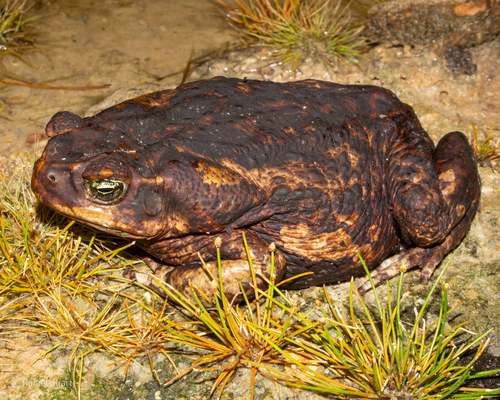
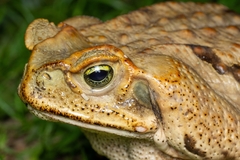
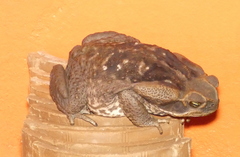
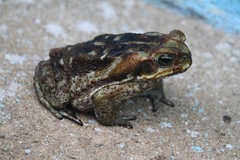
Rhinella diptycha, sometimes referred to as Cope's toad, Schneider's toad, cururu toad, or rococo toad, is a toad found in northern Argentina, Paraguay, Uruguay, eastern Bolivia, and eastern and southern Brazil. It is one of three rather similar species sometimes referred to as "cururu toads" in Brazil, the others being R. jimi and R. marina (cane toad). Like those, R. diptycha is a large toad, females up to 25 cm (9.8 in) in snout–to–vent length and males up to 18 cm (7.1 in).

Rhinella diptycha is a widespread and very common species that occurs in a variety of habitats but most commonly in open and urban ones. It breeds in permanent and temporary ponds, preferring ones without much vegetation. Its natural habitats include dry savanna, freshwater marshes, and intermittent freshwater marshes. It is threatened by habitat loss. It is sometimes kept as a pet, but pet trade is not occurring at levels that would constitute a threat. Wikipedia →

Sounds

Advertisement call1:27

Argentina · 2025

© Guillaume Dillenseger · XC1039651 · CC BY-NC-SA 4.0

Recording0:21

Brazil · 2026

© Tori Veiga de Araújo · iNaturalist · CC BY-NC 4.0

Recording0:30

Brazil · 2022

© charlesavenengo · iNaturalist · CC BY-NC 4.0

Global Distribution

Parks Where Found

# Park Country Daily sighting probability
1 Iberá National Park 🇦🇷 Argentina
~40%
2 Chapada Diamantina National Park 🇧🇷 Brazil
~40%
3 El Impenetrable National Park 🇦🇷 Argentina
~30%
4 Chapada dos Guimarães National Park 🇧🇷 Brazil
~30%
5 El Palmar National Park 🇦🇷 Argentina
~30%
6 Emas National Park 🇧🇷 Brazil
~20%
7 Iguazú National Park 🇦🇷 Argentina
~10%
8 Iguaçu National Park 🇧🇷 Brazil
~10%

Cities Where Found

# City Country Daily sighting probability
1 Santa Cruz de la Sierra 🇧🇴 Bolivia
~50%
2 Recife 🇧🇷 Brazil
~40%
3 Salvador 🇧🇷 Brazil
~30%
4 Asuncion 🇵🇾 Paraguay
~30%
5 Goiânia 🇧🇷 Brazil
~30%
6 João Pessoa 🇧🇷 Brazil
~20%
7 Campo Grande 🇧🇷 Brazil
~20%
8 Maceió 🇧🇷 Brazil
~20%
9 Brasilia 🇧🇷 Brazil
~20%
10 Fortaleza 🇧🇷 Brazil
~10%

Zoos & Centres Where Found

# Zoo / Centre Country
1 São Paulo Zoo 🇧🇷 Brazil In captivity
2 Simba Safari 🇧🇷 Brazil In captivity
3 Ménagerie du Jardin des Plantes 🇫🇷 France In captivity
4 Dierenpark Zie-ZOO 🇳🇱 Netherlands In captivity

Before you go

What are the chances of seeing a Cururu Toad in Asuncion?

Possible

About 30% of wildlife watchers report a Cururu Toad sighting in Asuncion on a given day, based on 18 verified sightings from GBIF citizen-science data. Over three days the chance rises to about 70%, and over a week to about 90%, if each day is a fresh chance.

When is the best time to see a Cururu Toad in Asuncion?

November to January

In those months about 50% of wildlife watchers report a Cururu Toad in Asuncion on a given day, against under 5% in April and June–August, the lowest months.

What time of day is best to see a Cururu Toad?

Between 7 and 10 pm

Across all the parks we cover, that three-hour window holds the most Cururu Toad sightings with a recorded time, and about 7 in 10 of them come between 6 pm and 6 am: it is mostly seen at night.

Is Asuncion the best place to see a Cururu Toad?

4th of 11

Of the 11 cities where we can rate Cururu Toad sightings, Asuncion ranks 4th at about 30%. The best odds are in Santa Cruz de la Sierra (Bolivia, about 50%), Recife (Brazil, about 40%) and Salvador (Brazil, about 30%).

Where does the Cururu Toad sighting chance come from?

GBIF citizen-science records

It is estimated from how often the Cururu Toad is recorded against all the amphibians logged in Asuncion (18 verified sightings), calibrated against known sighting rates. Figures are rounded to the nearest 10% because citizen-science data supports honest approximations, not decimals, and months with records from fewer than five people show "—". How it works.

← Back to Asuncion