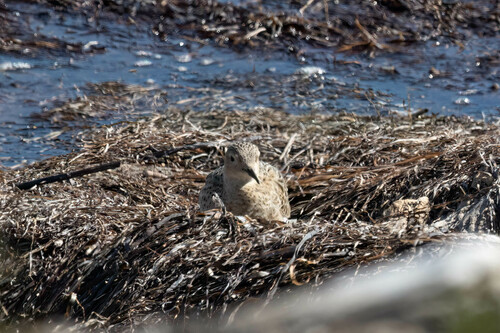
Yellow-billed Tern

Yellow-billed Tern

Sternula superciliaris

Silhouette: Sheatherius · PhyloPic

LCLeast ConcernNTVUENCR
Daily sighting probability <5% · Rare
at Asuncion

In 3 days ~10% in a week ~20%

57 Verified sightings at Asuncion
3,002 In all 10 parks From 2019 to 2026
November Best month
☀️ Diurnal When it's spotted

About the Yellow-billed Tern

The yellow-billed tern (Sternula superciliaris) is a small seabird found in South America. It is a species of tern in the family Laridae. It is found in Argentina, Bolivia, Brazil, Colombia, Ecuador, French Guiana, Guyana, Panama, Paraguay, Peru, Suriname, Trinidad and Tobago, Uruguay, and Venezuela.

Its natural habitats are rivers, swamps, and freshwater lakes. It measures approximately 23–25 centimeters in body length and weighs 40–57 grams. It has a yellow beak and feet, silvery grey wings and white underbody and forehead. Its crown, nape, and eyeline are black. Juveniles are brown and white without the black cap.

It frequently nests alongside colonies of the large-billed tern (Phaetusa simplex) and the black skimmer (Rynchops niger). The yellow-billed tern breeds from August to December on sand banks and island beaches. Non-breeding season habitats include coastal lagoons, river mouths, and rice fields. Their nests consist of shallow scrapes in the sand. Most commonly a clutch contains 2 eggs, but the yellow-billed tern can lay anywhere between 1–4 eggs. The incubation period is approximately 24 days. Nests are usually formed very close to each other... Wikipedia →

Sounds

Call0:16

Brazil · 2025

© Joost van Bruggen · XC1050667 · CC BY-NC-ND 4.0

Duet0:12

Brazil · 2025

© JAYRSON ARAUJO DE OLIVEIRA · XC1045146 · CC BY-NC-SA 4.0

Alarm call0:27

Argentina · 2020

© Guillermo Treboux · XC630543 · CC BY-NC-SA 4.0

Global Distribution

Parks Where Found

# Park Country Daily sighting probability
1 Parque Estadual Encontro das Águas 🇧🇷 Brazil
~70%
2 Anavilhanas National Park 🇧🇷 Brazil
~10%
3 Cuyabeno Wildlife Reserve 🇪🇨 Ecuador
~10%
4 El Impenetrable National Park 🇦🇷 Argentina
~10%
5 Manu National Park 🇵🇪 Peru
~10%
6 Tambopata National Reserve 🇵🇪 Peru
~10%
7 Amacayacu National Natural Park 🇨🇴 Colombia
~10%
8 Iberá National Park 🇦🇷 Argentina
<5%
9 Yasuní National Park 🇪🇨 Ecuador
<5%
10 Sierra de la Macarena National Park 🇨🇴 Colombia
<5%

Cities Where Found

# City Country Daily sighting probability
1 Barranquilla 🇨🇴 Colombia
~10%
2 Rosario 🇦🇷 Argentina
<5%
3 Asuncion 🇵🇾 Paraguay
<5%
4 Santa Cruz de la Sierra 🇧🇴 Bolivia
<5%
5 Montevideo 🇺🇾 Uruguay
<5%
6 Rio de Janeiro 🇧🇷 Brazil
<5%
7 Buenos Aires 🇦🇷 Argentina
<5%

Before you go

What are the chances of seeing a Yellow-billed Tern in Asuncion?

Rare

Under 5% of wildlife watchers report a Yellow-billed Tern sighting in Asuncion on a given day, based on 57 verified sightings from GBIF citizen-science data. It is the 128th most-seen of the 224 birds we can rate there. Over three days the chance rises to about 10%, and over a week to about 20%, if each day is a fresh chance.

When is the best time to see a Yellow-billed Tern in Asuncion?

September and November

In those months about 10% of wildlife watchers report a Yellow-billed Tern in Asuncion on a given day, against under 5% in October and December–August, the lowest months.

What time of day is best to see a Yellow-billed Tern?

Between 3 and 6 pm

Across all the parks we cover, that three-hour window holds the most Yellow-billed Tern sightings with a recorded time, and about 9 in 10 of them come between 6 am and 6 pm: it is a daytime animal.

Is Asuncion the best place to see a Yellow-billed Tern?

3rd of 7

Of the 7 cities where we can rate Yellow-billed Tern sightings, Asuncion ranks 3rd at under 5%. The best odds are in Barranquilla (Colombia, about 10%) and Rosario (Argentina, under 5%).

Where does the Yellow-billed Tern sighting chance come from?

GBIF citizen-science records

It is estimated from how often the Yellow-billed Tern is recorded against all the birds logged in Asuncion (57 verified sightings), calibrated against known sighting rates. Figures are rounded to the nearest 10% because citizen-science data supports honest approximations, not decimals, and months with records from fewer than five people show "—". How it works.

← Back to Asuncion