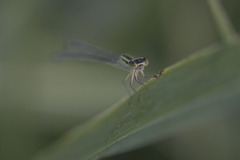
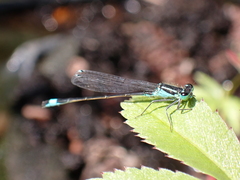
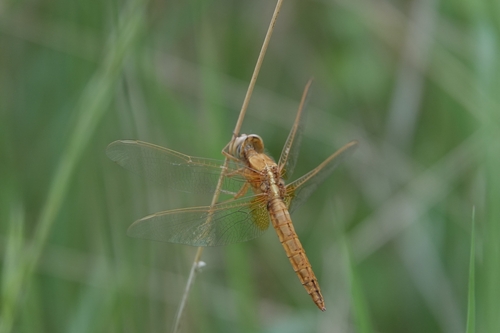
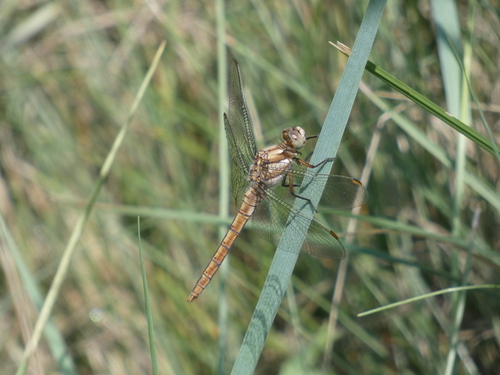
Blue-Tailed Damselfly

Blue-Tailed Damselfly

Ischnura elegans

Daily sighting probability ~10% · With luck
at Athens

In 3 days ~20% in a week ~40%

6 Verified sightings at Athens
338 In all 12 parks From 2019 to 2026
June Best month
☀️ Diurnal When it's spotted

About the Blue-Tailed Damselfly

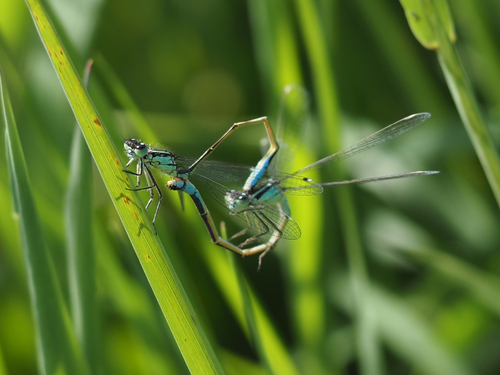
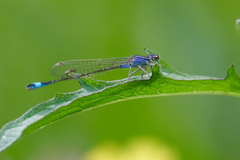
The blue-tailed damselfly or common bluetail (Ischnura elegans) is a damselfly, belonging to the family Coenagrionidae. Ischnura elegans pontica Schmidt, 1939 Ischnura elegans f. infuscans Ischnura elegans f. infuscans-obsoleta Ischnura elegans f. rufescens Ischnura elegans f. typica Ischnura elegans f. violacea This species is present in most of Europe and the Middle East. It is a common species.

These damselflies can be found in a wide range of lowland environments, with standing and slow flowing waters, brackish and polluted water. Ischnura elegans can reach a body length of 27–35 millimetres (1.1–1.4 in) and a wingspan of about 35 millimetres (1.4 in). Hindwings reach a length of 14–20 millimetres (0.55–0.79 in). Adult male blue-tailed damselflies have a head and thorax patterned with blue and black. There is a bi-coloured pterostigma on the front wings. Eyes are blue. They have a largely black abdomen with very narrow pale markings where each segment joins the next. Segment eight... Wikipedia →

Global Distribution

Parks Where Found

# Park Country Daily sighting probability
1 Kiskunság National Park 🇭🇺 Hungary
~40%
2 Hortobágy National Park 🇭🇺 Hungary
~40%
3 Camargue 🇫🇷 France
~30%
4 Fertő-Hanság National Park 🇭🇺 Hungary
~30%
5 Bavarian Forest National Park 🇩🇪 Germany
~10%
6 Triglav National Park 🇸🇮 Slovenia
~10%
7 Vanoise National Park 🇫🇷 France
~10%
8 Wadden Sea National Park 🇩🇪 Germany
~10%
9 Cairngorms National Park 🇬🇧 United Kingdom
~10%
10 Snowdonia National Park 🇬🇧 United Kingdom
~10%
11 Cévennes National Park 🇫🇷 France
<5%
12 Pyrénées National Park 🇫🇷 France
<5%

Cities Where Found

# City Country Daily sighting probability
1 Antalya 🇹🇷 Turkey
~40%
2 Brussels 🇧🇪 Belgium
~30%
3 Milan 🇮🇹 Italy
~30%
4 Rostov-on-Don 🇷🇺 Russia
~20%
5 Kharkiv 🇺🇦 Ukraine
~20%
6 Paris 🇫🇷 France
~20%
7 Jerusalem 🇮🇱 Israel
~20%
8 Leeds 🇬🇧 United Kingdom
~20%
9 Birmingham 🇬🇧 United Kingdom
~20%
10 Rotterdam [The Hague] 🇳🇱 Netherlands
~20%

Before you go

What are the chances of seeing a Blue-Tailed Damselfly in Athens?

With luck

About 10% of wildlife watchers report a Blue-Tailed Damselfly sighting in Athens on a given day, based on 6 verified sightings from GBIF citizen-science data. It is the 162nd most-seen of the 242 insects we can rate there. Over three days the chance rises to about 20%, and over a week to about 40%, if each day is a fresh chance.

When is the best time to see a Blue-Tailed Damselfly in Athens?

May–July and September

In those months about 10% of wildlife watchers report a Blue-Tailed Damselfly in Athens on a given day, against under 5% in August and October–April, the lowest months. Those are among Athens's driest months, with about 20 mm of rain a month against 85 mm in December.

What time of day is best to see a Blue-Tailed Damselfly?

Between 11 am and 2 pm

Across all the parks we cover, that three-hour window holds the most Blue-Tailed Damselfly sightings with a recorded time, and about 9 in 10 of them come between 6 am and 6 pm: it is a daytime animal.

Is Athens the best place to see a Blue-Tailed Damselfly?

39th of 42

Of the 42 cities where we can rate Blue-Tailed Damselfly sightings, Athens ranks 39th at about 10%. The best odds are in Antalya (Turkey, about 40%), Brussels (Belgium, about 30%) and Milan (Italy, about 30%).

Which relatives of the Blue-Tailed Damselfly live in Athens?

Same order: Odonata

The closest relatives of the Blue-Tailed Damselfly that you can see in Athens (order Odonata, Dragonflies and Damselflies) are Keeled Skimmer (about 20%), Nomad (about 10%) and Violet Dropwing (about 10%), with each one's daily chance of a sighting.

Where does the Blue-Tailed Damselfly sighting chance come from?

GBIF citizen-science records

It is estimated from how often the Blue-Tailed Damselfly is recorded against all the insects logged in Athens (6 verified sightings), calibrated against known sighting rates. Figures are rounded to the nearest 10% because citizen-science data supports honest approximations, not decimals, and months with records from fewer than five people show "—". How it works.
← Back to Athens