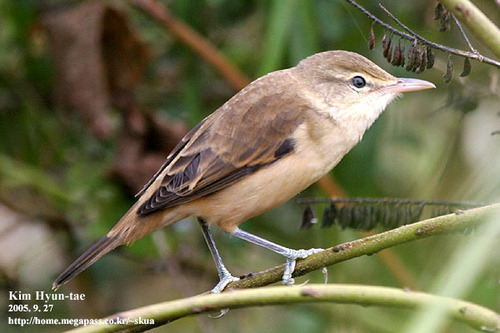
Thick-billed Warbler

Thick-billed Warbler

Iduna aedon

Silhouette: Sheatherius · PhyloPic

Daily sighting probability <5% · Rare
at Beijing

In 3 days ~10% in a week ~20%

172 Verified sightings at Beijing
680 In all 12 parks From 2019 to 2026
May Best month
☀️ Diurnal When it's spotted

About the Thick-billed Warbler

The thick-billed warbler (Arundinax aedon) breeds in the temperate east Palearctic, from south Siberia to west Mongolia. It is migratory, wintering in tropical South Asia and South-east Asia. It is a very rare vagrant to western Europe.

This passerine bird is a species found in dense vegetation such as reeds, bushes and thick undergrowth. Five or six eggs are laid in a nest in a low tree. This is a large warbler, at 16–17.5 cm (6.3–6.9 in) long, which is nearly as big as the great reed warbler. The adult has an unstreaked brown back and buff underparts, with few obvious distinctive plumage features. The forehead is rounded, and the bill is short and pointed. The sexes are identical, as with most warblers, but young birds are richer buff below. Like most warblers, it is insectivorous, but will take other small prey items.

The song is fast and loud, and similar to the marsh warbler, with much mimicry and typically acrocephaline whistles added. It was sometimes placed in the monotypic genus Phragmaticola (or Phragamaticola) and for a long time as Acrocephalus and in 2009 suggested as being within the Iduna clade. However, a 2014 phylogeny study based on more loci indicated that it did not fit into the Iduna clade, and therefore suggested a resurrection of the genus Phragamaticola or Arundinax; the latter, being the older available genus name, has priority.

The genus Arundinax is from Latin arundo, arundinis meaning "reed" and Ancient Greek anax which means "master". The specific aedon is from Ancient Greek aedon and means nightingale. In Greek mythology, Queen Aëdon was changed into a nightingale after killing her own son Itylus while attempting to murder one of the sons of her sister-in-law Niobe. Wikipedia →


Sounds

Recording0:15

China · 2023

© wresy · iNaturalist · CC BY-NC 4.0

Recording0:14

China · 2025

© Amaël Borzée · iNaturalist · CC BY-NC 4.0

Recording0:14

Russia · 2023

© Natalia Ivanova · iNaturalist · CC BY-NC 4.0

Global Distribution

Parks Where Found

# Park Country Daily sighting probability
1 Manas National Park 🇮🇳 India
~10%
2 Gobi Gurvansaikhan National Park 🇲🇳 Mongolia
~10%
3 Kaeng Krachan National Park 🇹🇭 Thailand
~10%
4 Kaziranga National Park 🇮🇳 India
<5%
5 Chitwan National Park 🇳🇵 Nepal
<5%
6 Periyar National Park 🇮🇳 India
<5%
7 Doi Inthanon National Park 🇹🇭 Thailand
<5%
8 Khao Yai National Park 🇹🇭 Thailand
<5%
9 Mudumalai National Park 🇮🇳 India
<5%
10 Royal Manas National Park 🇧🇹 Bhutan
<5%
11 Sundarbans National Park 🇮🇳 India
<5%
12 Nagarhole National Park 🇮🇳 India
<5%

Cities Where Found

# City Country Daily sighting probability
1 Tamluk 🇮🇳 India
~10%
2 Jinan 🇨🇳 China
~10%
3 Guwahati 🇮🇳 India
~10%
4 Kathmandu 🇳🇵 Nepal
~10%
5 Yangon 🇲🇲 Myanmar
<5%
6 Dhaka 🇧🇩 Bangladesh
<5%
7 Bangkok 🇹🇭 Thailand
<5%
8 Beijing 🇨🇳 China
<5%
9 Phnom Penh 🇰🇭 Cambodia
<5%
10 Kolkata 🇮🇳 India
<5%

Before you go

What are the chances of seeing a Thick-billed Warbler in Beijing?

Rare

Under 5% of wildlife watchers report a Thick-billed Warbler sighting in Beijing on a given day, based on 172 verified sightings from GBIF citizen-science data. It is the 147th most-seen of the 324 birds we can rate there. Over three days the chance rises to about 10%, and over a week to about 20%, if each day is a fresh chance.

When is the best time to see a Thick-billed Warbler in Beijing?

May and August–September

In those months about 10% of wildlife watchers report a Thick-billed Warbler in Beijing on a given day, against under 5% in June–July and October–April, the lowest months. Those are among Beijing's wettest months, with about 70 mm of rain a month against almost none in January.

What time of day is best to see a Thick-billed Warbler?

Between 7 and 10 am

Across all the parks we cover, that three-hour window holds the most Thick-billed Warbler sightings with a recorded time, and about 8 in 10 of them come between 6 am and 6 pm: it is a daytime animal.

Is Beijing the best place to see a Thick-billed Warbler?

8th of 17

Of the 17 cities where we can rate Thick-billed Warbler sightings, Beijing ranks 8th at under 5%. The best odds are in Tamluk (India, about 10%), Jinan (China, about 10%) and Guwahati (India, about 10%).

Which relatives of the Thick-billed Warbler live in Beijing?

Same family: Acrocephalidae

The closest relatives of the Thick-billed Warbler that you can see in Beijing (family Acrocephalidae, Reed Warblers and Allies) are Oriental Reed-Warbler (about 10%) and Black-browed Reed Warbler (about 10%), with each one's daily chance of a sighting.

Where does the Thick-billed Warbler sighting chance come from?

GBIF citizen-science records

It is estimated from how often the Thick-billed Warbler is recorded against all the birds logged in Beijing (172 verified sightings), calibrated against known sighting rates. Figures are rounded to the nearest 10% because citizen-science data supports honest approximations, not decimals, and months with records from fewer than five people show "—". How it works.

← Back to Beijing