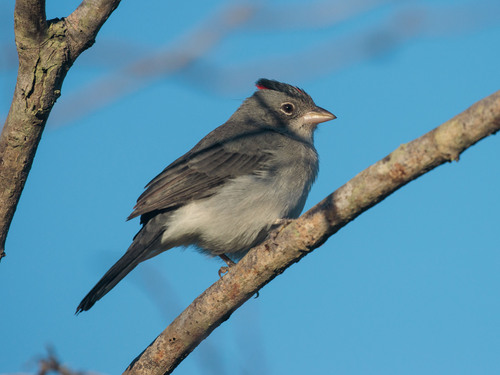
Ruby-crowned Tanager

Ruby-crowned Tanager

Tachyphonus coronatus

Silhouette: Sheatherius · PhyloPic

LCLeast ConcernNTVUENCR
Daily sighting probability <5% · Rare
at Belo Horizonte

In 3 days ~10% in a week ~20%

49 Verified sightings at Belo Horizonte
3,469 In all 6 parks From 2019 to 2026
May Best month
☀️ Diurnal When it's spotted

About the Ruby-crowned Tanager

The ruby-crowned tanager (Tachyphonus coronatus) is a species of bird in the family Thraupidae, the tanagers and allies. It is found in Argentina, Brazil, Paraguay, and as a vagrant to Uruguay. The ruby-crowned tanager was formally described in 1822 with the binomial Agelaius Coronatus [sic], mistakenly classifying it as a New World blackbird. It now shares the genus Tachyphonus with four other species and is sister to the white-lined tanager (T. rufus).

The ruby-crowned tanager is monotypic. The ruby-crowned tanager is about 16 cm (6.3 in) long and weighs 26 to 33 g (0.92 to 1.2 oz). The species is sexually dimorphic. Adult males are mostly glossy blue-black. They have the eponymous red patch in the center of their crown, though it is usually hidden except during a display. They sometimes have a white patch on the scapulars that also is seldom visible. Their underwing coverts are white and show well in flight. Adult females have a grayish head. Their upperparts and wings are rufous-brown and their rump, uppertail coverts, and tail are more rufescent. Their throat is pale yellowish buff and the rest of their underparts a darker yellowish... Wikipedia →

Sounds

Call0:24

Brazil · 2026

© JAYRSON ARAUJO DE OLIVEIRA · XC1150805 · CC BY-NC-SA 4.0

Song0:19

Argentina · 2018

© Franco Vushurovich · XC594743 · CC BY-NC-SA 4.0

Chamado1:30

Brazil · 2016

© Caio Brito · XC428024 · CC BY-NC-SA 4.0

Global Distribution

Parks Where Found

# Park Country Daily sighting probability
1 Serra dos Órgãos National Park 🇧🇷 Brazil
~60%
2 Itatiaia National Park 🇧🇷 Brazil
~50%
3 Iguazú National Park 🇦🇷 Argentina
~20%
4 Iguaçu National Park 🇧🇷 Brazil
~20%
5 Serra da Canastra National Park 🇧🇷 Brazil
~20%
6 Tijuca National Park 🇧🇷 Brazil
<5%

Cities Where Found

# City Country Daily sighting probability
1 Curitiba 🇧🇷 Brazil
~20%
2 São Paulo 🇧🇷 Brazil
~10%
3 Santos 🇧🇷 Brazil
~10%
4 Campinas 🇧🇷 Brazil
<5%
5 Belo Horizonte 🇧🇷 Brazil
<5%
6 Rio de Janeiro 🇧🇷 Brazil
<5%
7 Buenos Aires 🇦🇷 Argentina
<5%

Zoos & Centres Where Found

# Zoo / Centre Country
1 Parque Zoobotânico de Joinville 🇧🇷 Brazil In captivity

Before you go

What are the chances of seeing a Ruby-crowned Tanager in Belo Horizonte?

Rare

Under 5% of wildlife watchers report a Ruby-crowned Tanager sighting in Belo Horizonte on a given day, based on 49 verified sightings from GBIF citizen-science data. It is the 109th most-seen of the 220 birds we can rate there. Over three days the chance rises to about 10%, and over a week to about 20%, if each day is a fresh chance.

When is the best time to see a Ruby-crowned Tanager in Belo Horizonte?

April–May and December

In those months about 10% of wildlife watchers report a Ruby-crowned Tanager in Belo Horizonte on a given day, against under 5% in January–March and June–November, the lowest months.

What time of day is best to see a Ruby-crowned Tanager?

Between 2 and 5 pm

Across all the parks we cover, that three-hour window holds the most Ruby-crowned Tanager sightings with a recorded time, and nearly all of them come between 6 am and 6 pm: it is a daytime animal.

Is Belo Horizonte the best place to see a Ruby-crowned Tanager?

5th of 7

Of the 7 cities where we can rate Ruby-crowned Tanager sightings, Belo Horizonte ranks 5th at under 5%. The best odds are in Curitiba (Brazil, about 20%), São Paulo (Brazil, about 10%) and Santos (Brazil, about 10%).

Which relatives of the Ruby-crowned Tanager live in Belo Horizonte?

Same family: Thraupidae

The closest relatives of the Ruby-crowned Tanager that you can see in Belo Horizonte (family Thraupidae, Tanagers and Allies) are Bananaquit (about 80%), Sayaca Tanager (about 70%) and Saffron Finch (about 30%), with each one's daily chance of a sighting.

Where does the Ruby-crowned Tanager sighting chance come from?

GBIF citizen-science records

It is estimated from how often the Ruby-crowned Tanager is recorded against all the birds logged in Belo Horizonte (49 verified sightings), calibrated against known sighting rates. Figures are rounded to the nearest 10% because citizen-science data supports honest approximations, not decimals, and months with records from fewer than five people show "—". How it works.

← Back to Belo Horizonte