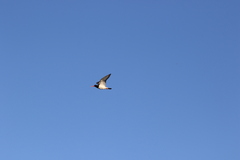
European Oystercatcher

European Oystercatcher

Haematopus ostralegus

Silhouette: Wouter Koch · PhyloPic

LCNTNear ThreatenedVUENCR
Daily sighting probability ~20% · Possible
at Birmingham

In 3 days ~40% in a week ~70%

281 Verified sightings at Birmingham
11,052 In all 8 parks From 2019 to 2026
February Best month
☀️ Diurnal When it's spotted

About the European Oystercatcher

The Eurasian oystercatcher or European oystercatcher (Haematopus ostralegus), also known as the common pied oystercatcher, or (in Europe) just oystercatcher, is a wader in the oystercatcher bird family Haematopodidae. It has striking black and white plumage, a long straight orange-red bill, red eyes and relatively short dull pink legs. The sexes are similar in appearance but the bill of the female is longer than that of the male.

It is the most widespread of the oystercatchers, with four subspecies breeding in western Europe, central Eurosiberia, Kamchatka, China, and the western coast of Korea. No other oystercatcher occurs within this area. The Eurasian oystercatcher was listed by Swedish naturalist Carl Linnaeus in 1758 in the 10th edition of his Systema Naturae under the binomial name Haemotopus ostralegus. The genus name Haematopus combines the Ancient Greek haima αἷμα meaning "blood" and pous πούς meaning "foot". The specific epithet ostralegus combines the Latin ostrea meaning "oyster" and legere meaning "to gather".

The name "oyster catcher" was coined by Mark Catesby in 1731 as a common name for the North American species H. palliatus, described as eating oysters... Wikipedia →

Sounds

Flight call1:13

United Kingdom · 2022

© Kent bird sounds · XC1155191 · CC BY-NC-SA 4.0

Call0:12

Netherlands · 2026

© Susanne Kuijpers · XC1137173 · CC BY-NC-SA 4.0

Recording0:42

Finland · 2026

© Miika Silfverberg · XC1135057 · CC BY-NC-SA 4.0

Global Distribution

Parks Where Found

# Park Country Daily sighting probability
1 Wadden Sea National Park 🇩🇪 Germany
~70%
2 Snowdonia National Park 🇬🇧 United Kingdom
~50%
3 Cairngorms National Park 🇬🇧 United Kingdom
~30%
4 Vatnajokull National Park 🇮🇸 Iceland
~20%
5 Camargue 🇫🇷 France
~10%
6 Doñana National Park 🇪🇸 Spain
<5%
7 West Coast National Park 🇿🇦 South Africa
<5%
8 iSimangaliso Wetland Park 🇿🇦 South Africa
<5%

Cities Where Found

# City Country Daily sighting probability
1 Liverpool 🇬🇧 United Kingdom
~50%
2 Dublin 🇮🇪 Ireland
~40%
3 Helsinki 🇫🇮 Finland
~30%
4 Rotterdam [The Hague] 🇳🇱 Netherlands
~30%
5 Birmingham 🇬🇧 United Kingdom
~20%
6 Karachi 🇵🇰 Pakistan
~10%
7 Manchester 🇬🇧 United Kingdom
~10%
8 Amsterdam 🇳🇱 Netherlands
~10%
9 Kitakyushu 🇯🇵 Japan
~10%
10 Casablanca 🇲🇦 Morocco
~10%

Zoos & Centres Where Found

# Zoo / Centre Country
1 Moscow Zoo 🇷🇺 Russia In captivity
2 Pairi Daiza 🇧🇪 Belgium In captivity
3 Prague Zoo 🇨🇿 Czechia In captivity
4 Tierpark Berlin 🇩🇪 Germany In captivity
5 Natura Artis Magistra 🇳🇱 Netherlands In captivity
6 Ostrava Zoo 🇨🇿 Czechia In captivity
7 Parc des oiseaux 🇫🇷 France In captivity
8 Bronx Zoo 🇺🇸 United States In captivity
9 Slimbridge Wetland Centre 🇬🇧 United Kingdom In captivity
10 Tama Zoological Park 🇯🇵 Japan In captivity
11 Selwo Aventura 🇪🇸 Spain In captivity
12 Berlin Zoological Garden 🇩🇪 Germany In captivity
13 Zoo d'Amnéville 🇫🇷 France In captivity
14 Ueno Zoo 🇯🇵 Japan In captivity
15 Terra Natura Murcia 🇪🇸 Spain In captivity
16 Biotropica 🇫🇷 France In captivity
17 Reserva Zoológica Oasys MiniHollywood 🇪🇸 Spain In captivity
18 Oasi Naturalistica di Sant'Alessio 🇮🇹 Italy In captivity
19 Ueno Zoological Gardens (West Garden) 🇯🇵 Japan In captivity
20 L'Oceanogràfic 🇪🇸 Spain In captivity
21 Pyrénées Animal Park 🇫🇷 France In captivity
22 Bois de la Bâtie 🇨🇭 Switzerland In captivity
23 Santillana Zoo 🇪🇸 Spain In captivity
24 Zoo Lagos 🇵🇹 Portugal In captivity
25 Florida Aquarium 🇺🇸 United States In captivity
26 Aquarium d'Amnéville 🇫🇷 France In captivity
27 Rákosův pavilon 🇨🇿 Czechia In captivity
28 Velemlokárium 🇨🇿 Czechia In captivity
29 Les Oiseaux du Marais Poitevin 🇫🇷 France In captivity
30 Natuurcentrum Ameland 🇳🇱 Netherlands In captivity

Before you go

What are the chances of seeing a European Oystercatcher in Birmingham?

Possible

About 20% of wildlife watchers report a European Oystercatcher sighting in Birmingham on a given day, based on 281 verified sightings from GBIF citizen-science data. It is the 52nd most-seen of the 119 birds we can rate there. Over three days the chance rises to about 40%, and over a week to about 70%, if each day is a fresh chance.

When is the best time to see a European Oystercatcher in Birmingham?

February

In that month about 40% of wildlife watchers report a European Oystercatcher in Birmingham on a given day, against under 5% in September to January, the lowest months.

What time of day is best to see a European Oystercatcher?

Between 3 and 6 pm

Across all the parks we cover, that three-hour window holds the most European Oystercatcher sightings with a recorded time, and about 8 in 10 of them come between 6 am and 6 pm: it is a daytime animal.

Is Birmingham the best place to see a European Oystercatcher?

5th of 38

Of the 38 cities where we can rate European Oystercatcher sightings, Birmingham ranks 5th at about 20%. The best odds are in Liverpool (United Kingdom, about 50%), Dublin (Ireland, about 40%) and Helsinki (Finland, about 30%).

Where does the European Oystercatcher sighting chance come from?

GBIF citizen-science records

It is estimated from how often the European Oystercatcher is recorded against all the birds logged in Birmingham (281 verified sightings), calibrated against known sighting rates. Figures are rounded to the nearest 10% because citizen-science data supports honest approximations, not decimals, and months with records from fewer than five people show "—". How it works.

← Back to Birmingham