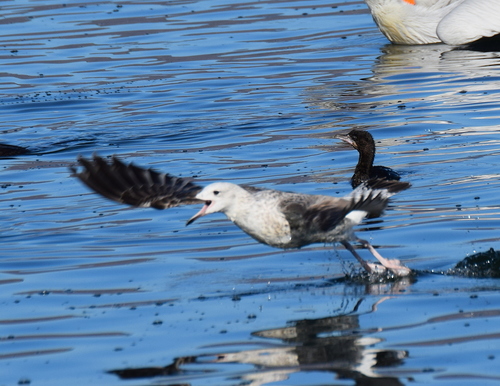
About the Great Black-backed Gull
The great black-backed gull (Larus marinus) is the largest member of the gull and tern family Laridae. It is a very aggressive hunter, pirate and scavenger which breeds on the North Atlantic coasts and islands of northern Europe and northeastern North America. Southern populations are generally sedentary, while those breeding in the far north (northern Norway, northwest Russia) migrate farther south in winter. A few also move inland to large lakes and reservoirs. The adult has a white head, neck and underparts, dark blackish-grey wings and back, pink legs and the bill yellow with a red spot.
The great black-backed gull was one of the many species originally described by Carl Linnaeus in his 1758 10th edition of Systema Naturae, and it still bears its original scientific name of Larus marinus. Larus appears to have referred to a gull or other large seabird. The specific name marinus means "marine", or when taken together, "sea gull". The name predates Linnean taxonomy, as it had been called Larus ingens marinus by Carolus Clusius.
The terms swaabie (from Norn: swartbak, lit. 'black back'), baagie and baigie (Norn: bagi, from Old Norse: bak, lit. 'back') are local names... Wikipedia →