Pink-Spotted Hawkmoth

Pink-Spotted Hawkmoth

Agrius cingulata

Daily sighting probability ~10% · With luck
at Brasilia

In 3 days ~20% in a week ~40%

7 Verified sightings at Brasilia
108 In all 7 parks From 2019 to 2026
March Best month
☀️🌙 Day & Night When it's spotted

About the Pink-Spotted Hawkmoth

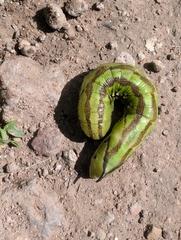
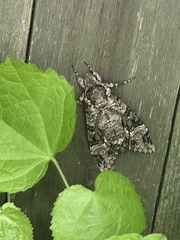
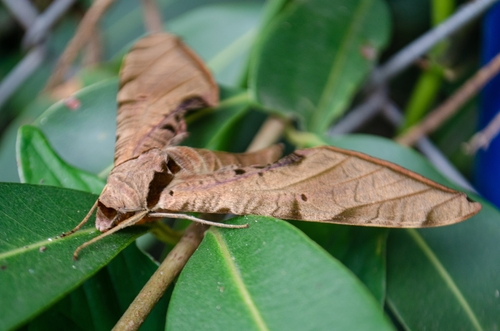
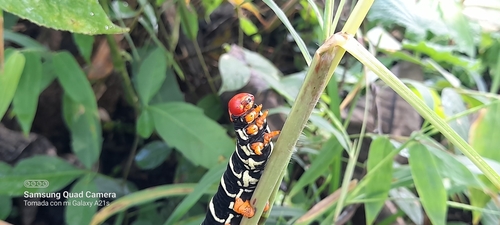
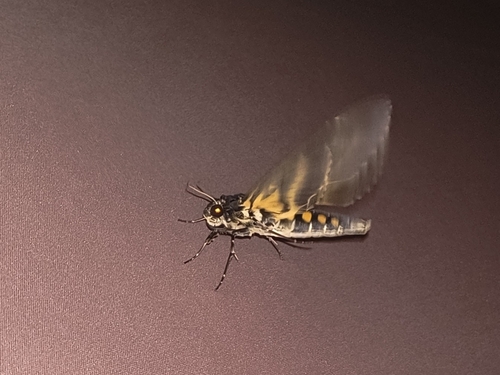
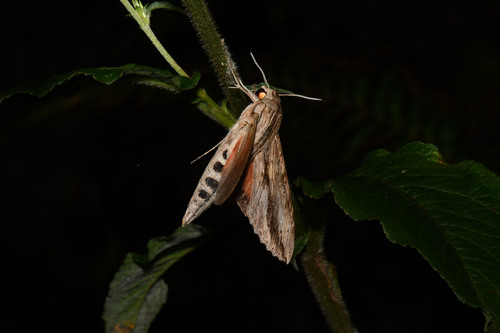
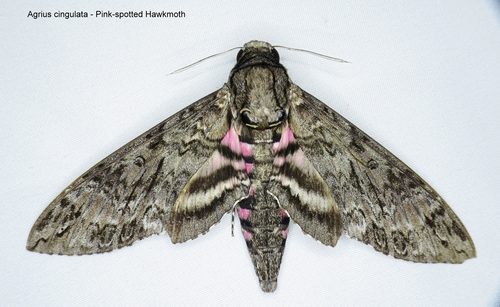
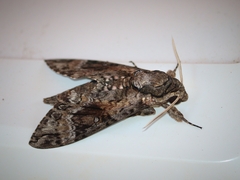
Agrius cingulata, the pink-spotted hawkmoth or sweetpotato hornworm, is a moth in the family Sphingidae. The species was first described by Johan Christian Fabricius in 1775. The imago has a wingspan of 3+3⁄4 to 4+3⁄4 inches (9.5–12 cm). Its robust body is gray brown with pink bands. The abdomen tapers to a point. The hindwings are gray with black bands and pink at the bases.

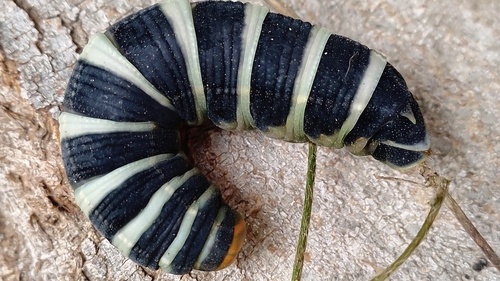
The imago is nocturnal. It feeds on the nectar from deep-throated flowers including moonflower (Calonyction aculeatum), morning glories (Convolvulus species), and petunias (Petunia species). The larva is a large, stout caterpillar with a horn. It feeds during the day and the night on sweet potato (Ipomoea batatas), Datura species, and other plants. It is known as a pest of sweet potato.

This is mainly a neotropical species, and the adults migrate north to Canada and south to Patagonia and the Falkland Islands. It can also be found in the Galápagos Islands and Hawaii. It has been reported from western Europe, including Portugal and the United Kingdom. It has recently become established in West Africa and Cape Verde, possibly having originated in Brazil. Wikipedia →
Global Distribution

Parks Where Found

# Park Country Daily sighting probability
1 Machalilla National Park 🇪🇨 Ecuador
~20%
2 Galápagos Islands 🇪🇨 Ecuador
~10%
3 Bahía de Loreto National Park 🇲🇽 Mexico
~10%
4 Padre Island National Seashore 🇺🇸 United States
~10%
5 La Amistad International Park (Panama) 🇵🇦 Panama
<5%
6 Parque Natural Metropolitano 🇵🇦 Panama
<5%
7 Cumbres de Monterrey National Park 🇲🇽 Mexico
<5%

Cities Where Found

# City Country Daily sighting probability
1 Quito 🇪🇨 Ecuador
~20%
2 Goiânia 🇧🇷 Brazil
~10%
3 Mexico City 🇲🇽 México
~10%
4 Toluca 🇲🇽 México
~10%
5 Guayaquil 🇪🇨 Ecuador
~10%
6 Guatemala City 🇬🇹 Guatemala
~10%
7 Puebla 🇲🇽 México
~10%
8 Brasilia 🇧🇷 Brazil
~10%
9 San Luis Potosí 🇲🇽 México
~10%
10 Maceió 🇧🇷 Brazil
~10%

Before you go

What are the chances of seeing a Pink-Spotted Hawkmoth in Brasilia?

With luck

About 10% of wildlife watchers report a Pink-Spotted Hawkmoth sighting in Brasilia on a given day, based on 7 verified sightings from GBIF citizen-science data. It is the 60th most-seen of the 102 insects we can rate there. Over three days the chance rises to about 20%, and over a week to about 40%, if each day is a fresh chance.

When is the best time to see a Pink-Spotted Hawkmoth in Brasilia?

March

In that month about 20% of wildlife watchers report a Pink-Spotted Hawkmoth in Brasilia on a given day, against under 5% in May–October and December, the lowest months. That is one of Brasilia's wettest months, with about 200 mm of rain against almost none in July.

What time of day is best to see a Pink-Spotted Hawkmoth?

Between 6 and 9 am

Across all the parks we cover, that three-hour window holds the most Pink-Spotted Hawkmoth sightings with a recorded time, and about 6 in 10 of them come between 6 am and 6 pm: it is seen both by day and at night.

Is Brasilia the best place to see a Pink-Spotted Hawkmoth?

8th of 30

Of the 30 cities where we can rate Pink-Spotted Hawkmoth sightings, Brasilia ranks 8th at about 10%. The best odds are in Quito (Ecuador, about 20%), Goiânia (Brazil, about 10%) and Mexico City (México, about 10%).

Which relatives of the Pink-Spotted Hawkmoth live in Brasilia?

Same family: Sphingidae

The closest relatives of the Pink-Spotted Hawkmoth that you can see in Brasilia (family Sphingidae, Sphinx Moths) are Streaked Sphinx (about 10%), Pachylia syces (about 10%) and Tetrio Sphinx (about 10%), with each one's daily chance of a sighting.

Where does the Pink-Spotted Hawkmoth sighting chance come from?

GBIF citizen-science records

It is estimated from how often the Pink-Spotted Hawkmoth is recorded against all the insects logged in Brasilia (7 verified sightings), calibrated against known sighting rates. Figures are rounded to the nearest 10% because citizen-science data supports honest approximations, not decimals, and months with records from fewer than five people show "—". How it works.

← Back to Brasilia