Black-throated Blue Warbler

Black-throated Blue Warbler

Setophaga caerulescens

Silhouette: Dylan GE Gomes · PhyloPic

LCLeast ConcernNTVUENCR
Daily sighting probability <5% · Rare
at Chicago

In 3 days ~10% in a week ~30%

2,533 Verified sightings at Chicago
10,142 In all 19 parks From 2019 to 2026
September Best month
☀️ Diurnal When it's spotted

About the Black-throated Blue Warbler

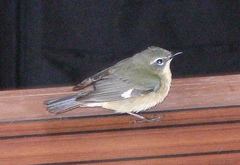
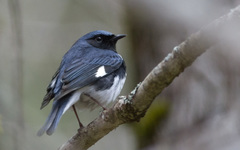
The black-throated blue warbler (Setophaga caerulescens) is a small passerine bird of the New World warbler family. Its breeding ranges are located in the interior of deciduous and mixed coniferous forests in eastern North America. Over the cooler months, it migrates to islands in the Caribbean and Central America. It is very rarely found in western Europe, where it is considered to be a non-indigenous species. The black-throated blue warbler is sexually dimorphic; the adult male has a black face and cheeks, deep blue upperparts and white underparts, while the adult female is olive-brown above and light yellow below.

Predominantly insectivorous, the black-throated blue warbler supplements its diet with berries and seeds in winter. It builds its nests in thick shrubs and the closeness of its nesting sites to the ground make it a favored species for the study of warbler behavior in the wild. The black-throated blue warbler defends its territory against other birds of the same species for both nesting and winter habitats. As the black-throated blue warbler requires large, unbroken forest areas for nesting, its numbers are declining.

The black-throated blue warbler was formally... Wikipedia →

Sounds

Song0:49

United States · 2026

© Scott Olmstead · XC1141316 · CC BY-NC-SA 4.0

Call0:18

Jamaica · 2022

© Bobby Wilcox · XC795317 · CC BY-NC-SA 4.0

Nocturnal flight call0:04

Canada · 2021

© Jeff Stewart · XC703601 · CC BY-NC-SA 4.0

Global Distribution

Parks Where Found

# Park Country Daily sighting probability
1 Blue and John Crow Mountains National Park 🇯🇲 Jamaica
~70%
2 Ciénaga de Zapata 🇨🇺 Cuba
~50%
3 Point Pelee National Park 🇨🇦 Canada
~40%
4 Great Smoky Mountains National Park 🇺🇸 United States
~10%
5 Los Haitises National Park 🇩🇴 Dominican Republic
~10%
6 Jaragua National Park 🇩🇴 Dominican Republic
~10%
7 Congaree National Park 🇺🇸 United States
~10%
8 Everglades National Park 🇺🇸 United States
~10%
9 Shenandoah National Park 🇺🇸 United States
<5%
10 Arrecifes de Cozumel National Park 🇲🇽 Mexico
<5%
11 Isle Royale National Park 🇺🇸 United States
<5%
12 Acadia National Park 🇺🇸 United States
<5%
13 Merritt Island National Wildlife Refuge 🇺🇸 United States
<5%
14 Cape Breton Highlands National Park 🇨🇦 Canada
<5%
15 Arenal Volcano National Park 🇨🇷 Costa Rica
<5%
16 Big Cypress National Preserve 🇺🇸 United States
<5%
17 Chagres National Park 🇵🇦 Panama
<5%
18 Sian Ka'an Biosphere Reserve 🇲🇽 Mexico
<5%
19 Monteverde Cloud Forest Reserve 🇨🇷 Costa Rica
<5%

Cities Where Found

# City Country Daily sighting probability
1 Miami 🇺🇸 United States
~20%
2 New York City 🇺🇸 United States
~10%
3 Havana 🇨🇺 Cuba
~10%
4 Orlando 🇺🇸 United States
~10%
5 Baltimore 🇺🇸 United States
~10%
6 Philadelphia 🇺🇸 United States
~10%
7 Detroit 🇺🇸 United States
~10%
8 Mesa 🇺🇸 United States
<5%
9 Toronto 🇨🇦 Canada
<5%
10 Chicago 🇺🇸 United States
<5%

Zoos & Centres Where Found

# Zoo / Centre Country
1 San Diego Zoo 🇺🇸 United States In captivity
2 National Zoological Park 🇺🇸 United States In captivity

Before you go

What are the chances of seeing a Black-throated Blue Warbler in Chicago?

Rare

Under 5% of wildlife watchers report a Black-throated Blue Warbler sighting in Chicago on a given day, based on 2,533 verified sightings from GBIF citizen-science data. It is the 111th most-seen of the 314 birds we can rate there. Over three days the chance rises to about 10%, and over a week to about 30%, if each day is a fresh chance.

When is the best time to see a Black-throated Blue Warbler in Chicago?

May and September

In those months about 10% of wildlife watchers report a Black-throated Blue Warbler in Chicago on a given day, against under 5% in June–August and October–April, the lowest months.

What time of day is best to see a Black-throated Blue Warbler?

Between 8 and 11 am

Across all the parks we cover, that three-hour window holds the most Black-throated Blue Warbler sightings with a recorded time, and about 9 in 10 of them come between 6 am and 6 pm: it is a daytime animal.

Is Chicago the best place to see a Black-throated Blue Warbler?

10th of 23

Of the 23 cities where we can rate Black-throated Blue Warbler sightings, Chicago ranks 10th at under 5%. The best odds are in Miami (United States, about 20%), New York City (United States, about 10%) and Havana (Cuba, about 10%).

Which relatives of the Black-throated Blue Warbler live in Chicago?

Same genus: Setophaga

The closest relatives of the Black-throated Blue Warbler that you can see in Chicago (genus Setophaga, Setophaga Warblers) are Yellow-rumped Warbler (about 30%), American Redstart (about 20%) and Yellow Warbler (about 20%), with each one's daily chance of a sighting.

Where does the Black-throated Blue Warbler sighting chance come from?

GBIF citizen-science records

It is estimated from how often the Black-throated Blue Warbler is recorded against all the birds logged in Chicago (2,533 verified sightings), calibrated against known sighting rates. Figures are rounded to the nearest 10% because citizen-science data supports honest approximations, not decimals, and months with records from fewer than five people show "—". How it works.

← Back to Chicago