Baird's Sandpiper

Baird's Sandpiper

Calidris bairdii

Silhouette: Edwin Price · PhyloPic

LCLeast ConcernNTVUENCR
Daily sighting probability ~10% · With luck
at Cochabamba

In 3 days ~30% in a week ~50%

30 Verified sightings at Cochabamba
1,072 In all 26 parks From 2019 to 2026
September Best month
☀️ Diurnal When it's spotted

About the Baird's Sandpiper

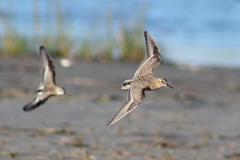
Baird's sandpiper (Calidris bairdii) is a small shorebird. It is among those Calidris species which were formerly sometimes included in the genus Erolia, which was subsumed into the genus Calidris in 1973. The genus name is from Ancient Greek kalidris or skalidris, a term used by Aristotle for some grey-coloured waterside birds. The English name and specific bairdii commemorate Spencer Fullerton Baird, 19th-century naturalist and assistant secretary of the Smithsonian Institution.

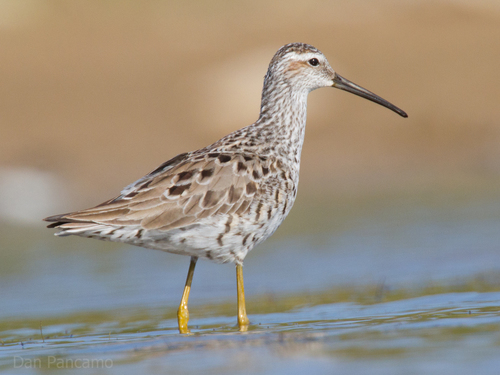
Adults have black legs and a short, straight, thin dark bill. They are dark brown on top and mainly white underneath with a black patch on the rump. The head and breast are light brown with dark streaks. In winter plumage, this species is paler brownish grey above. This bird can be difficult to distinguish from other similar tiny shorebirds; these are known collectively as "peeps" or "stints".

One of the best identification features is the long wings, which extend beyond the tail when the bird is on the ground. Only the white-rumped sandpiper also shows this, and that bird can be distinguished by its namesake white rump patch.

Baird's sandpiper breeds in the northern tundra... Wikipedia →

Sounds

Call0:05

France · 2022

© Stanislas Wroza · XC767039 · CC BY-NC-SA 4.0

Flight call0:10

Brazil · 2021

© JAYRSON ARAUJO DE OLIVEIRA · XC686881 · CC BY-NC-SA 4.0

Alarm call0:04

United Kingdom · 2020

© Peter Stronach · XC588760 · CC BY-NC-SA 4.0

Global Distribution

Parks Where Found

# Park Country Daily sighting probability
1 Lauca National Park 🇨🇱 Chile
~40%
2 Península Valdés 🇦🇷 Argentina
~20%
3 Isla del Coco National Park 🇨🇷 Costa Rica
~20%
4 El Impenetrable National Park 🇦🇷 Argentina
<5%
5 Nahuel Huapi National Park 🇦🇷 Argentina
<5%
6 Pacific Rim National Park Reserve 🇨🇦 Canada
<5%
7 Torres del Paine National Park 🇨🇱 Chile
<5%
8 Celestún Biosphere Reserve 🇲🇽 Mexico
<5%
9 Padre Island National Seashore 🇺🇸 United States
<5%
10 Channel Islands National Park 🇺🇸 United States
<5%
11 Tierra del Fuego National Park 🇦🇷 Argentina
<5%
12 Yellowstone National Park 🇺🇸 United States
<5%
13 Redwood National Park 🇺🇸 United States
<5%
14 Bastimentos Island National Marine Park 🇵🇦 Panama
<5%
15 El Vizcaíno Biosphere Reserve 🇲🇽 Mexico
<5%
16 Table Mountain National Park 🇿🇦 South Africa
<5%
17 Olympic National Park 🇺🇸 United States
<5%
18 Grand Teton National Park 🇺🇸 United States
<5%
19 Marino Ballena National Park 🇨🇷 Costa Rica
<5%
20 Palo Verde National Park 🇨🇷 Costa Rica
<5%
21 Great Bear Rainforest 🇨🇦 Canada
<5%
22 La Amistad International Park (Panama) 🇵🇦 Panama
<5%
23 Rocky Mountain National Park 🇺🇸 United States
<5%
24 Point Pelee National Park 🇨🇦 Canada
<5%
25 Galápagos Islands 🇪🇨 Ecuador
<5%
26 Acadia National Park 🇺🇸 United States
<5%

Cities Where Found

# City Country Daily sighting probability
1 Cochabamba 🇧🇴 Bolivia
~10%
2 Mexico City 🇲🇽 México
<5%
3 Lima 🇵🇪 Peru
<5%
4 Panama City 🇵🇦 Panama
<5%
5 Montevideo 🇺🇾 Uruguay
<5%
6 Dallas 🇺🇸 United States
<5%
7 Denver 🇺🇸 United States
<5%
8 Chicago 🇺🇸 United States
<5%
9 Vancouver 🇨🇦 Canada
<5%
10 San José 🇨🇷 Costa Rica
<5%

Before you go

What are the chances of seeing a Baird's Sandpiper in Cochabamba?

With luck

About 10% of wildlife watchers report a Baird's Sandpiper sighting in Cochabamba on a given day, based on 30 verified sightings from GBIF citizen-science data. It is the 59th most-seen of the 112 birds we can rate there. Over three days the chance rises to about 30%, and over a week to about 50%, if each day is a fresh chance.

When is the best time to see a Baird's Sandpiper in Cochabamba?

September

In that month about 30% of wildlife watchers report a Baird's Sandpiper in Cochabamba on a given day, against under 5% in May–August and December–January, the lowest months. That is one of Cochabamba's driest months, with about 10 mm of rain against 100 mm in January.

What time of day is best to see a Baird's Sandpiper?

Between 2 and 5 pm

Across all the parks we cover, that three-hour window holds the most Baird's Sandpiper sightings with a recorded time, and about 9 in 10 of them come between 6 am and 6 pm: it is a daytime animal.

Is Cochabamba the best place to see a Baird's Sandpiper?

Yes

Of the 22 cities where we can rate Baird's Sandpiper sightings, Cochabamba has the highest daily chance: about 10%. Next come Mexico City (México, under 5%) and Lima (Peru, under 5%).

Where does the Baird's Sandpiper sighting chance come from?

GBIF citizen-science records

It is estimated from how often the Baird's Sandpiper is recorded against all the birds logged in Cochabamba (30 verified sightings), calibrated against known sighting rates. Figures are rounded to the nearest 10% because citizen-science data supports honest approximations, not decimals, and months with records from fewer than five people show "—". How it works.

← Back to Cochabamba