Sick's Swift

Sick's Swift

Chaetura meridionalis

Silhouette: Aviceda (vectorized by T. Michael Keesey) · PhyloPic

LCLeast ConcernNTVUENCR
Daily sighting probability ~30% · Possible
at Curitiba

In 3 days ~70% in a week ~90%

532 Verified sightings at Curitiba
2,013 In all 11 parks From 2019 to 2026
October Best month
☀️ Diurnal When it's spotted

About the Sick's Swift

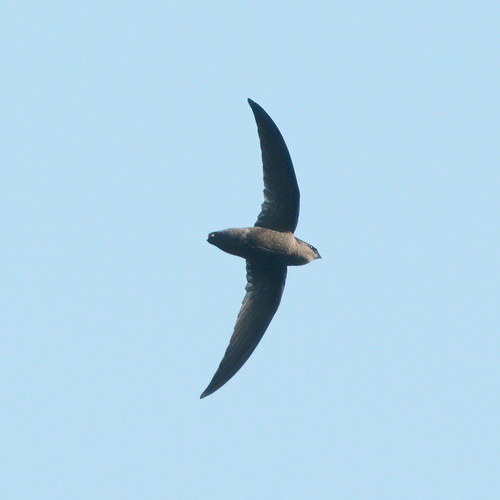
Sick's swift (Chaetura meridionalis) is a species of swift in the family Apodidae. It was previously considered conspecific with the smaller ashy-tailed swift, but a study published in 1997 found that Sick's swift was closer to the chimney swift. The English name commemorates the German-born ornithologist Helmut Sick who studied South American birds. It is a migratory species that breeds in central South America and overwinters in northern South America. The IUCN has listed it as being of "Least Concern".

Sick's swift was formally described in 1907 by the Austrian ornithologist Carl Eduard Hellmayr from specimens collected in the Santiago del Estero Province of northern Argentina. Hellmayr considered it to be a subspecies of the ashy-tailed swift and coined the trinomial name Chaetura andrei meridionalis. The specific epithet is a Latin word meaning "southern". Based on a study by the ornithologist Manuel Marín, Sick's swift is now considered to be separate from the ashy-tailed swift and has been elevated to species status. The English name commemorates the German-born ornithologist, Helmut Sick, who studied Brazilian birdlife.

The upperparts dark smoky... Wikipedia →

Sounds

Flight call0:05

Brazil · 2025

© JAYRSON ARAUJO DE OLIVEIRA · XC1053028 · CC BY-NC-SA 4.0

Call0:47

Paraguay · 2014

© Fabrice Schmitt · XC611914 · CC BY-NC-SA 4.0

Recording0:15

Brazil · 2013

© William Zaca · XC158730 · CC BY-NC-SA 3.0

Global Distribution

Parks Where Found

# Park Country Daily sighting probability
1 Serra dos Órgãos National Park 🇧🇷 Brazil
~30%
2 Itatiaia National Park 🇧🇷 Brazil
~20%
3 Emas National Park 🇧🇷 Brazil
~20%
4 Iguazú National Park 🇦🇷 Argentina
~10%
5 Serra da Canastra National Park 🇧🇷 Brazil
~10%
6 Iguaçu National Park 🇧🇷 Brazil
~10%
7 Tijuca National Park 🇧🇷 Brazil
~10%
8 El Impenetrable National Park 🇦🇷 Argentina
<5%
9 Chapada Diamantina National Park 🇧🇷 Brazil
<5%
10 Chapada dos Guimarães National Park 🇧🇷 Brazil
<5%
11 Parque Estadual Encontro das Águas 🇧🇷 Brazil
<5%

Cities Where Found

# City Country Daily sighting probability
1 Porto Alegre 🇧🇷 Brazil
~40%
2 Salvador 🇧🇷 Brazil
~40%
3 Curitiba 🇧🇷 Brazil
~30%
4 Niterói 🇧🇷 Brazil
~30%
5 São Paulo 🇧🇷 Brazil
~20%
6 Vitória 🇧🇷 Brazil
~20%
7 Campinas 🇧🇷 Brazil
~20%
8 Belo Horizonte 🇧🇷 Brazil
~10%
9 João Pessoa 🇧🇷 Brazil
~10%
10 Fortaleza 🇧🇷 Brazil
~10%

Before you go

What are the chances of seeing a Sick's Swift in Curitiba?

Possible

About 30% of wildlife watchers report a Sick's Swift sighting in Curitiba on a given day, based on 532 verified sightings from GBIF citizen-science data. It is the 23rd most-seen of the 247 birds we can rate there. Over three days the chance rises to about 70%, and over a week to about 90%, if each day is a fresh chance.

When is the best time to see a Sick's Swift in Curitiba?

January, March and September–November

In those months about 50% of wildlife watchers report a Sick's Swift in Curitiba on a given day, against under 5% in May to August, the lowest months.

What time of day is best to see a Sick's Swift?

Between 4 and 7 pm

Across all the parks we cover, that three-hour window holds the most Sick's Swift sightings with a recorded time, and about 9 in 10 of them come between 6 am and 6 pm: it is a daytime animal.

Is Curitiba the best place to see a Sick's Swift?

3rd of 15

Of the 15 cities where we can rate Sick's Swift sightings, Curitiba ranks 3rd at about 30%. The best odds are in Porto Alegre (Brazil, about 40%) and Salvador (Brazil, about 40%).

Where does the Sick's Swift sighting chance come from?

GBIF citizen-science records

It is estimated from how often the Sick's Swift is recorded against all the birds logged in Curitiba (532 verified sightings), calibrated against known sighting rates. Figures are rounded to the nearest 10% because citizen-science data supports honest approximations, not decimals, and months with records from fewer than five people show "—". How it works.

← Back to Curitiba