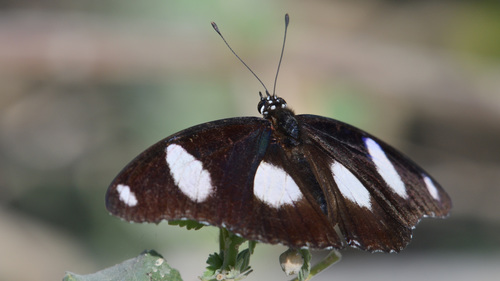
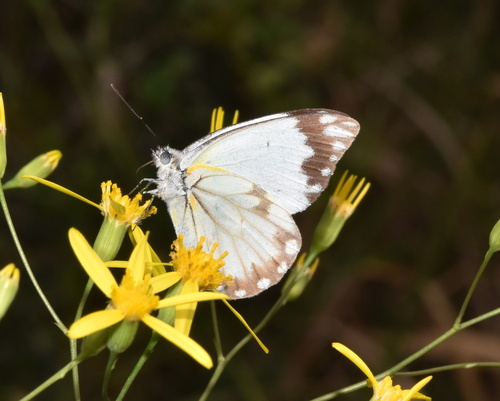
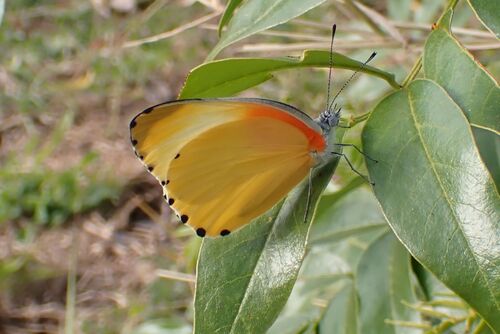
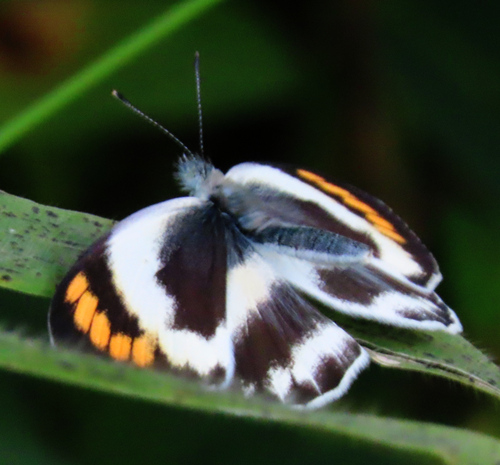
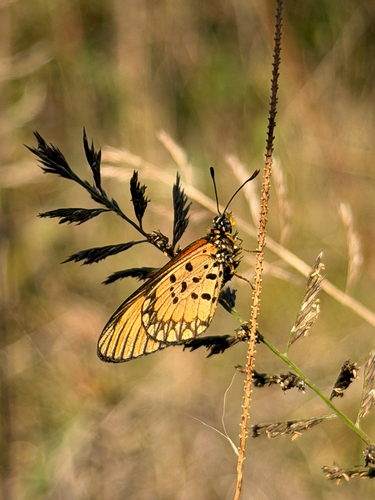
Dancing Amber

Dancing Amber

Telchinia serena

Daily sighting probability ~20% · Possible
at Dar es-Salaam

In 3 days ~50% in a week ~80%

5 Verified sightings at Dar es-Salaam
491 In all 12 parks From 2019 to 2026
June Best month
☀️ Diurnal When it's spotted

About the Dancing Amber

Acraea serena, the dancing acraea, is a butterfly of the family Nymphalidae. It is found throughout Africa south of the Sahara. It is the most common of the Acraea, from Dakar to Fort-Dauphin and from Yemen to the Cape. This is the type species of the old genus Telchinia, which may warrant re-separation from Acraea. Formerly, A. serena was often misidentified as Acraea eponina (small orange acraea) or Acraea terpsicore (tawny coaster).

It is very likely that the butterfly's black-spotted orange markings are a sign of unpalatability and it may well form part of a mimicry ring with Erikssonia edgei. Acraea manjaca from Madagascar, now considered to be conspecific with Acraea serena, has a complex taxonomic history which illustrates the problems in interpreting the genus as a whole. Here is an account of how Acraea manjaca was placed by different authors.

Boisduval notes the proximity with eponina Cramer in his original description of 1833. Aurivillius (1898) considers... Wikipedia →

Global Distribution

Parks Where Found

# Park Country Daily sighting probability
1 Gonarezhou National Park 🇿🇼 Zimbabwe
~40%
2 iSimangaliso Wetland Park 🇿🇦 South Africa
~30%
3 Gorongosa National Park 🇲🇿 Mozambique
~30%
4 South Luangwa National Park 🇿🇲 Zambia
~20%
5 Kruger National Park 🇿🇦 South Africa
~20%
6 uMkhuze Game Reserve 🇿🇦 South Africa
~20%
7 Hwange National Park 🇿🇼 Zimbabwe
~20%
8 Odzala-Kokoua National Park 🇨🇬 Republic of the Congo
~20%
9 Pilanesberg National Park 🇿🇦 South Africa
~10%
10 Nairobi National Park 🇰🇪 Kenya
~10%
11 Hluhluwe-Imfolozi Park 🇿🇦 South Africa
~10%
12 Chobe National Park 🇧🇼 Botswana
~10%

Cities Where Found

# City Country Daily sighting probability
1 Maputo 🇲🇿 Mozambique
~40%
2 Accra 🇬🇭 Ghana
~40%
3 Cotonou 🇧🇯 Benin
~40%
4 Serrekunda 🇬🇲 Gambia
~30%
5 Ouagadougou 🇧🇫 Burkina Faso
~20%
6 Pretoria 🇿🇦 South Africa
~20%
7 Dar es-Salaam 🇹🇿 Tanzania
~20%
8 Antananarivo 🇲🇬 Madagascar
~20%
9 Kampala 🇺🇬 Uganda
~20%
10 Harare 🇿🇼 Zimbabwe
~20%

Before you go

What are the chances of seeing a Dancing Amber in Dar es-Salaam?

Possible

About 20% of wildlife watchers report a Dancing Amber sighting in Dar es-Salaam on a given day, based on 5 verified sightings from GBIF citizen-science data. It is the 9th most-seen of the 12 insects we can rate there. Over three days the chance rises to about 50%, and over a week to about 80%, if each day is a fresh chance.

When is the best time to see a Dancing Amber in Dar es-Salaam?

June

In that month about 50% of wildlife watchers report a Dancing Amber in Dar es-Salaam on a given day, against under 5% in May and July–March, the lowest months. That is one of Dar es-Salaam's driest months, with about 25 mm of rain against 260 mm in April.

What time of day is best to see a Dancing Amber?

Between 10 am and 1 pm

Across all the parks we cover, that three-hour window holds the most Dancing Amber sightings with a recorded time, and nearly all of them come between 6 am and 6 pm: it is a daytime animal.

Is Dar es-Salaam the best place to see a Dancing Amber?

7th of 14

Of the 14 cities where we can rate Dancing Amber sightings, Dar es-Salaam ranks 7th at about 20%. The best odds are in Maputo (Mozambique, about 40%), Accra (Ghana, about 40%) and Cotonou (Benin, about 40%).

Which relatives of the Dancing Amber live in Dar es-Salaam?

Same family: Nymphalidae

The closest relatives of the Dancing Amber that you can see in Dar es-Salaam (family Nymphalidae, Brush-footed Butterflies) are Dark Blue Pansy (about 40%), Danaid Eggfly (about 30%) and Spotted Brown Pansy (about 30%), with each one's daily chance of a sighting.

Where does the Dancing Amber sighting chance come from?

GBIF citizen-science records

It is estimated from how often the Dancing Amber is recorded against all the insects logged in Dar es-Salaam (5 verified sightings), calibrated against known sighting rates. Figures are rounded to the nearest 10% because citizen-science data supports honest approximations, not decimals, and months with records from fewer than five people show "—". How it works.
← Back to Dar es-Salaam