Black-capped Chickadee

Black-capped Chickadee

Poecile atricapillus

Silhouette: Ferran Sayol · PhyloPic

LCLeast ConcernNTVUENCR
Daily sighting probability ~50% · Likely
at Detroit

In 3 days ~90% in a week >90%

5,261 Verified sightings at Detroit
29,601 In all 27 parks From 2019 to 2026
December Best month
☀️ Diurnal When it's spotted

About the Black-capped Chickadee

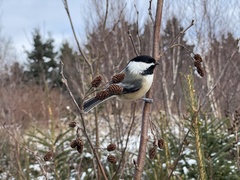
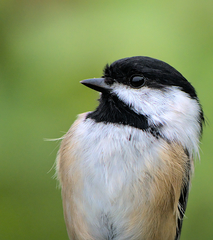
The black-capped chickadee (Poecile atricapillus) is a small, nonmigratory, North American passerine bird that lives in deciduous and mixed forests. It is a member of the Paridae family, also known as tits. It has a distinct black cap on its head, a black bib underneath, and white cheeks. It has a white belly, buff sides, and grey wings, back, and tail. The bird is well known for its vocalizations, including its fee-bee song and its chick-a-dee-dee-dee call, from which it derives its name.

The black-capped chickadee is widely distributed throughout North America, ranging from the northern United States to southern Canada and all the way up to Alaska and Yukon. It feeds primarily on insects and seeds, and is known for its ability to cache food for use during the winter. The hippocampus of the black-capped chickadee grows during the caching season, which is believed to help it better remember its cache locations. The black-capped chickadee is a social bird and forms strict dominance hierarchies within its flock. During the winter, these flocks include other bird species. It has the ability to lower its body temperature during cold winter nights, allowing it to conserve energy.

Black-capped chickadees build nests in tree cavities, with the nesting season starting in late April and lasting until late June. They lay on average 6–8 eggs, which hatch after 11–14 days. Juveniles fledge 12–16 days after hatching.

The population of black-capped chickadees is thought to be increasing, and they are considered a species of least concern by the International Union for Conservation of Nature (IUCN). It is the state bird of both Massachusetts and Maine in the United States, and the provincial bird of New Brunswick in Canada. Wikipedia →

Sounds

Call1:13

United States · 2026

© Valerie Heemstra · XC1087463 · CC BY-NC-SA 4.0

Alarm call0:52

Canada · 2010

© MARK BRENNAN · XC1012404 · CC BY-NC-SA 4.0

Song0:14

United States · 2025

© Rory Nefdt · XC994313 · CC BY-NC-SA 4.0

Global Distribution

Parks Where Found

# Park Country Daily sighting probability
1 Acadia National Park 🇺🇸 United States
~70%
2 Elk Island National Park 🇨🇦 Canada
~60%
3 Riding Mountain National Park 🇨🇦 Canada
~60%
4 Isle Royale National Park 🇺🇸 United States
~60%
5 Voyageurs National Park 🇺🇸 United States
~60%
6 Cape Breton Highlands National Park 🇨🇦 Canada
~60%
7 Kluane National Park 🇨🇦 Canada
~50%
8 Point Pelee National Park 🇨🇦 Canada
~40%
9 Katmai National Park 🇺🇸 United States
~30%
10 Glacier National Park 🇺🇸 United States
~30%
11 Grand Teton National Park 🇺🇸 United States
~30%
12 Gros Morne National Park 🇨🇦 Canada
~30%
13 Olympic National Park 🇺🇸 United States
~30%
14 Wrangell-St. Elias National Park 🇺🇸 United States
~20%
15 Banff National Park 🇨🇦 Canada
~20%
16 Rocky Mountain National Park 🇺🇸 United States
~20%
17 Wood Buffalo National Park 🇨🇦 Canada
~20%
18 Denali National Park 🇺🇸 United States
~20%
19 Jasper National Park 🇨🇦 Canada
~20%
20 Kenai Fjords National Park 🇺🇸 United States
~10%
21 Redwood National Park 🇺🇸 United States
~10%
22 Yellowstone National Park 🇺🇸 United States
~10%
23 Great Smoky Mountains National Park 🇺🇸 United States
~10%
24 Zion National Park 🇺🇸 United States
~10%
25 Badlands National Park 🇺🇸 United States
<5%
26 Shenandoah National Park 🇺🇸 United States
<5%
27 Great Bear Rainforest 🇨🇦 Canada
<5%

Cities Where Found

# City Country Daily sighting probability
1 Vancouver 🇨🇦 Canada
~90%
2 Calgary 🇨🇦 Canada
~90%
3 Montreal 🇨🇦 Canada
~80%
4 Seattle 🇺🇸 United States
~80%
5 Edmonton 🇨🇦 Canada
~80%
6 Portland 🇺🇸 United States
~70%
7 Minneapolis [Saint Paul] 🇺🇸 United States
~70%
8 Denver 🇺🇸 United States
~70%
9 Salt Lake City 🇺🇸 United States
~70%
10 Toronto 🇨🇦 Canada
~70%

Zoos & Centres Where Found

# Zoo / Centre Country
1 National Zoological Park 🇺🇸 United States In captivity
2 Iowa Raptor Project 🇺🇸 United States In captivity
3 Montreal Biodome 🇨🇦 Canada In captivity

Before you go

What are the chances of seeing a Black-capped Chickadee in Detroit?

Likely

About 50% of wildlife watchers report a Black-capped Chickadee sighting in Detroit on a given day, based on 5,261 verified sightings from GBIF citizen-science data. It is the 12th most-seen of the 199 birds we can rate there. Over three days the chance rises to about 90%, and over a week to over 90%, if each day is a fresh chance.

When is the best time to see a Black-capped Chickadee in Detroit?

December and January

In those months about 70% of wildlife watchers report a Black-capped Chickadee in Detroit on a given day, against about 30% in June, the lowest month.

What time of day is best to see a Black-capped Chickadee?

Between 10 am and 1 pm

Across all the parks we cover, that three-hour window holds the most Black-capped Chickadee sightings with a recorded time, and about 9 in 10 of them come between 6 am and 6 pm: it is a daytime animal.

Is Detroit the best place to see a Black-capped Chickadee?

14th of 17

Of the 17 cities where we can rate Black-capped Chickadee sightings, Detroit ranks 14th at about 50%. The best odds are in Vancouver (Canada, about 90%), Calgary (Canada, about 90%) and Montreal (Canada, about 80%).

Where does the Black-capped Chickadee sighting chance come from?

GBIF citizen-science records

It is estimated from how often the Black-capped Chickadee is recorded against all the birds logged in Detroit (5,261 verified sightings), calibrated against known sighting rates. Figures are rounded to the nearest 10% because citizen-science data supports honest approximations, not decimals, and months with records from fewer than five people show "—". How it works.

← Back to Detroit