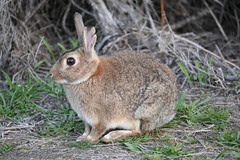
European Rabbit

European Rabbit

Oryctolagus cuniculus

Silhouette: Steven Traver · PhyloPic

LCNTVUENEndangeredCR
Daily sighting probability ~10% · With luck
at Dublin

In 3 days ~20% in a week ~40%

11 Verified sightings at Dublin
1,980 In all 8 parks From 2019 to 2026
January Best month
☀️ Diurnal When it's spotted

About the European Rabbit

The European rabbit (Oryctolagus cuniculus) or coney is a species of rabbit native to the Iberian Peninsula and southwestern France. It has been introduced to hundreds of locations around the world. Wild and domesticated European rabbits around the world can vary widely in size, shape, and colour. The average adult European rabbit is smaller than the European hare, though size and weight vary with habitat and diet.

European rabbits prefer grassland habitats and are herbivorous, mainly feeding on grasses and leaves, though they may supplement their diet with berries, tree bark, and field crops such as maize. They are prey to a variety of predators, including birds of prey, weasels, cats, and canids. The European rabbit's main defence against predators is to run and hide, using vegetation and its own burrows for cover. It is well known for digging networks of burrows, called warrens, where it spends most of its time when not feeding. The European rabbit lives in social groups centred around territorial females. European rabbits in an established social group will rarely stray far from their warren, with female rabbits leaving the warren mainly to establish nests where they will raise their young. Unlike hares, rabbits are born blind and helpless, requiring maternal care until they leave the nest.

The European rabbit has been hunted since the Paleolithic period, and raised as a food source since at least the first century BCE. It has also had major agricultural and biological impacts as an invasive species. It is the only domesticated species of rabbit, and all known breeds of domestic rabbit are its descendants. It has often been introduced to exotic locations as a food source or for sport hunting. It has been introduced to at least 800 islands and every continent except Antarctica, often with devastating effects on local biodiversity due to a lack of predators. However, the species is listed as near threatened by the International Union for Conservation of Nature, as it has faced population decline in its native range due to overhunting, habitat destruction, and diseases such as myxomatosis and rabbit haemorrhagic disease. This decline has directly led to negative impacts on populations of the Iberian lynx and Spanish imperial eagle, predators that rely on the rabbit as food. Wikipedia →

Sounds

Call0:08

United Kingdom · 2020

© Simon Elliott · XC960433 · CC BY-NC-ND 4.0

Global Distribution

Parks Where Found

# Park Country Daily sighting probability
1 Cairngorms National Park 🇬🇧 United Kingdom
~30%
2 Sierra de Guadarrama National Park 🇪🇸 Spain
~30%
3 Wadden Sea National Park 🇩🇪 Germany
~30%
4 Snowdonia National Park 🇬🇧 United Kingdom
~30%
5 Doñana National Park 🇪🇸 Spain
~20%
6 Fertő-Hanság National Park 🇭🇺 Hungary
~10%
7 Garden Route National Park 🇿🇦 South Africa
~10%
8 Table Mountain National Park 🇿🇦 South Africa
<5%

Cities Where Found

# City Country Daily sighting probability
1 Essen 🇩🇪 Germany
~40%
2 Berlin 🇩🇪 Germany
~30%
3 Leeds 🇬🇧 United Kingdom
~30%
4 Cologne 🇩🇪 Germany
~30%
5 Liverpool 🇬🇧 United Kingdom
~20%
6 Paris 🇫🇷 France
~20%
7 Birmingham 🇬🇧 United Kingdom
~20%
8 Helsinki 🇫🇮 Finland
~20%
9 Rome 🇮🇹 Italy
~20%
10 Manchester 🇬🇧 United Kingdom
~20%

Zoos & Centres Where Found

# Zoo / Centre Country
1 Pairi Daiza 🇧🇪 Belgium In captivity
2 ZooParc de Beauval 🇫🇷 France In captivity
3 Leipzig Zoological Garden 🇩🇪 Germany In captivity
4 Copenhagen Zoo 🇩🇰 Denmark In captivity
5 Skansen 🇸🇪 Sweden In captivity
6 Zürich Zoo 🇨🇭 Switzerland In captivity
7 Lisbon Oceanarium 🇵🇹 Portugal In captivity
8 Cabarceno Natural Park 🇪🇸 Spain In captivity
9 Ostrava Zoo 🇨🇿 Czechia In captivity
10 Korkeasaari Zoo 🇫🇮 Finland In captivity
11 Melaka Zoo and Bird Park 🇲🇾 Malaysia In captivity
12 Kaliningrad Zoo 🇷🇺 Russia In captivity
13 Zoobotánico Jerez 🇪🇸 Spain In captivity
14 La Tanière 🇫🇷 France In captivity
15 Museum–aquarium of Nancy 🇫🇷 France In captivity
16 Nordens Ark 🇸🇪 Sweden In captivity
17 Parc animalier de Merlet 🇫🇷 France In captivity
18 Wildwald Voßwinkel 🇩🇪 Germany In captivity
19 Dalian forest zoo 🇨🇳 China In captivity
20 Beijing Wildlife Park 🇨🇳 China In captivity
21 Taman Safari Indonesia 🇮🇩 Indonesia In captivity
22 Safaripark Beekse Bergen 🇳🇱 Netherlands In captivity
23 Taman Safari Bogor 🇮🇩 Indonesia In captivity
24 Tierpark Sababurg 🇩🇪 Germany In captivity
25 Wildpark Alte Fasanerie 🇩🇪 Germany In captivity
26 Khao Kheow Open Zoo 🇹🇭 Thailand In captivity
27 Ramat Gan Safari 🇮🇱 Israel In captivity
28 Nakhon Ratchasima Zoo 🇹🇭 Thailand In captivity
29 Chiang Mai Night Safari 🇹🇭 Thailand In captivity
30 Planète Sauvage 🇫🇷 France In captivity
31 DéfiPlanet' 🇫🇷 France In captivity
32 Wildpark Schorfheide 🇩🇪 Germany In captivity
33 Shanghai Zoo 🇨🇳 China In captivity
34 江苏淹城野生动物世界 🇨🇳 China In captivity
35 Yorkshire Wildlife Park 🇬🇧 United Kingdom In captivity
36 Mogilyov Zoo 🇧🇾 Belarus In captivity
37 Naturwildpark Granat 🇩🇪 Germany In captivity
38 Banham Zoo 🇬🇧 United Kingdom In captivity
39 Nuremberg Zoo 🇩🇪 Germany In captivity
40 National Zoological Garden of South Africa 🇿🇦 South Africa In captivity
41 Wildpark Gangelt 🇩🇪 Germany In captivity
42 Wildpark Poing 🇩🇪 Germany In captivity
43 Parco Natura Viva 🇮🇹 Italy In captivity
44 Leofoo Village Theme Park 🇹🇼 Taiwan In captivity
45 Novosibirsk Zoo 🇷🇺 Russia In captivity
46 Tier-Natur-Erlebnispark Mundenhof 🇩🇪 Germany In captivity
47 Kyiv Zoo 🇺🇦 Ukraine In captivity
48 Wildpark Hufeisen Veldensteiner Forst 🇩🇪 Germany In captivity
49 Friguia Park 🇹🇳 Tunisia In captivity
50 Berlin Zoological Garden 🇩🇪 Germany In captivity

Before you go

What are the chances of seeing a European Rabbit in Dublin?

With luck

About 10% of wildlife watchers report a European Rabbit sighting in Dublin on a given day, based on 11 verified sightings from GBIF citizen-science data. It is the 6th most-seen of the 11 mammals we can rate there. Over three days the chance rises to about 20%, and over a week to about 40%, if each day is a fresh chance.

When is the best time to see a European Rabbit in Dublin?

January and June

In those months about 20% of wildlife watchers report a European Rabbit in Dublin on a given day, against under 5% in February, May, October and December, the lowest months.

What time of day is best to see a European Rabbit?

Between 3 and 6 pm

Across all the parks we cover, that three-hour window holds the most European Rabbit sightings with a recorded time, and about 9 in 10 of them come between 6 am and 6 pm: it is a daytime animal.

Is Dublin the best place to see a European Rabbit?

24th of 28

Of the 28 cities where we can rate European Rabbit sightings, Dublin ranks 24th at about 10%. The best odds are in Essen (Germany, about 40%), Berlin (Germany, about 30%) and Leeds (United Kingdom, about 30%).

Where does the European Rabbit sighting chance come from?

GBIF citizen-science records

It is estimated from how often the European Rabbit is recorded against all the mammals logged in Dublin (11 verified sightings), calibrated against known sighting rates. Figures are rounded to the nearest 10% because citizen-science data supports honest approximations, not decimals, and months with records from fewer than five people show "—". How it works.

← Back to Dublin