About the Common Giant Turtle Ant
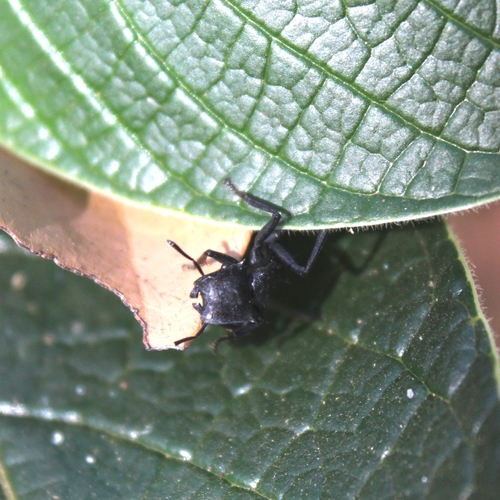
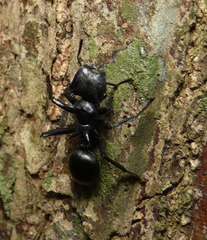
Cephalotes atratus is a species of arboreal ant in the genus Cephalotes, a genus characterized by its odd shaped head. These ants are known as gliding ants because of their ability to "parachute" by steering their fall if they lose their footing.
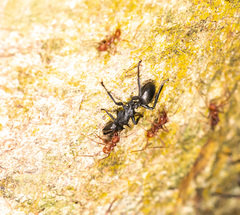
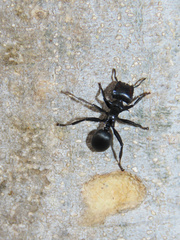
It is called kaka-sikikoko in the Kwaza language of Rondônia, Brazil. Cephalotes atratus is a large, mainly black ant; workers are 8 to 14 mm (0.3 to 0.6 in) in length and females 20 mm (0.8 in). Males are up to 14 mm (0.55 in) and have black heads and thoraxes, and dark reddish-brown gasters and limbs. The workers are spiny and heavily armoured with powerful mandibles for chewing through wood.
This ant occurs in lowland tropical rainforests in South America where its range extends from Panama and Venezuela to Peru, Bolivia, Paraguay, Uruguay and northern Argentina. It is a common arboreal species and colonies are found in forested areas, parkland with isolated trees, and urban habitats.
This ant usually builds its nest in a hollow in a large live or dead tree. A small entrance may lead to a complex of tunnels and chambers, all excavated by the ants. From the nest the workers emerge... Wikipedia →