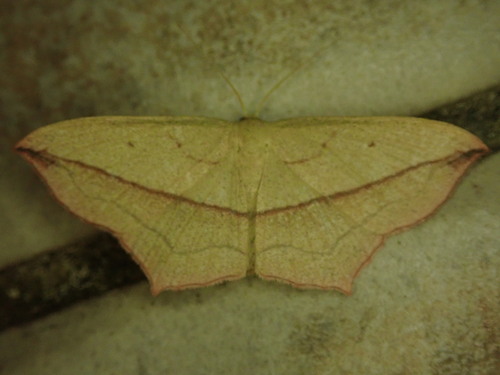
Light Emerald

Light Emerald

Campaea margaritaria

Daily sighting probability ~10% · With luck
at Hamburg

In 3 days ~20% in a week ~40%

23 Verified sightings at Hamburg
234 In all 10 parks From 2019 to 2026
September Best month
☀️🌙 Day & Night When it's spotted

About the Light Emerald

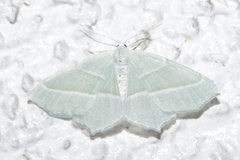
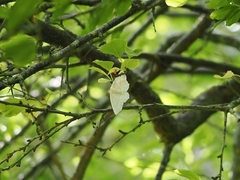
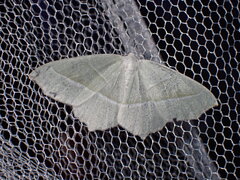
Campaea margaritata, commonly known as the light emerald, is a moth of the family Geometridae. The species was first described by Carl Linnaeus in his 1767 12th edition of Systema Naturae. It is widely distributed throughout Europe, the Near East and North Africa. The habitat is mixed forests including parks and large gardens.

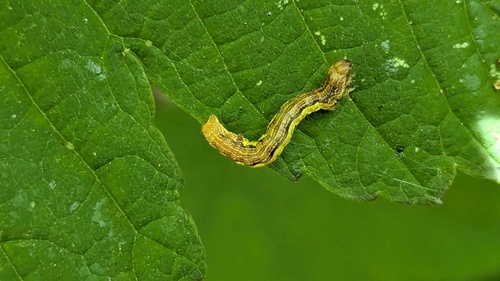
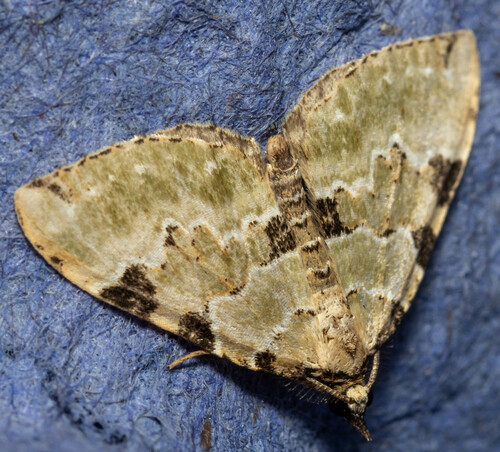
Newly emerged adults have delicately pale green wings marked with green and white fascia, two on the slightly crenulate forewing, one on the hindwing. As with most moths of this colour, the green colouration is fugitive fading over time and older specimens tend to be almost pure white. The wingspan is 42–54 mm, the female generally being considerably larger than the male. The egg is smooth, long oval, but laid with the micropyle at the top; light grey, dark-dotted, later pink with the dots deep red. The larva is grey, brown or brownish-green, commonly with whitish dots, the segment-incisions well marked.

One or two broods are produced each year and adults can be seen at any time between July and September [1]. The larva feeds on a variety of deciduous trees, including apple, beech, birch, elm, hawthorn, hazel and oak as well... Wikipedia →

Global Distribution

Parks Where Found

# Park Country Daily sighting probability
1 Snowdonia National Park 🇬🇧 United Kingdom
~20%
2 Cairngorms National Park 🇬🇧 United Kingdom
~10%
3 Bavarian Forest National Park 🇩🇪 Germany
~10%
4 Aigüestortes National Park 🇪🇸 Spain
~10%
5 Mercantour National Park 🇫🇷 France
~10%
6 Pyrénées National Park 🇫🇷 France
~10%
7 Wadden Sea National Park 🇩🇪 Germany
~10%
8 Triglav National Park 🇸🇮 Slovenia
~10%
9 Cévennes National Park 🇫🇷 France
~10%
10 Sierra de Guadarrama National Park 🇪🇸 Spain
<5%

Cities Where Found

# City Country Daily sighting probability
1 Liverpool 🇬🇧 United Kingdom
~20%
2 London 🇬🇧 United Kingdom
~10%
3 Birmingham 🇬🇧 United Kingdom
~10%
4 Manchester 🇬🇧 United Kingdom
~10%
5 Essen 🇩🇪 Germany
~10%
6 Hamburg 🇩🇪 Germany
~10%
7 Berlin 🇩🇪 Germany
~10%
8 Cologne 🇩🇪 Germany
~10%
9 Prague 🇨🇿 Czechia
~10%
10 Copenhagen 🇩🇰 Denmark
~10%

Before you go

What are the chances of seeing a Light Emerald in Hamburg?

With luck

About 10% of wildlife watchers report a Light Emerald sighting in Hamburg on a given day, based on 23 verified sightings from GBIF citizen-science data. It is the 119th most-seen of the 423 insects we can rate there. Over three days the chance rises to about 20%, and over a week to about 40%, if each day is a fresh chance.

When is the best time to see a Light Emerald in Hamburg?

September

In that month about 20% of wildlife watchers report a Light Emerald in Hamburg on a given day, against under 5% in July and November–May, the lowest months.

What time of day is best to see a Light Emerald?

Between 10 pm and 1 am

Across all the parks we cover, that three-hour window holds the most Light Emerald sightings with a recorded time, and about 6 in 10 of them come between 6 am and 6 pm: it is seen both by day and at night.

Is Hamburg the best place to see a Light Emerald?

6th of 17

Of the 17 cities where we can rate Light Emerald sightings, Hamburg ranks 6th at about 10%. The best odds are in Liverpool (United Kingdom, about 20%), London (United Kingdom, about 10%) and Birmingham (United Kingdom, about 10%).

Which relatives of the Light Emerald live in Hamburg?

Same family: Geometridae

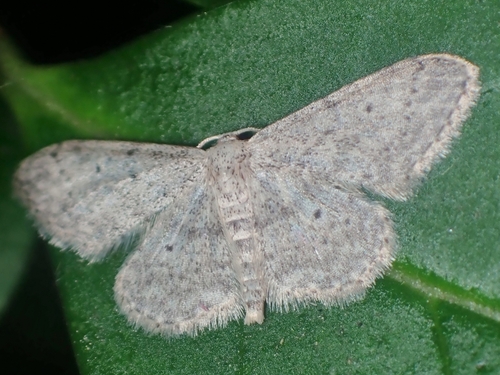
The closest relatives of the Light Emerald that you can see in Hamburg (family Geometridae, Geometer Moths) are Yellow Shell Moth (about 10%), Small Dusty Wave (about 10%) and Riband Wave (about 10%), with each one's daily chance of a sighting.

Where does the Light Emerald sighting chance come from?

GBIF citizen-science records

It is estimated from how often the Light Emerald is recorded against all the insects logged in Hamburg (23 verified sightings), calibrated against known sighting rates. Figures are rounded to the nearest 10% because citizen-science data supports honest approximations, not decimals, and months with records from fewer than five people show "—". How it works.

← Back to Hamburg