Speckled Piculet

Speckled Piculet

Picumnus innominatus

Silhouette: Pepe Reigada · PhyloPic

LCLeast ConcernNTVUENCR
Daily sighting probability ~20% · Possible
at Hangzhou

In 3 days ~40% in a week ~70%

289 Verified sightings at Hangzhou
763 In all 13 parks From 2019 to 2026
September Best month
☀️ Diurnal When it's spotted

About the Speckled Piculet

The speckled piculet (Picumnus innominatus) is a species of bird in the family Picidae. It is found in India, China and Southeast Asia. The speckled piculet was formally described in 1836 by the English zoologist Edward Burton under the current binomial name Picumnus innominatus from a specimen collected in the "Himalayas". The locality is taken to be the state of Sikkim in northeast India. The specific epithet innominatus is Latin meaning "unnamed".

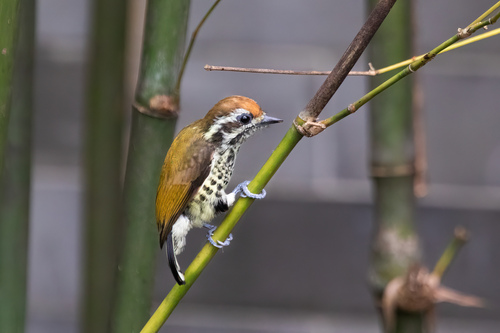
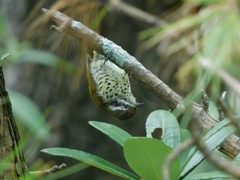
Three subspecies are recognised: The male and female birds look alike. They have olive-green backs, with two white stripes on the side of their heads. The male bird has orange and brown on the forecrown. They have a creamy-white coloring below, with black spots. There is a dark green band near the eyes.

It is found in the Indian subcontinent and Southeast Asia, ranging across Bangladesh, Bhutan... Wikipedia →

Sounds

Call0:29

China · 2026

© Albert Lastukhin · XC1138595 · CC BY-NC-ND 4.0

Drumming0:49

China · 2025

© Feather V · XC986931 · CC BY-NC-SA 4.0

Song0:08

China · 2024

© Bo Shunqi 薄顺奇 · XC985957 · CC BY-NC-SA 4.0

Global Distribution

Parks Where Found

# Park Country Daily sighting probability
1 Doi Inthanon National Park 🇹🇭 Thailand
~10%
2 Royal Manas National Park 🇧🇹 Bhutan
~10%
3 Kaeng Krachan National Park 🇹🇭 Thailand
~10%
4 Jim Corbett National Park 🇮🇳 India
<5%
5 Langtang National Park 🇳🇵 Nepal
<5%
6 Manas National Park 🇮🇳 India
<5%
7 Mudumalai National Park 🇮🇳 India
<5%
8 Namdapha National Park 🇮🇳 India
<5%
9 Nagarhole National Park 🇮🇳 India
<5%
10 Chitwan National Park 🇳🇵 Nepal
<5%
11 Periyar National Park 🇮🇳 India
<5%
12 Kaziranga National Park 🇮🇳 India
<5%
13 Bandipur National Park 🇮🇳 India
<5%

Cities Where Found

# City Country Daily sighting probability
1 Guiyang 🇨🇳 China
~20%
2 Hangzhou 🇨🇳 China
~20%
3 Changsha 🇨🇳 China
~10%
4 Nanjing 🇨🇳 China
~10%
5 Wuhan 🇨🇳 China
~10%
6 Dehradun 🇮🇳 India
~10%
7 Guangzhou 🇨🇳 China
~10%
8 Hefei 🇨🇳 China
<5%
9 Kathmandu 🇳🇵 Nepal
<5%
10 Shanghai 🇨🇳 China
<5%

Before you go

What are the chances of seeing a Speckled Piculet in Hangzhou?

Possible

About 20% of wildlife watchers report a Speckled Piculet sighting in Hangzhou on a given day, based on 289 verified sightings from GBIF citizen-science data. It is the 41st most-seen of the 219 birds we can rate there. Over three days the chance rises to about 40%, and over a week to about 70%, if each day is a fresh chance.

When is the best time to see a Speckled Piculet in Hangzhou?

September

In that month about 30% of wildlife watchers report a Speckled Piculet in Hangzhou on a given day, against about 10% in March and October, the lowest months.

What time of day is best to see a Speckled Piculet?

Between 9 am and noon

Across all the parks we cover, that three-hour window holds the most Speckled Piculet sightings with a recorded time, and about 9 in 10 of them come between 6 am and 6 pm: it is a daytime animal.

Is Hangzhou the best place to see a Speckled Piculet?

Among the best

Of the 13 cities where we can rate Speckled Piculet sightings, Hangzhou ranks 2nd at about 20%, level with the leaders once rounded. The best odds are in Guiyang (China, about 20%).

Which relatives of the Speckled Piculet live in Hangzhou?

Same family: Picidae

The closest relatives of the Speckled Piculet that you can see in Hangzhou (family Picidae, Woodpeckers) are Great Spotted Woodpecker (about 10%) and Grey-capped Woodpecker (about 10%), with each one's daily chance of a sighting.

Where does the Speckled Piculet sighting chance come from?

GBIF citizen-science records

It is estimated from how often the Speckled Piculet is recorded against all the birds logged in Hangzhou (289 verified sightings), calibrated against known sighting rates. Figures are rounded to the nearest 10% because citizen-science data supports honest approximations, not decimals, and months with records from fewer than five people show "—". How it works.
← Back to Hangzhou


