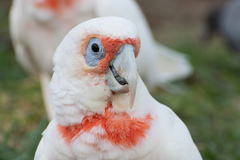
Long-billed Corella

Long-billed Corella

Cacatua tenuirostris

Silhouette: Ferran Sayol · PhyloPic

LCLeast ConcernNTVUENCR Endemic
Daily sighting probability <5% · Rare
at Hobart

In 3 days ~10% in a week ~30%

74 Verified sightings at Hobart
848 In all 5 parks From 2019 to 2026
February Best month
☀️ Diurnal When it's spotted

About the Long-billed Corella

The long-billed corella, also known as long-billed cockatoo or slender-billed corella (Cacatua tenuirostris), is a cockatoo native to Australia, which is similar in appearance to the little corella. This species is mostly white, with a reddish-pink face and forehead, and has a long, pale beak, which is used to dig for roots and seeds. It has reddish-pink feathers on the breast and belly.

The long-billed corella does not have any recognized subspecies. The first formal written description was by German naturalist Heinrich Kuhl in 1820. It is one of several related species of cockatoos called corellas and classified in the subgenus Licmetis within the genus Cacatua, members of which are known as "white cockatoos".

The adult long-billed corella measures from 38 to 41 cm in length, has a wingspan around 80–90 cm, and averages 567 g in weight. It has a long, bone-coloured beak, and a rim of featherless, bluish skin around the eyes. The plumage is predominantly white with reddish feathers around the eyes and lores. The underside of the wings and tail feathers are tinged with yellow.

The long-billed corella can be found in the... Wikipedia →

Sounds

Call0:16

Australia · 2025

© Marc Anderson · XC1015711 · CC BY-NC-ND 4.0

Begging call1:02

Australia · 2018

© Greg McLachlan · XC448184 · CC BY-NC-SA 4.0

Call0:14

Australia · 2023

© Romuald Mikusek · XC953367 · CC BY-NC-SA 4.0

Global Distribution

Parks Where Found

# Park Country Daily sighting probability
1 Grampians National Park 🇦🇺 Australia
~50%
2 Great Otway National Park 🇦🇺 Australia
<5%
3 Royal National Park 🇦🇺 Australia
<5%
4 Blue Mountains National Park 🇦🇺 Australia
<5%
5 Hattah-Kulkyne National Park 🇦🇺 Australia
<5%

Cities Where Found

# City Country Daily sighting probability
1 Melbourne 🇦🇺 Australia
~20%
2 Perth 🇦🇺 Australia
~10%
3 Sydney 🇦🇺 Australia
~10%
4 Hobart 🇦🇺 Australia
<5%
5 Brisbane 🇦🇺 Australia
<5%

Zoos & Centres Where Found

# Zoo / Centre Country
1 Parc des oiseaux 🇫🇷 France In captivity
2 Healesville Sanctuary 🇦🇺 Australia In captivity
3 Indianapolis Zoo 🇺🇸 United States In captivity
4 Lisbon Zoo 🇵🇹 Portugal In captivity
5 Fresno Chaffee Zoo 🇺🇸 United States In captivity
6 East Coast Natureworld 🇦🇺 Australia In captivity
7 Paphos Zoo 🇨🇾 Cyprus In captivity
8 Australian Reptile Park 🇦🇺 Australia In captivity
9 Jardin zoologique tropical 🇫🇷 France In captivity
10 Billabong Koala and Wildlife Park 🇦🇺 Australia In captivity
11 Koala Park Sanctuary 🇦🇺 Australia In captivity
12 Tralaga Wildlife park 🇦🇺 Australia In captivity
13 Bioparc Genève 🇨🇭 Switzerland In captivity
14 Bonorong Wildlife Sanctuary 🇦🇺 Australia In captivity
15 Bird Kingdom 🇨🇦 Canada In captivity
16 Caversham Wildlife Park 🇦🇺 Australia In captivity
17 Ranger Red’s Zoo & Conservation Park 🇦🇺 Australia In captivity

Before you go

What are the chances of seeing a Long-billed Corella in Hobart?

Rare

Under 5% of wildlife watchers report a Long-billed Corella sighting in Hobart on a given day, based on 74 verified sightings from GBIF citizen-science data. It is the 51st most-seen of the 79 birds we can rate there. Over three days the chance rises to about 10%, and over a week to about 30%, if each day is a fresh chance.

When is the best time to see a Long-billed Corella in Hobart?

July–August, October and December–February

In those months about 10% of wildlife watchers report a Long-billed Corella in Hobart on a given day, against under 5% in March–June, September and November, the lowest months.

What time of day is best to see a Long-billed Corella?

Between 11 am and 2 pm

Across all the parks we cover, that three-hour window holds the most Long-billed Corella sightings with a recorded time, and nearly all of them come between 6 am and 6 pm: it is a daytime animal.

Is Hobart the best place to see a Long-billed Corella?

4th of 5

Of the 5 cities where we can rate Long-billed Corella sightings, Hobart ranks 4th at under 5%. The best odds are in Melbourne (Australia, about 20%), Perth (Australia, about 10%) and Sydney (Australia, about 10%).

Where does the Long-billed Corella sighting chance come from?

GBIF citizen-science records

It is estimated from how often the Long-billed Corella is recorded against all the birds logged in Hobart (74 verified sightings), calibrated against known sighting rates. Figures are rounded to the nearest 10% because citizen-science data supports honest approximations, not decimals, and months with records from fewer than five people show "—". How it works.

← Back to Hobart